




Industry experts have shared their insights on the practical use of Defra’s small sites metric (SSM) calculation tool to help a project adhere to Biodiversity Net Gain (BNG) regulations.
The calculator figures out how many units a habitat contains before development takes place, and how many are needed to replace the units of habitat lost and to achieve 10% BNG, through the creation or enhancement of habitat.
Defra do state that except for small developments using the SSM, a developer or land manager should hire a competent person such as an ecologist to use the metric tool and advise on its calculations.
Karl Powell, from KADS Design, explained how it led to a very quick change in plans when it was apparent that a project would not qualify for a BNG exception.
It was for a project which involved designing and developing a set of new garages in Warwickshire, but after examining the original plans, the team was able to quickly tweak them to ensure compliance.
Powell explains: “The team saw the impact of the original plans on the biodiversity score. We agreed that there was no need to pave over the land around the edges of the garages as originally intended. Instead, we decided to convert the paving into grassland with a few small trees. Following this, the team adapted the designs to add a set of trees and two areas of high-quality grassland habitat.
“Within hours, it had a new design, which clearly delivered an on-site gain of over 10% and fully complied with the principles of the mitigation hierarchy.
“The Small Site Metric saved time and money. It also allowed the client and developer to work together to find a solution that suited everyone.”
Oliver Lewis, from Joe’s Blooms, had a similarly positive experience with using the tool.
He summarises: “By using the SSM and digital tools available to them, they were able to generate the SSM Excel sheet, habitat plans, and submit them to the Local Planning Authority. The Small Site Metric allows developers a simple, proportionate and effective way to measure biodiversity.”
He was discussing a project to secure planning permission for a new agricultural building and to extend a gravel pathway on a field. He also praised the tool for not requiring an ecologist, although it still needed someone competent, this allowed the team to use it freely and quickly.
Lewis explains: “The team used these tools to map out all the habitats within the red line boundary. They adapted the site design to add small trees to the perimeter of the field.
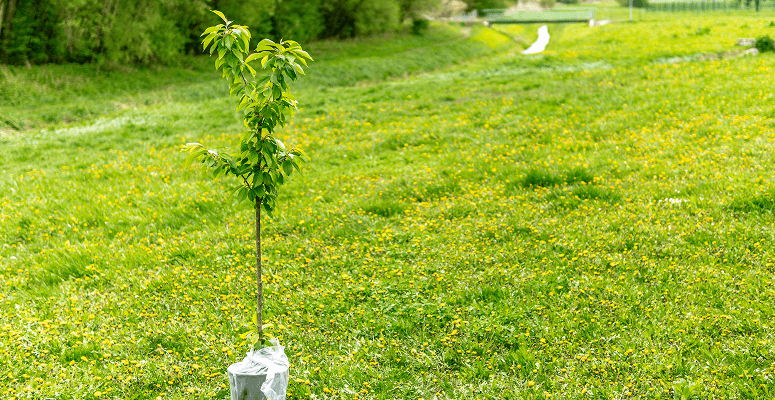
“These included saplings with diameter at breast height of under 30cm. It was also deemed possible to improve the grass mix within the margins by planting a more diverse mix of species, which would further boost the BNG score.
“By iterating the design, the project found a way to secure the needed on-site uplift by planning to transform what was originally a species-poor field margin into a species-rich area.”
It’s a recurring theme in their discussions, that the tool has allowed teams to quickly identify where changes are needed and to come up with and implement them.
Ella Dangerfield, from Burton Reid Associates, found this when working on a rural farmyard site in Devon, which involved ground hosting a caravan.
Dangerfield explains: “When measuring the habitat impacts, we looked at the static caravan’s position on habitat classified as ‘bare ground’. This means any type of bare soil or unvegetated substrate, rather than just hardstanding.
“So, net gains can still be triggered. We also found the groundworks for the installation of the soakaway will cause loss of ‘modified grassland habitats’. However, the loss of this habitat was recorded as a temporary loss because the habitat would reach its pre-development state again within two years.
“The ‘other neutral grassland’ would be retained, and a 10% gain would be achieved with the planting of a tree adjacent to the caravan.”
Dangerfield did point out the tool’s limitations however, as small sites will typically contain limited areas to deliver BNG.
Dangerfield explained that it is not possible to use the SSM on all small sites, for instance when European protected species are present or when a designated site such as a site of special scientific interest or a special area of conservation is within 500m.
However, she concludes: “The SSM has proved to be a simplified tool for calculating the habitat needed to fulfil the mandatory net gain requirement. It does so in a way that is proportional to the scale of the impacts on small sites.”
The tool, which is contained within an Microsoft Excel spreadsheet, can be downloaded here.











0 Comments