



Outdoor rooms have become the new must-have extension. Not simply “a patio”, but a series of purposeful, connected spaces that work as hard as the rooms indoors. For professional landscapers, zoning is the difference between a garden that looks good in a photograph and one that genuinely performs. Cooking, dining, relaxing, playing, pausing. As expectations rise, the material choices you make can either help zones feel effortless, or create maintenance headaches and awkward transitions that come back to you months later.
Millboard’s resin mineral composite decking and cladding ranges are particularly well-suited to modern zoning because they combine design flexibility with practical performance. When you can create contrast, definition and flow with the same family of Millboard products and finish it cleanly with purpose-made accessories and subframe solutions, you are able to deliver outdoor spaces that feel coherent, premium and built for real life.
Zoning: Design intent, made tangible

At its simplest, zoning is about clarifying how a space will be used. But in practice, the best zoned gardens do three things at once:
1. They guide movement. Clear routes prevent wear patterns across planting and lawns and help a garden feel intuitive, even for first-time visitors.
2. They create atmosphere. Different textures, levels and enclosures shift the mood from sociable to secluded.
3. They support maintenance. Practical boundaries between cooking and planting, or water and lounging, reduce mess, staining and damage.
For a landscaper, zoning is also about client confidence. When each area has a clear purpose, the garden feels larger, more considered and easier to live with. The right surface materials help you draw those boundaries with finesse, rather than relying on blunt changes that can make a scheme feel chopped up.
Designing with contrast: Separation without severance

A common mistake in outdoor zoning is over-separation. Hard lines and abrupt changes can split a garden into disconnected parts. The more refined approach is contrast with continuity. Use changes in colour, board direction, edging, level and vertical detailing to define zones while keeping the overall scheme calm and cohesive.
Millboard decking and cladding supports this style of design because you can build variation without introducing a jumble of unrelated materials. A few proven techniques that work particularly well in premium outdoor settings:
· Board direction as a cue. Run boards lengthways on a main circulation route, then switch direction to “anchor” a dining or lounge area. It subtly changes the pace of the space and makes the layout feel intentional.
· Stepped levels to mark function. A low rise to a dining platform, or a slightly sunken snug, can create an outdoor “room” without needing walls.
· Picture framing and borders. A crisp perimeter board around a zone gives it structure and helps hide cut ends for a cleaner finish.
· Pattern and feature panels. Consider a herringbone-style effect, a defined Modello decking feature area, or using direction changes and framing, particularly in courtyards or compact gardens where detail carries the design.
Done well, these moves do not shout. They simply make the garden feel designed, not just installed.
The outdoor kitchen zone: Robust, sociable, easy to live with

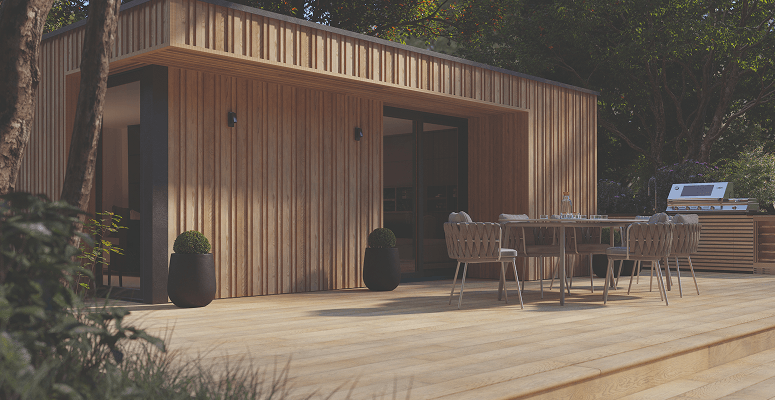
Outdoor kitchens have moved well beyond a barbeque tucked in the corner. Clients want prep space, storage, power, lighting and seating, all integrated. That brings practical demands: dropped food, grease splashes, moisture, and regular footfall.
For this zone, surface performance and cleanability matter just as much as aesthetics. Millboard decking offers the look of timber with the everyday practicality many clients now expect, and an exceptionally slip-resistant surface is a genuine advantage around food, drinks and changeable UK weather. Specify it confidently, then reinforce the design by keeping edges tidy with coordinated finishing details and accessories so the kitchen zone looks properly built-in, not added on.
A slim, easy-sweep buffer line between planting and cooking space can be as simple as a framed border or a small change in board direction. The benefit is the same, but it feels more design-led and less utilitarian: you protect the cooking and dining area from soil flick and leaf litter, and you make cleaning quicker for the homeowner.
Relaxation zones: Comfort underfoot, calm in the eye line

The lounging zone is where clients judge how the garden feels. It often requires a sense of shelter, even without solid boundaries. Use planting, screens, pergolas and carefully placed cladding to create enclosure, then support the mood with colour choices. Lighter tones can suit bright, open schemes, while deeper shades can make a seating nook feel warmer and more intimate.
This is also where curves come into their own. A soft, sweeping edge between a dining terrace and a lounge area can shift the atmosphere without introducing another material. Curves also help in awkward plots, where straight lines exaggerate pinch points or odd angles. With Millboard decking, you can create flowing shapes that feel natural, particularly when paired with built-in seating or stepped detailing.
Vertical surfaces matter too. Millboard cladding can turn a boundary into a feature, conceal awkward elevations, or create a backdrop for lighting and planting. It is also a smart way to add depth in smaller gardens, where a strong vertical element can make the whole scheme feel more architectural.
Water features and planting: Manage moisture without losing the magic

Water and planting introduce movement, sound and seasonal change. They can also bring moisture, algae, mud and leaf litter. The key is placing these elements where they enhance the experience, without making the primary living areas harder to keep looking sharp.
Water features work brilliantly as transitions, especially when they sit on the journey between dining and lounging. The sound softens background noise, and the visual pause helps different zones feel distinct without physical barriers. Planting beds can do the same job, creating softer edges and a sense of immersion.
From a specification point of view, routes near water or through lush planting need to feel dependable underfoot. This is where choosing a surface with exceptionally slip-resistant performance supports not only design, but also usability for families and older clients. It is the kind of detail that clients may not articulate, but they will feel it every time they step outside.
Built-in seating and feature areas: Add value and unify the scheme

Zoning does not have to rely only on what is underfoot. Built-in elements define purpose even more clearly, and they add tangible value to your quote. Using Millboard decking to create integrated benches, planters, step details, retaining edges and feature plinths helps the whole garden read as one considered composition.
These features are also where your craftsmanship shows. Crisp lines, consistent spacing and strong finishing details are what separate a premium install from a basic deck. Millboard products are designed to work as a system, and when you pair Millboard decking and cladding with compatible accessories and subframe solutions, you make it easier to achieve the seamless finish clients notice immediately.
The real payoff: Year-round living, fewer call-backs, more referrals

A well-zoned outdoor space invites use beyond a sunny weekend. When you provide areas for cooking, eating, socialising and quiet time, and layer in lighting and shelter, clients get a garden that supports daily life. The wellbeing benefits are real too. More time outdoors, more fresh air, more of that restorative calm that good landscapes bring.
For you, the upside is commercial as well as creative:
· Reduced call-backs thanks to durable, low-maintenance finishes and well-resolved details
· Better client satisfaction because zones work as intended and keep looking good, season after season with minimal maintenance
· More word-of-mouth referrals from clients who genuinely use and enjoy their gardens and outdoor spaces
· Greater pride in the job when the final result is cohesive, premium and practical
Zoning is customer care in design form. With Millboard decking and cladding, supported by purpose-made accessories and subframe solutions, you can create outdoor rooms that look exceptional on day one and continue to earn their keep season after season.
For more information visit www.millboard.com.












0 Comments