



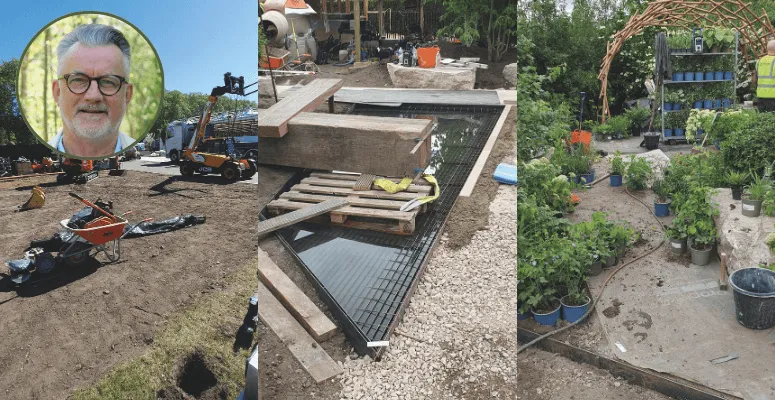
David Keegan reflects on RHS Chelsea Flower Show 2026 calling for more recognition for landscapers and debating the presence of AI.
It’s that time of year again – the pinnacle of the horticultural calendar: the RHS Chelsea Flower Show. And yet, I find myself thinking about MasterChef.
Specifically, what the programme would look like if we stripped out the part where chefs select their ingredients and craft their dishes – if we were shown only the final plate. Beautiful, immaculate… but entirely disconnected from the process that made it.
Because that, increasingly, is what Chelsea feels like.
We are presented with finished masterpieces – sumptuous, polished, photogenic – but the people who physically build them, whose skill transforms a muddy plot into a show garden in just two weeks, remain largely invisible. The landscapers quite literally make the show, yet they are rarely seen or meaningfully acknowledged.
Speak to almost any landscape professional and they will tell you: building a garden at Chelsea is the pinnacle of their craft. And yet, for those achieving it, the recognition is minimal. This is especially puzzling given that judging weighs heavily on the quality and precision of the build itself – the translation of design into reality.
I saw this firsthand in 2005, working on one of Diarmuid Gavin’s Chelsea show gardens as part of the BBC2 Garden School programme. As a complete novice, I was struck by the sheer level of craftsmanship required to create the illusion of permanence – gardens assembled in a matter of days that appear to have settled for years. Plants stood in hidden pots, hard landscaping was meticulously detailed, and every element contributed to a seamless final impression.
It was, quite simply, extraordinary work. And yet, that work remains largely in the background.
This year, Peter Gregory Landscapes – who build most of my own projects – completed their seventh Chelsea show garden and were awarded Best Construction for this year’s install: a significant achievement by any standard. But even with multiple builds and awards to their name, Gregory readily acknowledges that landscapers at Chelsea – and across RHS shows more broadly – receive little public recognition. The spotlight remains fixed on the designer.
What makes this even more striking is the scale of what’s being achieved. The garden that won Best Construction in 2026 was built by just two people: Gregory himself and his assistant, Thomas. Around them, comparable gardens were delivered by teams of up to ten.
Of course, it’s also worth noting that most gardens are planted by teams of specialists who swoop in once the hard landscaping is complete – and they, too, receive little mention or attention. But that’s a whole other article, and one that doesn’t resonate with me to the same degree, given I do my own plant selection and set out on all my projects.
That disparity matters – because it speaks directly to a broader issue.
As a designer, it might seem counterintuitive to champion landscapers so strongly. It’s not though as I started out as a designer builder myself installing and working on the install of my early designs. But the reality is also this: we are facing a serious shortage of skilled landscape professionals. Demand for high-quality garden builds continues to grow, but the workforce is not keeping pace. That should concern everyone in the industry – from the RHS and the BBC to designers, contractors and professional bodies.
What’s missing from Chelsea – and from much of its media coverage – is the how. How are these gardens built, never mind the fact that they are then deconstructed in just three days? What challenges are faced on site? What problem-solving, collaboration and expertise are required?
I would say there’s a whole untapped program in there of itself, but surely, at the very least it’s not too much to ask that daily coverage includes even a short segment dedicated to the build process – profiling the teams behind the scenes, documenting the pressures, and giving proper credit to the craft. Because the reality is far from glamorous.
During build week, delivery lorries can wait hours for site access, sometimes leaving altogether before unloading. Schedules are tight, conditions demanding, and the margin for error almost non-existent. These are not just aesthetic achievements – they are feats of logistics and technical skill.
And yet you would struggle to find more than a passing mention of this in the RHS official Chelsea Flower Show guide. Yes, landscapers are credited – but no more prominently than any other contributor, despite their central role in realising the gardens themselves. This was my main concern – until another, not disconnected, issue emerged: AI designed gardens.
In the days leading up to the show, headlines announced that AI-designed gardens would feature at Chelsea. When one designer was asked to respond, the reported reaction was bleak: “Point me to the nearest job centre.” My response is different – but no less serious.
The debate around AI in garden design is not just about creativity – it is also about consequence. At a global level, the environmental cost of AI is significant, driven by energy-intensive data centres and resource-heavy polluting infrastructure. Closer to home, there are practical implications too.
Take the argument that AI opens garden design to a wider public – those who may not otherwise engage a professional. On the surface, it is an appealing idea. But in an industry already struggling with a shortage of skilled landscapers, increasing demand without increasing capability creates a dangerous imbalance.
That gap will not remain empty for long. It will be filled – often by less experienced or less scrupulous operators, cutting corners and compromising standards.
Even now, AI struggles with the fundamentals. It cannot reliably produce detailed planting plans or construction drawings – the very elements that underpin a successful garden. Design is not simply about visual composition; it is about buildability, context and long-term performance. And then there is the question of originality.
Garden design is a creative discipline. Ideas are shaped by experience, observation and intent – not assembled from datasets. The risk with AI is not just inefficiency – it is dilution: a gradual erosion of authorship, replaced by iterations of what has already been done. Garden and landscape design is an emotional and contextual creative process that no AI can replicate.
Perhaps I am placing too much weight on this year’s AI debut. Chelsea has always embraced innovation, and not every idea endures. Last year’s concepts have already faded quietly from view. This one may follow the same path. But it may not.
By allowing AI into the showground, the RHS is signalling acceptance – if not endorsement. More broadly, we risk drifting into a passive acceptance of technology as inevitable. It isn’t.
There are already examples of resistance – communities pushing back against the environmental cost of AI infrastructure, challenging the assumption that progress must come at any cost. The same principle applies here.
AI has its place – but not everywhere. And certainly not, in my view, at the expense of skilled craftsmanship and creative integrity.
Because in the end, Chelsea is about more than spectacle. It is about people – their expertise, their judgement, their hands. And that is something no algorithm can replicate.
After all, AI cannot smell the roses.



0 Comments