



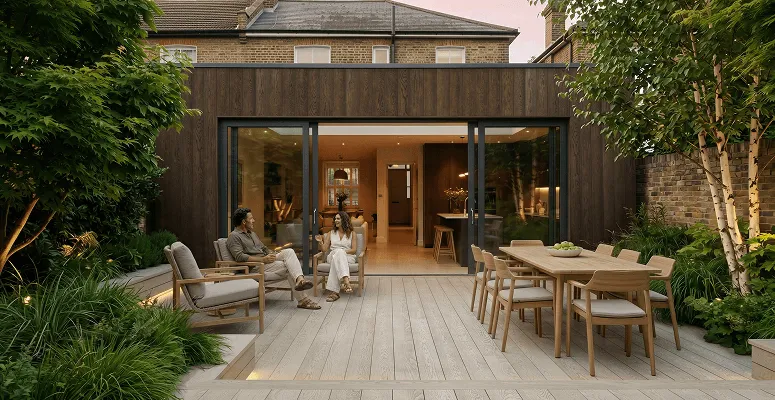
For most garden design and landscaping businesses, the deck is where the composite conversation ends. The boards go down, the client is delighted, and the team moves on to the next project. But a growing number of businesses in the sector are looking up as well as down, and finding that cladding can offer a natural, profitable extension to the work they already do.
The commercial case
Think about your last few projects. How many included a garden building, a home office, an outbuilding, a tired garage wall overlooking the new deck? Garden structures have boomed in recent years as homeowners invest in outdoor rooms as well as wellness and workspaces, and clients increasingly expect these buildings to be finished to the same standard as the landscaping around them.
The opportunity does not stop at the garden building either. Homeowners are turning to cladding to refresh and modernise the house itself, whether that is a full elevation, a porch, a dormer or an extension. For a designer or landscaper already trusted and on site, being able to offer that work, or partner with someone who can, adds significant value to a project the client has already committed to.

You are already there. You already have the client’s trust. Adding cladding capability means increasing the value of existing projects rather than chasing new ones, and that is one of the most efficient ways to grow any trade business.
There is a seasonal benefit too. Decking enquiries can naturally slow through the winter months, but cladding and garden structure work often carries on. For businesses looking to smooth out the annual peaks and troughs and keep skilled teams busy year-round, verticals can fill the gap.
The skills you already have
If you and your team can design or install a deck to a high standard, most of the fundamentals are already in place: accurate setting out, batten principles, cutting and fixing composite boards, and an understanding of movement, ventilation and drainage.
What changes when you go vertical? A few things worth learning properly. Weatherproofing details matter more, particularly around openings, corners and junctions. Fixing methods differ depending on the substrate behind the battens. And depending on the building and application, fire performance and building regulations come into play, so it pays to understand the current certification of any product you specify and when building control needs to be involved. Crucially, you do not have to work it all out alone. Companies like Millboard have a team of technical experts on hand at the end of the phone or email, and are available to support on site, backing that saw Millboard voted Best Installer Support in Pro Landscaper’s Most Influential Decking Suppliers 2026. With that kind of guidance behind you, cladding is an extension of an existing skill set, not a new trade.
Why composite works so well on walls
There are practical reasons composite boards suit vertical applications particularly well. Nobody wants to be up a ladder every couple of years staining or repainting, so a material that holds its colour and doesn’t need constant re-coating is a genuine selling point at height. Millboard’s cladding boards are made from a resin mineral composite rather than a wood-plastic mix, so they do not absorb moisture, which means no swelling or rotting, on a surface that takes the full force of the weather.
The result is an exceptionally durable facade that continues to look great for years to come without the demanding maintenance cycle that can put many clients off timber cladding, and without the safety and cost implications of working at height to maintain it.

Where cladding transforms a space
Beyond the obvious applications, cladding opens up real design opportunities:
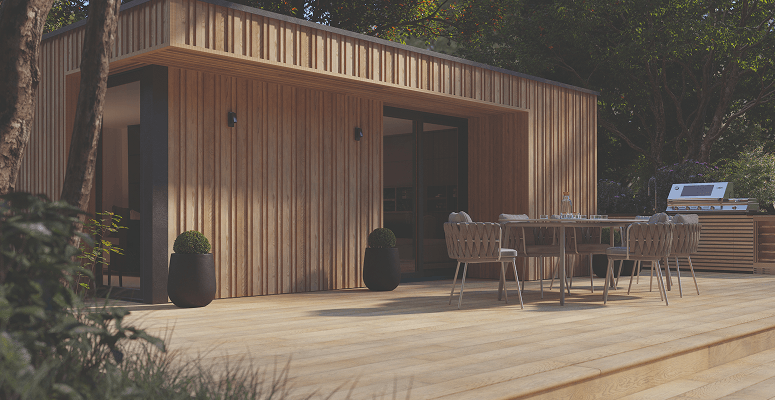
The garden building. Cladding can be what turns a functional home office or studio into a piece of garden architecture, tying it visually into the wider scheme.
The home itself. A refreshed elevation, a clad extension or a modernised frontage can transform how a property sits within its landscape, and clients increasingly want the house and garden designed as one.
The feature wall. A clad wall can make a striking focal point, and textured options such as Millboard’s Décor panels add depth and shadow play that come alive in an outdoor space and under garden lighting.

A consistent design language. When the deck, the cladding and the boundary treatments share the same tones and textures, the whole space reads as one considered design rather than a collection of separate elements. That is the kind of detail that wins happy awards, happy customers, referrals and repeat work.
Everything in between. The same boards lend themselves to planters, screening, fencing, bespoke seating and outdoor kitchens. Same material, same skills, and an efficient use of offcuts too.

Getting started
The route in is straightforward. Millboard runs installer training courses covering both decking and cladding, backed by technical support, detailed installation guides and samples, so teams can build confidence before quoting their first vertical project.
The materials are in the van, the skills are on the team and the demand is in the market. Cladding is not so much a new trade as an extension of one you have already mastered.
Five common cladding pitfalls to avoid:
1. Skipping the ventilation gap. Cladding needs an air cavity behind it to drain and dry. Fixing boards tight to the wall can invite trouble.
2. Fixing into the wrong substrate. Battens must be secured to something structural, not just render or insulation. Check what is behind the wall before you quote.
3. Ignoring expansion allowances. Composite boards can move with temperature. Follow the specified gaps at ends and junctions.
4. Poor detailing at openings. Windows, doors and corners are where water can get in. Get the trims and flashings right first time.
5. Overlooking regulations. Check the fire classification and building regulation requirements for the specific application before specifying, particularly on habitable buildings, anything above ground floor level and surfaces close to a boundary.
To find out more about Millboard’s cladding range, order samples, or book a place on an installer training course, visit millboard.com, email: enquiries@millboard.com or call 024 7643 9943.

















0 Comments