



Nature Unlocked launched in 2021 at Kew Wakehurst as a means of developing science-led solutions to climate change, nature recovery and biodiversity loss, which can be fed back for landscape development.
Wakehurst uses UK landscapes as living laboratories. Its scientists gather data from soil to sky, generating innovative solutions to enable collaboration between businesses, educators, policy managers, land managers and communities. A particular project dives into the pollinators at Wakehurst.
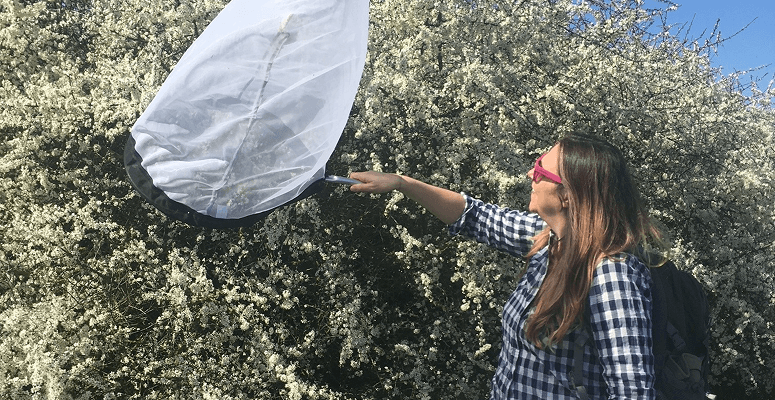
“I’ve been looking at resting nesting sites for wild bees, wild solitary bees and using different ways of collecting pollen that would otherwise be really difficult to obtain,” explains pollination research lead Dr Janine Griffiths-Lee. With around 110 species of bee spotted at Wakehurst, reveals recent research, she and her team are working towards being able to advise landscape architects and developers on how to bring more bees to urban areas.
Bees are vital because they pollinate a huge portion of the world’s crops and wild plants. “We have to think about the value of bees for ecosystem services, crop protection and food security,” Griffiths-Lee says. In tracking their routines, amongst other pollinators, they are able to understand their day to night activity. She comments:
“We collect pollen in a variety of different ways, then we do DNA metabarcoding on it to hopefully get some great information about the different trees and herbaceous plants that these bees are using and need for their young.”

In turn, the research creates a clearer picture of what bees are most attracted to. This becomes even more vital amid a warming and changing climate. It has recently been announced that almost three-quarters of England is officially in drought as conditions worsen after the driest July ever recorded. On top of this, record-breaking high temperatures have enveloped the UK this summer, with many landscapes suffering.
“We have to build climate resilience,” states Griffiths-Lee. “When we create a planting scheme based on our results, we will consider climate resilience as well. When I work with landscape architects, I always consider the climate resilience in the plants that we recommend.”
For example, the team has to consider how the plants will react when major cities such as London are experiencing soaring temperatures. “The planting will have to be monsoon resilient and heat resilient in a changing climate. We need to consider all sorts of different climate scenarios,” she adds.
So, as important as bees are to rural environments, “we also have to think about how we’re protecting them in urban environments as well,” Griffiths-Lee determines. “They’ve been relatively forgotten about in urban environments for many years. If you think about the need for food production, like within allotments in urban environments, we still do really need their pollination services.”
She advises the need for nesting sites and site management for successful landscape development. This could include the removal of any pesticide use or mowing less regularly. Nesting sites can be created with a bee bank, which can really enhance the biodiversity of a space. At Wakehurst, there is a nine metre bee bank which was visited by 45 species of bee within just two years.
Plants such as dandelions can be crucial for increasing biodiversity and attracting pollinators, but this would involve changing public perception on the so-called ‘weed’. “When the public visits a botanic garden and sees dandelions, it could slowly make them see the beauty of that dandelion and carry that into their own garden. We can change the public’s perception,” Griffiths-Lee argues.
Wakehurst engages with the public frequently. Now in its fourth year, the Trees for Bees project urges visitors to record pollinator counts on an app, with all data going straight to the scientists.
The botanic garden also welcomes all kinds of insects and species. From March to October 2023-2025, the team collected and identified 2,100 insects, including bees, moths and hoverflies, with pollen samples harvested from each one.

Scientists have recorded 27 species of hoverfly specifically, which have seen a dramatic decline in recent years. Wakehurst hosts resilient habitats such as the American Prairie, which brings benefits to UK landscapes and the wildlife that rely on them. Prairie Lead, Jack Harrison, comments:
“Over the past few years, we’ve seen it transform from blankets of yellow to a diverse display of over 80 species, a true representation of a native North American Prairie. As an experimental piece of horticulture, we’re continuing to add even more species, many of which have come from seed banked in the Millennium Seed Bank and grown in our Nursery, to create an even more balanced and diverse prairie.”
It is expected to reach its peak in August, as Wakehurst urges visitors to come and take a look. For more information, visit: www.kew.org/wakehurst.







0 Comments