



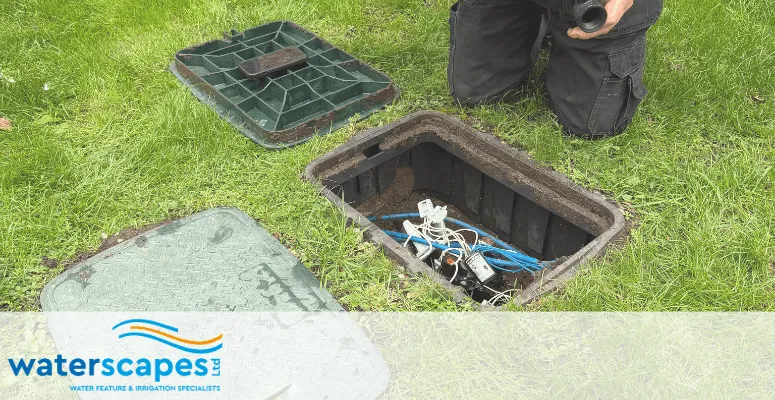
Irrigation winterisation gets treated as a job rather than a plan, and that is where most freeze damage starts. A system blown down in a rush on the first cold morning of October is a system where something gets missed, and what gets missed usually does not announce itself until April.
The work itself is not complicated. Getting it right is mostly a matter of deciding early what happens, in what order, and who is responsible for each part. Here is how to plan a commercial irrigation shutdown so the system comes back on in spring without a repair bill attached.

Decide the date before the weather decides it for you
The single most common mistake is letting the first cold snap dictate the timing.
Shutting down too early wastes an autumn’s worth of establishment watering, which matters on sites with new planting or recently laid turf. September and early October can be dry, and young planting still needs water. Shutting down too late risks water sitting in pipework, valves and backflow devices when temperatures drop below freezing, and that is where the expensive damage happens.
The practical answer is to book the shutdown for a fixed window, usually late October into early November in most of the UK, and hold the system in a reduced-run configuration until then rather than switching off entirely. That gives planting what it needs through autumn without leaving the system exposed.
Sites in exposed or northern locations, or with shallow pipework, should plan earlier. Sites with significant new planting may justify holding on later, provided someone is watching the forecast and the system can be drained at short notice.
Work out what you actually have before you drain it
A surprising number of commercial sites do not have a current record of their own irrigation system, particularly where it has been extended over the years.
Before the shutdown, confirm the location of every isolation valve, drain point, backflow device and manifold, and note which zones feed which areas. Where the system has been added to since installation, the newer sections are the ones most likely to be missed, because they are not on any drawing and nobody remembers they exist.
This matters more than it sounds. A zone that never gets drained because nobody knew it was there will keep failing every spring, and the cause looks like bad luck rather than an omission.
The sequence that prevents most of the damage

A proper shutdown follows an order. Skip a step, or run them out of sequence, and water gets left behind.
Isolate the supply first. Shut the water off at the main isolation valve or stopcock serving the system, and confirm it is fully closed rather than nearly closed.
Then drain what gravity will take. Open the manual drain points and let the system empty where the fall allows it. On systems designed with drainage in mind, this does a good deal of the work.
Blow the remainder down with compressed air. Give this part to someone experienced. Air pressure has to match the system, and too much pressure damages sprinklers, dripline and valve seals just as effectively as frost does. Work zone by zone, running each until only mist comes through rather than water, and keep individual blow cycles short to avoid heat damage at the sprinklers.
Drain and protect the backflow device. Backflow preventers are among the most expensive components on a commercial system and among the most commonly damaged over winter. Drain them fully, leave the test cocks part open, and insulate where the device stays outdoors.
Leave the valves where residual water can escape. Solenoid valves sit partially open where the design allows it, so anything left in the line has somewhere to go rather than sitting against a diaphragm.
Set the controller to its rain or off mode rather than cutting the power. That holds programmes in memory without running any zones, and it takes a moment to check the backup battery while you are there. A controller that loses its programme over winter turns spring restart into a reprogramming job.
Protect any pumps last. Where a booster or borehole pump serves the system, drain it, isolate it electrically, and follow the manufacturer’s winter guidance. Pumps left with water in them over a cold winter are a predictable spring failure.
Dripline needs its own attention
Subsurface and surface dripline behaves differently from sprinkler zones and is often the part of a system that survives winter least well.
Emitters hold small volumes of water that gravity drainage will not clear, and blowdown pressure that is safe for sprinklers can be too high for dripline. Lower the pressure for those zones, flush the lines properly before draining, and check that flush end caps and any air relief valves have been dealt with rather than left closed.
Where dripline runs under planting that will be lifted or replaced over winter, note the location before the beds are worked on. Dripline damaged by autumn planting works is one of the more frequent spring faults, and it is entirely preventable.
Water features do not shut down, which is the point

Commercial water features generally run through winter, which makes it tempting to leave them for another day. Deal with them while the irrigation contractor is on site instead.
Features that stay running need their winter position confirmed: circulation adequate to prevent standing water freezing, top-up and trigger sensors working, and any frost protection or low-temperature shutdown correctly configured. Features being taken out of service for the season need draining properly, with pumps removed or protected and standing water cleared from any element that can crack.
Check structural condition at the same time. Cracks and failing joints get worse over winter, and repairs are considerably cheaper before frost has had a season to work on them.
Write down what you did
Shutdown documentation is the cheapest insurance available on a commercial irrigation system, and most sites still do not produce it.
A short record of what was drained, when, by whom, and anything found or deferred in the process turns spring recommissioning from an investigation into a checklist. It also settles the question that comes up every April when something fails: whether the fault was there in October or arrived over winter.
Include the controller settings as they were left, the position of any valve left part open, anything that could not be drained and why, and photographs of anything found in poor condition. Where a specialist carried out the work, ask for this as standard.
The mistakes that cause most of the damage
Four issues account for most of the freeze damage seen at spring restart.
- Partial drainage, with water left in low points, dripline, backflow devices or extended sections that were never on the drawings.
- Blowdown pressure set too high, which is quicker and damages sprinklers, seals and dripline while it works. Those failures surface the following season and get blamed on age.
- Controllers powered down completely, so programmes are lost, batteries flat, and spring restart begins with reprogramming rather than testing.
- No record of what was done, which makes every spring fault a fresh investigation and makes it impossible to tell whether a problem is new.
Scope it and book it
For contractors managing grounds on behalf of clients, scope and quote the shutdown properly rather than folding it into general autumn works. It takes longer than most sites assume, and it needs equipment and judgement. It is also the job with the clearest link between doing it well and avoiding cost in spring.
For estates and facilities teams, book it now, with a named date and a named responsible party, and ask for documentation as part of the deliverable. A shutdown that happens on a plan rather than on the first frost is one that gets done properly.
“Nearly everything we repair in April traces back to something that was not done properly in October,” says Ed Harwood, maintenance contracts manager at Waterscapes. “Usually it is water somewhere it should not have been. It is a cheap job to do well and an expensive one to do quickly.”
Waterscapes provides specialist irrigation and water feature maintenance, repair, refurbishment and technical support, including a full design facility, for commercial and public-facing environments across the UK. Contact maintenance@waterscapes.co.uk or visit www.waterscapes.co.uk.








0 Comments