


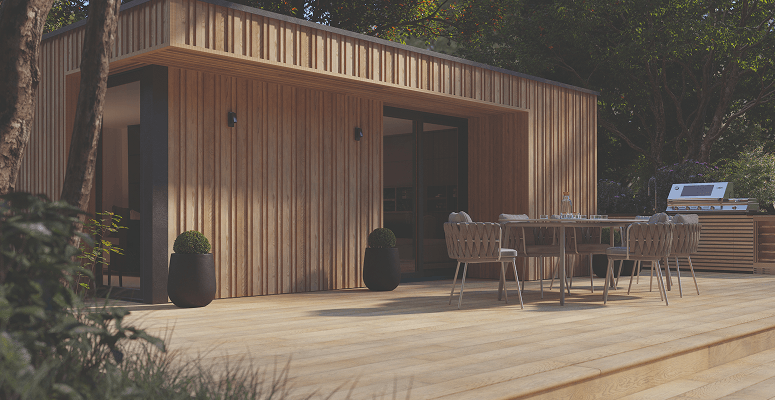
Composite decking is usually judged on what it is made of. Millboard makes the case that on its resin mineral decking and cladding, the layer on top does just as much to determine how a project performs.
Ask most people what makes a composite board perform and they will talk about what it is made of. Recycled content, wood fibre percentages, density. All of it matters. But none of it is what your client actually touches, walks on or looks at on a day-to-day basis. That is the surface, and on Millboard decking and cladding it is a layer called Lastane®.
What is Lastane®?
Lastane® is a flexible polyurethane layer applied over the resin mineral core of every Millboard decking and cladding board. It is the reason Millboard decking offers exceptional slip resistance, wet or dry, and it also delivers the authentic wood grain detail, ease of maintenance and colour retention that clients notice year after year. It is designed to be highly resistant to impact, stains and wear.
Lastane® goes on as a liquid rather than being laminated or embossed, which matters more than it sounds.
Because it is applied wet into the mould, it takes the full depth of grain from the original timber master rather than flattening it. Millboard decking is hand-moulded from selected oak, then hand-tinted, so the boards carry the character and irregularity of real wood instead of a repeating pattern. It is the detail at close range that usually gives composite away, and this is where Lastane® does its quietest work.
What it changes on site
For landscapers, the surface layer solves several familiar challenges at once.
Millboard decking and cladding boards can be cut and worked with standard tools. No specialist kit is needed, and there’s no pre-drilling required before fixing. Because the material is wood-free and has no internal grain direction to fight, it does not split out on the cut.
Virtually hidden fixings, without the fiddle. This is where the surface earns its keep. Millboard’s Durafix® screws are face-fixed, and the elasticated Lastane® layer closes back over each screw head as it goes in, leaving only the subtlest of witness marks. The result is the lost-head finish, a clean, uncluttered deck with no line of screw heads.
It is worth being precise about how that differs from the alternatives. This is not a hidden clip or secret-fix groove system. You fix from above, which can be quicker, easier to correct, and far less frustrating than dealing with clips. You get the uncluttered appearance of a concealed system with the speed of face fixing, which is an unusual combination and one of the more persuasive reasons installers tend to stay with the product once they have used it.
Curves are the other practical gain. The flexibility of Lastane® means boards, fascia and edging can be cut and worked to follow a radius without losing their finish, so a sweeping terrace does not become a segmented approximation of one.
There are no splinters either, which installers appreciate when handling boards all week, and homeowners enjoy a more comfortable finish for years to come.
What it changes for the client
The surface is also where a great deal of the long-term performance sits.
The exceptional slip resistance of Millboard decking comes from the Lastane® surface rather than grooves or grit strips. Lastane® has the supple, grippy quality of a shoe sole, and it grips wet as well as dry. Tested by the industry-standard pendulum method, Millboard Enhanced Grain decking scores 49 to 60 in the dry and 36 to 42 in the wet, against the 36-point threshold that defines low slip risk. For poolside work, hot tub surrounds, care settings, hospitality and public realm, that is a specification point that can be evidenced rather than asserted.
It also behaves well underfoot. There is a slight give rather than the hard tap of a rigid composite, and it feels noticeably softer than stone or porcelain paving, which makes it well suited to family gardens and spaces that see a lot of everyday use. It is part of why designers working on wellbeing-led spaces tend to notice it before they notice anything else.
Then there is the maintenance conversation, which every landscaper inevitably has with their clients. Lastane® is non-porous, so Millboard decking and cladding boards need no sealing, sanding, staining or oiling. Clearing debris and an occasional wash with soapy water is the whole regime. A simple aftercare routine is easier for a client to follow, which makes the finished project more likely to remain looking good for years to come.
Why it matters when you specify
Across the composite decking and cladding market, callbacks can often relate to the surface: boards that have faded noticeably, become slippery, splintered, or no longer look like the sample the client approved eighteen months earlier. That’s why the surface deserves as much attention as the core when you specify.
The core and the surface do different jobs, and a specification that examines only one of them, is only half a specification. Core composition tells you about structural stability and what the board is made from. Surface performance tells you how the deck or cladding elevation will look, feel and behave years down the line.
Millboard decking and cladding are built on both. A fibre-reinforced, wood-free resin-mineral core gives the boards their strength and stability, while the Lastane® surface provides the grain, the grip and the soft-touch feel. Neither works as well without the other. Together, they are why the boards read as timber close up, while being designed for durability, ease of maintenance, and exceptional slip and fade resistance.
The core holds the board together. The surface is what your client lives with. For more information, visit Millboard.com or order free samples to see the difference for yourself and share with your customers.



















0 Comments