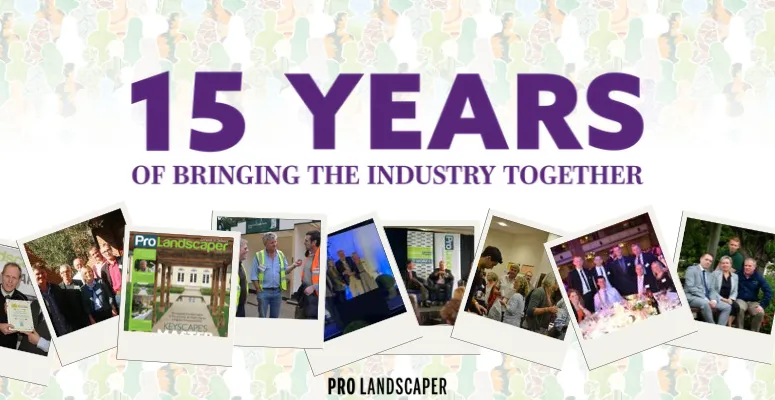
Pro Landscaper spent the month of September celebrating its 15 year anniversary.
In February 2011, Eljays44 was founded by three original directors, including former managing director Jim Wilkinson, Lisa Wilkinson and current CEO Jamie Wilkinson. By September, Pro Landscaper magazine was launched, quickly establishing itself within the industry. The 15 years that followed saw the launch of the Pro Landscaper’s Business Awards, Project Awards, 30 Under 30: The Next Generation and the Sustainability & Biodiversity Awards.
Inside the pages of Pro Landscaper’s September issue, we dive into each milestone, including the launch of FutureScape in 2012, and the return of Rachael Forsyth, who stepped into the role of editor earlier this year.
Not only this, but we spoke to familiar faces for a two-page special of Little Interviews. Jim, Lisa and Jamie Wilkinson have their turn in the hot seat, joined by Lucy Bravington, Liz Hughes and Karl Harrison, all of whom featured in the very first issue of Pro Landscaper. This can be read online or inside the magazine.
We also asked people from across the entire industry, ‘what’s changed in 15 years?‘. Whether its technology, innovation, relationships or policy, we heard from those inside the industry about how their last 15 years have gone.
On our social media, we took a walk down memory lane. We’ve been flicking through old photos, old magazines and previous shows, which reminds us just how much we’ve grown.
While we’ve been busy celebrating, several other companies have also reached milestone anniversaries. NAO Landscapes reaches its 10th birthday, while Make Space for Girls celebrates its 5th. Read about the other companies celebrating in 2026.
Through it all, the readers have been at the heart of Pro Landscaper. Some kindly sent in a video talking about just how much Pro Landscaper has helped shape and connect the industry. Take a look:
Celebrating its 30th anniversary this year, directors Debs and Rod Winrow explore the growth, lessons and highlights of Garden House Design.
After 30 years, Debs and Rod Winrow are an integral part of our industry. There aren’t many events that they don’t have a presence at; not many who don’t know their names; and many who would like to replicate their business model. Everyone starts somewhere, though. Like many other businesses in the landscaping industry, for Debs and Rod it all began with a man, or a few, a van and a touch of magic.
Founded in 1996, the business began trading as Touch of Magic. Back then it was just Rod and his brother Mark. They set out with a van, two mowers and a chainsaw but before long picked up a contract with Leaders’ properties undertaking small, local maintenance jobs and later contracts with Ground Control at post offices and Tesco stores. The team also helped create what was, in 2007, the largest living wall in Europe for Westfield shopping centre in partnership with Aldingbourne Nurseries. And as the contracts grew, so did the team and so did their expertise.
What’s in a name?
The name Touch of Magic took the business to RHS Chelsea Flower Show and to Channel 4 for the Great Garden Challenge, but when they nearly missed out on job and the name was the reason why, it was time for a rebrand. Having won a project designed by Ann-Marie Powell, the client shared that they were nearly put off by the company name.
“Touch of Magic worked for maintenance work, but it didn’t give us credibility in the marketplace. And brand is so important,” explains Rod Winrow, managing director at Garden House Design.
In a cafe – Garden House Cafe – in New Zealand, Debs was struck with inspiration. That evening the domain name was registered and by the time the pair were back in the UK, Garden House Design was ready to take the business in a new direction. Around the same time Debs joined the business full time as creative director and started the journey into developing into a lifestyle brand. This eventually saw the business move away from property and landscaping and towards “above patio” styling and outdoor living.
A big part of becoming successful at this has been getting credibility from within the industry as much as they did outside of it. This hasn’t always been easy, with some concerns that, with a landscaping side to the business, they might try and take that work away. But with a strong B2B message and an above patio strategy that has become easier. Today, Garden House Design has certainly got credibility.
As Debs Winrow, creative director at Garden House Design surmises, “When somebody like Mark Gregory says you’ve cracked it – that’s a highlight for us. We’re building as much for our peers as anyone else.”
The Flower Show experience
Most people’s first RHS Chelsea Flower Show experience comes with a learning curve, and Rod’s was no exception. Under Touch of Magic, the team built Simple Harmony, designed by Lindsey Knight. Entirely self-funded, the garden was made using off-the-shelf, readily available materials to the general public and won the team a silver gilt medal.
While they were proud of this, the garden had missed out on the gold due to the height of pergola. Judges said it was too low, but the team had built it according to the brief which stated it couldn’t be higher. It was tempting to challenge this medal, but Rod says he got some wise advice from a judge. “He sympathised that I was upset but explained to me “be proud of what we’d achieved and move on”. So, I did.”
The show also shed light on the difference between designers and landscapers. In 2004, “We really learned that designers took front stage, less so now, as teamwork is highlighted as crucial to being success at shows” says Rod. “We were incredibly proud of our achievement and marketed locally. But our work slowed down as we were considered to be too expensive. So, what did we do? We changed our approach and said, “yes we are” and found a different higher end market.”
RHS Hampton Court Garden Festival in 2011 marked another pivotal moment for Garden House Design. Debs recognised that the business needed to do something different. She had seen a Cloudy Bay stand which she describes as “like going through Disney” with a gift shop at the end – except in this case it was a marquee with wine. So that year, alongside a show garden Live Outdoors on APL Avenue, designed by Roger Smith, Garden House Design created its first ever trade stand to mirror the products on the garden.
The garden won a silver gilt medal, but what shone the most was the product placement and the launch of “liveoutdoors” to consumers. “Where we felt we made a difference was that we had product placed on the garden and then had somewhere you could buy that product,” explains Debs. Debs’ instincts paid off, with the launch of #liveoutdoors by Garden House Design traced back to this show.
After the success of this, the business launched the changeover to one clear brand under Garden House Design and started marketing high-end products to both consumers and business-to-business partners. Walking around the showground of Chelsea this year, it’s hard to imagine that there once wasn’t a presence in the Trade Stand category from Garden House Design. The shows have been pivotal for the business, and they’ve marked significant moments too, with the six consecutive RHS five-star awards.
A Renson relationship
It seems like a match made in heaven now, but Garden House Design’s relationship with Renson began on a bit of a whim some 15 years ago. Having observed the popularity of louvred canopies in New Zealand, the team had had an introductory meeting with Renson in the UK. Then, one rainy day in January, Rod and Mark decided to head over to its head office in Belgium. No meeting. No plan. Just a strong sense that there was something they could both offer one another. Twenty-four hours later they were on a ferry home having undertaken full training and secured an agreement that they could borrow a Renson louvred canopy for Hampton Court. This was the first time a louvred canopy had been taken to an RHS show and probably for Renson a garden show worldwide.
It’s something they all look back on with fondness now, and if there were any doubts or hesitations the record-breaking sales made at the show quelled them quickly. “They just weren’t ever shown in garden environments,” Debs says. “If you try and sell a canopy, you’ll never sell it. You are selling the dream lifestyle. Am I going to be able to cook outdoors? Are my grandchildren going to be able to stay up a bit later and read under here because there’s light? Am I going to be able to make it cosy when I’m at my pool? That’s what you’re selling.” In the years that have followed, they’ve worked closely with Renson, even helping to advise the worldwide marketing director.
Garden House Design remains one of the few businesses successful in this space and Rod says a key this has been, “adapting and changing while understanding where you want to sit in the market. We knew very early on where we wanted to sit. We knew that we wanted to partner with clients and industry colleagues, and so we don’t work with internal commission structures. We believe the clients should be offered the best solution for them not the best solution for the consultant. All of our projects are a team effort from the initial introduction to the final handover.”
Navigating challenges
The successes are one thing, but what Debs and Rod are most proud of is the way they have been able to steer the ship through stormy waters. The 2009 banking crisis hit, but the business didn’t make a single redundancy and instead pivoted the business strategy. Brexit caused the cost of products to soar, so Garden House Design changed its model, re-trained to be experts in international trade and more importantly embraced the difficulties as challenges to excel. “We believed if it was difficult for us, this would give more opportunities as we would have less competition,” explains Rod, “this certainly was the case until Covid when the market opened to retailers rather than companies with years of outdoor experience.”
The pair say that the biggest advice they can give for navigating these unforeseeable challenges is to not bury your head in the sand. “Be honest,” says Debs, “set realistic client expectations and if something’s not going to plan, share, discuss and agree on a solution. It’s about being really transparent.” Rod adds that as a business leader often the most important thing you can do is make quick informed decisions.
If Rod were starting out today, with everything he’s learnt, he says he would focus his energy on getting investment to buy install companies and maintenance companies. He admits he would have kept the Ground Control contracts too.
Though Debs candidly expresses she sometimes wishes they had taken more risks, ultimately, the fact that the Garden House Design ship has stayed afloat means they have made the right decisions.
“Yes, we would have liked to have taken more risks,” says Debs, “but I like the fact we can sleep at night knowing that we haven’t overextended, our cash flow is strong and clients are excited to be working with us. Whatever has been thrown at us, we’ve been able to adapt, pivot and overcome, working through it all as a team. That’s what we’re most proud of.”
What does the future hold?
“We’re excited about the future, we love our industry and have more challenges to accept and would love to give back in the form of mentoring and trade association support,” expresses Debs, “Watch this space for more exciting products and partnerships. In particular, the first timber louvred canopy was launched at The Glasshouse Collective this year. “
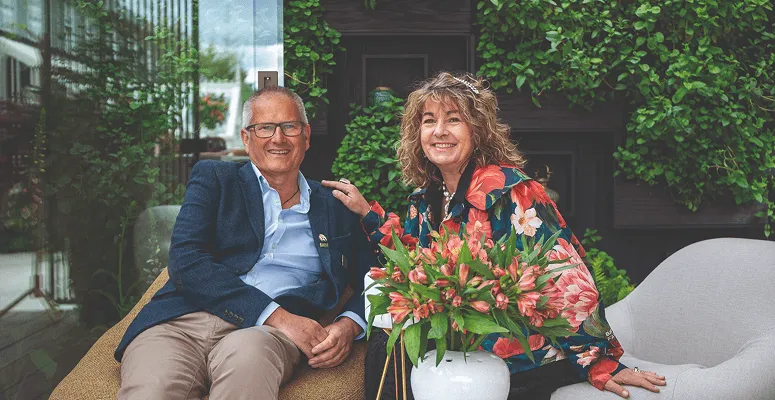
Debs and Rod are examples of when a family business just works. They’ve been married for 25 years, together for 35 years, and have worked with one another for the past 18 years. There are certainly moments when tension rises – Chelsea is a prime example. But ultimately Rod says they are “stronger together” and now rarely go anywhere without each other. It’s this mentality that is the key. After all, collaboration with designers and landscapers, engagement with trade associations, and their partnerships with brands like Renson & Cubic Outdoor Living, have driven the business forward. Add passion, creativity, and hard work and you have the secret to their success.
I’ve been writing my monthly column in Pro Landscaper for five years. This is something I’m incredibly proud of, not because of the writing itself, but because of what it represents. For me it’s been about raising standards in an industry I’ve spent my life working in.
Much of what I’ve written over the past five years has come directly from what I see on site. The reality is that the same problems come up. Poor installation, lack of understanding, and a growing race to the bottom in pricing and workmanship continue to affect the industry. Too often, contractors are underpricing, cutting corners, and not working to recognised standards. That is not always criticism, in most cases it’s observation. Once you understand the causes, you can start to fix them.
Across all my articles, the core message has remained consistent. Standards matter. Documents such as BS 7533 provide clear, structured guidance on how pavements should be constructed. It’s a document I’m proud to have had some input into and be a committee member of. In practice, however, many contractors either do not engage with them or do not fully understand how they translate to real site conditions. It’s impossible to consistently deliver professional results without working to recognised standards. That is the benchmark.
Over the last five years, the industry itself has evolved. The rise of porcelain paving, an increase in design-led projects, higher client expectations and greater visibility through social media have all changed the landscape. However, alongside that progress, there has also been an increase in failures and disputes.
Working as an expert witness has probably shaped my perspective more than anything else. When you are assessing work after it has failed, patterns become clear very quickly. Most issues come down to the same fundamental problems: inadequate ground preparation, poor drainage and falls, lack of effective edge restraint, unsuitable materials, and a failure to follow standards. None of these are complex engineering challenges, but all of them are critical to the performance of the finished surface.
Publications like Pro Landscaper play an important role in highlighting these issues. They provide a platform where knowledge can be shared across the industry, connecting contractors, designers and suppliers. The value of that should not be underestimated, because sometimes a single article, read at the right time, can prevent a failure on site. That has always been the intention behind my writing. Not to criticise, but to improve.
Five years on, the aim remains the same. It is about improving understanding, supporting good and willing to learn contractors, reducing failure and promoting best practice. Paving does not need to be complicated, but it requires knowledge and a willingness to progress with better, more up to date installation methods. When the fundamentals are done correctly the result will last.
In the end, the difference between paving that lasts five years and paving that lasts fifty years is rarely the material, it’s the understanding behind how it was built.
I would like to thank Jim, Lisa, Jamie and Nina for all their help and support, especially at a time when my career was changing direction and things were a little uncertain.
Over four decades, Countrywide Grounds Maintenance has grown from a single local operation in the North West into a nationwide network of more than 46 regional locations, servicing over 12,000 sites each year.
Founded in 1986, Countrywide was built on a simple principle: to provide reliable, high-quality grounds maintenance tailored to client needs.
A significant landmark came in 2017 when Countrywide joined Neighbourly, the world’s largest provider of service delivery, bringing additional infrastructure and support to strengthen its operations expertise.
As it marks its 40th year, Countrywide is also looking firmly to the future. In March, the business launched a brand-new customer engagement platform, countrywidegrounds.com, including an industry-first Site Assessment Tool.
Commenting on the milestone, managing director Mark Heath says:
“We are incredibly proud to be celebrating 40 years of Countrywide. It’s a significant achievement and a reflection of the dedication of our regional teams and support staff across the UK.
“From our humble beginnings in Manchester to the national network we are today, our focus has always been on delivering a dependable, high-quality service. The strength of our network and the loyalty of our customers is something we’re extremely proud of, and we’re excited about what the future holds.”
Philip Carr, managing director of Neighbourly UK, adds:
“Our local offices are deeply embedded in the communities they serve, and that commitment to delivering real, meaningful service at a regional level has been central to Countrywide’s success. We’re proud to have Countrywide as part of the Neighbourly family, and we look forward to supporting our customers as we continue to grow and evolve.”
Countrywide’s original van from 1986Countrywide vans in the 2000’s
Founded in 1991, this year marks award-winning design and build studio The Garden Company‘s 35th anniversary.
The Hertfordshire-based company has been delivering bespoke gardens and landscapes across private, commercial and public settings, picking up several awards on the way.
From Pro Landscaper Business Awards to BALI National Landscape Awards, managing director James Scott explains, “while we’re very pleased to have received national recognition for our work, the most rewarding feedback has always been hearing how a garden has positively impacted someone’s everyday life.
“When a client tells us their garden brings them joy every day, that’s the true measure of success.”
Over the years, The Garden Company shapes a project with clear understanding of client objectives through every stage while creating a space responding to the demands of wider-use environments. Many clients, it explains, return to the practice for subsequent projects.
Scott, also principal designer at the company, says, “anniversaries offer an important moment to pause and reflect – not just on the projects we’ve completed, but on the people who have made it all possible.”
Wyevale Nurseries has unveiled a special logo in celebration of its 95th anniversary.
Established by Harry Williamson in 1930, the Hereford-based nursery has grown into a leading wholesale supplier of British sown and grown trees and plants.
Heather Williamson, the founder’s granddaughter and current Wyevale chairman says “it has been an honour to have been part of the fabric of British horticulture for 95 years”.
As the family-run business makes preparations for its 100th birthday in 2030, it begins in celebrations with the new 95th anniversary logo. Williamson comments:
“It’s very exciting to be so close now to our 100th anniversary, which is just over four years away. We’re so proud of our achievements – there are so many.”
From supporting rewilding projects and biodiverse planting schemes, Wyevale Nurseries is also an active member of industry organisations such as the British Association of Landscape Industries (BALI) and Confor.