by Holly Chapman | 18 Aug 26 | International, Landscape Architecture, News
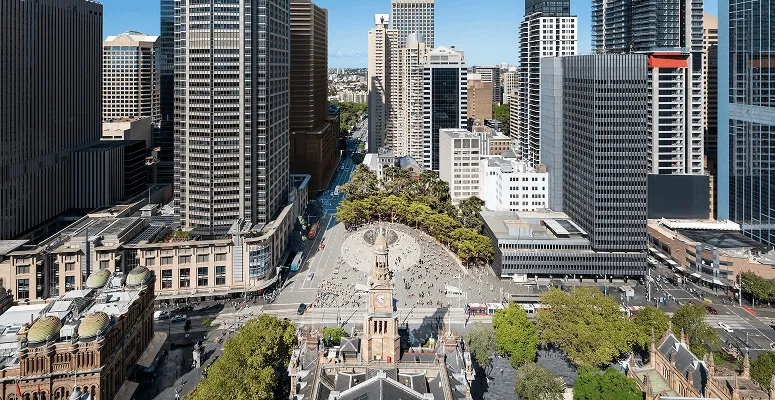
The City of Sydney has released designs for a new public square located opposite Sydney Town Hall.
The new contemporary plaza is set to transform the city, encompassing a curved grove of distinctly Australian trees.
Clover Moore, lord mayor of Sydney, says the plan is to create a magnet for people in the city centre, which is an investment in Sydney’s economic and cultural life. He comments:
“The design is tailored to our environment and culture and will be a uniquely Sydney square – a contemporary public space, with circular paving patterns and water elements that connect seamlessly with adjacent historic buildings and George Street.”
Four decades since the council purchased the first building to enable a square at the town hall, the space is set for a full transformation. The council has allocated AU$150m to the project’s design, demolition and construction.
Visitors will be invited to stop and linger, while the space will feature multiple seating areas. Moore adds:
“This is a once-in-a-lifetime opportunity to transform a major space in the heart of the city and deliver a generous, welcoming place destined to become the city’s living room and an iconic place to gather.”
As Sydney is expected to attract double the number of visitors by 2050, the square proved essential to support growth.
JPW is the lead design consultant and architect for the project, working alongside ASPECT Studios as landscape architects.
Sacha Coles, global design director at ASPECT Studios, comments:
“A grove of native trees will provide shade and softness in a warming climate, generous seating will invite people to linger, and cool moving water brings movement and a sense of delight. The tree canopy will light up and ensure the square is safe and welcoming.”
Demolition is expected to start in 2028 and the square is expected to be complete in 2031.
by Holly Chapman | 11 Aug 26 | International, Landscape Architecture, News
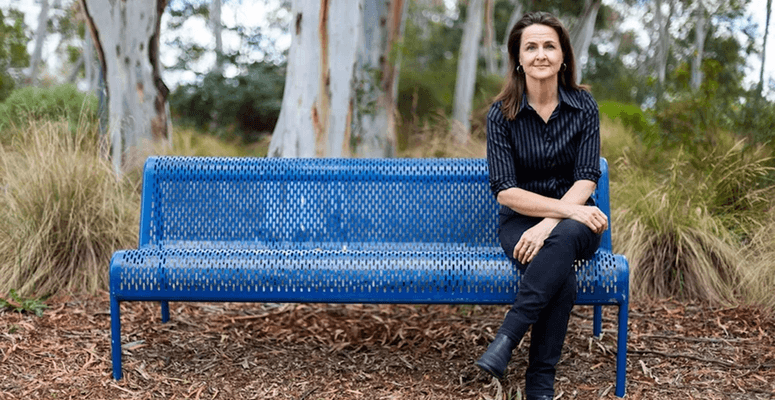
The Australian Institute of Landscape Architects (AILA) has announced the Australian Capital Territory’s (ACT) first government landscape architect.
Gweneth Leigh steps into the role on a mission to create a landscape plan for Canberra, located between Sydney and Melbourne.
In a statement online, Leigh says, “this role is really to connect the dots, to connect people, and to connect research, to make concrete some of the values we can put in place to validate what landscape does. We know intuitively it does important things for us. Capturing that in a way a broader audience understands is the key role that needs to be championed.”
Born in the United States, Leigh travelled to Australia in 2004 with a background in horticulture. After settling in Canberra, she completed a PHD in public health that led grant work capturing youth voice to improve outdoor spaces while producing a series of toolkits for principals and designers.
The AILA comments on the appointment:
“We look forward to seeing the other states and territories following the ACT’s lead and establishing a network of Government Landscape Architects across Australia.”
Leigh looks towards an Australia set on climate adaption while creating spaces that connect communities.

by Holly Chapman | 26 Jun 26 | International, Landscape Architecture, News
The designs for Brisbane Stadium in Queensland, Australia, have been unveiled, setting the stage for the 2032 Olympic and Paralympic Games.
Early design concepts have been published by principal architects COX, Hassell and Japan’s Azuka Sekkei.
Sat in Victoria Park, Brisbane, the stadium will balance green space with event-day activities.
Nestled between two ridges near Gilchrist Avenue, in a natural amphitheater that reduces earthwork requirements, the stadium’s design will make the most of the unique surrounding landscape.
The stadium is being delivered by the Games Independent Infrastructure and Coordination Authority (GIICA).
Simon Crooks, chief executive, comments on the design plan:
“The Brisbane Stadium has an important role during the Games, but its lasting value will come from what it offers Queenslanders long after 2032.
“That’s why the design is focused on building what’s needed, while protecting the character and openness of Victoria Park. Key decisions are being shaped by how the stadium sits within the park and how people will experience this space outside of major events.”
Once completed, the stadium will be home to AFL and cricket, ahead of the Olympic and Paralympic Games in 2032.

by Holly Chapman | 26 Jan 26 | International, Landscape Architecture, News
Australian developer Golden Sedayu has submitted planning for the Burswood Point water development in Perth, Western Australia.
The masterplan is being led by Skidmore, Ownings & Merrill (SOM), while the Precinct B landscape and public realm strategy is being headed up and designed by Grant Associates.
Set along the Swan River at the tip of Burswood Peninsula just 3.5km from Perth CBD, Precinct B intends to deliver a new mixed-use waterfront neighbourhood on a previously untouched stretch of the foreshore.
Featuring public open spaces, riverfront parkland and civic gathering spaces, the landscape concept also includes a water sensitive urban design strategy with rain gardens, vegetated swales, permeable surfaces and native planting. “This approach positions Precinct B as a climate-resilient waterfront neighbourhood designed for long-term environmental performance,” says Grant Associates.
Agnes Soh, senior associate at the landscape architects firm comments on the project:
“Precinct B is conceived as a contemporary estuary — a place where river, landscape and city are gently woven back together. By shaping the land in response to water, heritage and climate, the public realm becomes both grounded and fluid — a sequence of spaces that shift from wetland to plaza, from quiet edge to civic gathering.”
Now that planning has been submitted, Precinct B is expected to be Australia’s most vibrant new waterfront neighbourhoods currently progressing through approval.

by Holly Chapman | 15 Dec 25 | International, Landscape Architecture, News
Landscape architects Grant Associates has announced the completion of Barangaroo South in Sydney, Australia.
As part of Australia’s urban regeneration scheme, Barangaroo South sits on the western edge of Sydeney’s central business district, providing a new people-focussed destination.
Working in close collaboration with architects and masterplanners Rogers Stirk Harbour + Partners, award-winning Grant Associates has created a space with native planting that brings together sandstone edges, water features and subtropical greenery.
A key feature of the design is Waterman’s Cove, an amphitheatre-style public space on the water’s edge, surrounded by Hickson Park formed of mature trees and lawns.
Andrew Grant, founder and director of the landscape architecture firm, comments on the project’s completion:
“Barangaroo South demonstrates how integrated landscape and architecture can create an urban district that feels connected to nature, culture, and community. We’re proud to have contributed to the public realm of this landmark project.”
The project has been created for developer Lendlease in Sydney over the last 15 years.

by Holly Chapman | 05 Aug 25 | International, Landscape Architecture, News
Arcadia’s Newcastle studio has announced it will be working on two state significant projects that have been approved by the New South Wales Government in Australia.
Both projects received First Nations Knowledge and local indigenous stakeholder engagement to ensure the landscape designs provide a culturally safe space for community members.
The landscape architecture studio has designed University of Newcastle’s city campus student accommodation with open space and community connections.
In Lake Macquarie, the waterfront development project sits on 23 hectares featuring retail, dining and residential areas.
Arcadia’s design combines land and water through its landscape design in celebration of Awabakal Country using native planting, sculptures and wayfinding.

by Holly Chapman | 26 Mar 25 | Commercial Landscaping, International, News
Approval for a new park in rural Western Sydney, Australia has been granted.
The two-hectare park, designed by landscape architect Aspect Studios and traditional custodians, will be located in Australia’s new Bradfield City Centre development.
With plans to host community events, the park will feature a sky ring, providing shelter, and directing rainwater to support irrigation systems.
The park embraces Dharug cultural heritage, whilst homing 550 mature trees and 70,000 species of native plants, providing 65% tree canopy and chosen in collaboration with the Botanic Gardens of Sydney, First Nations nurseries and traditional custodians.
Bradfield Development Authority chief executive, Ken Morrison says:
“Iconic cities need iconic open spaces, and Bradfield’s Central Park will create a new green anchor for Australia’s first new city in 100 years.”
Sat atop Bradfield metro station, the park will link the new city to Western Sydney airport scheduled to open in 2026.
The 23km Western Sydney Airport metro line is also currently under construction and is due to open in April 2027 after being delayed. The park is planned to parallel the opening of the station.
With the new city providing 10,000 new homes and 20,000 new jobs, Morrison adds:
“Thousands of people will pour out of the metro station directly into Central Park, which will become a gathering spot for people to live, work, and play for generations to come.”
Investing AU$1BNinto the new city, the New South Wales Government will provide early commercial buildings and infrastructure surrounding Central Park.
With the approval of The State Significant Development Application (SSDA), Central Park follows the recent opening of the first building on 5 March 2025.

by Aidan Williams | 09 Oct 24 | Long Reads, News, Website Exclusive
This time next week we will all be at FutureScape with the eyes from abroad staring at the excitement at the ExCeL in London.
But before we get lost in the delight of the UK’s leading landscaping trade exhibition, let’s take a moment to breathe and look abroad to see what is happening across the globe.
First of all, we head to New York for some quite remarkable architecture that could revolutionise how we optimise green architecture.
Conceptual skyscraper reaches to the future
Oxman Design has showcased its Eden Tower conceptual skyscraper, which features a layer of rings progressively building higher, but in a way that allows it to include as much green space as possible.
While just a concept at this stage, the company is pursuing what they call ‘ecological programming’.
It is trying to figure out how to create masterplans, building layouts and building forms that increase biodiversity and resilience.
This means structures like the Eden Tower are important steps into thinking differently about green architecture and seeing what could be possible.
While there are no plans to construct the tower as of yet, it has announced a partnership with Australian developer Goodman Group for what it describes as “an integrated series of lab-tested master-planning scenarios that maximise the ecological presence and utility of the built environment.”
Yet New York is far from the only place which had exciting green development announcements in the past week.
Ghent gives green light for sustainable building
The Belgian city of Ghent is working with the Flanders regional government on a two-year, €5.5m project to make green-inclusive building the norm.
Three demonstration projects will be ongoing as a part of this, In the Rattendalepark in Ghent, a wildlife tower for tawny owls, stone martens and bats will be built.
A new competition tower at the Watersportbaan will have a roof where terns can breed and on the old abbey walls of the Saint-Bavo Abbey, a green roof with grass and plants that retains water so that it does not penetrate the walls will be installed.
As part of the project, methodologies and tools for support and participation are being developed to help nature-inclusive construction become the new normal, while project developers, builders, architects and policy officers are also being trained and retrained.
The project will run until the end of August 2026, but represents an exciting time for the green building in Belgium.
Now we head off to Hong Kong, for news of some awards.
Prizes for green perspectives
The winners of the Best Landscape Award for Private Property Development 2024 were announced at a prize presentation ceremony.
There were 13 properties with outstanding landscape design and quality horticultural maintenance which were rewarded with Gold Awards.
To commend organisations for their efforts in greening and enhancing public awareness of green issues, 30 Merit Awards and 12 Environmental Efficiency Awards were also given out at the ceremony.
It was organised by the Leisure and Cultural Services Department (LCSD) and it represents one of its major activities to promote greening.
The LCSD is making a huge push for greener spaces and last year it installed 500 flowering trees in Sha Tin Park and along Shing Mun River and Yuen Long Nullah.
Over the next five years, it plans to plant an additional 2,500 trees in leisure venues and along roads across all the 18 districts to create more flower-viewing hotspots.
Now we head down to the Australian city of Adelaide, which is consulting on a truly massive plan.
Long-distance vision for Adelaide
The South Australian government is returning for more feedback regarding a 30-year vision for suitable development.
The Greater Adelaide Regional Plan previously obtained feedback last year across a three-month consultation period.
It covers a huge 11,000m2 area from Cape Jervis to Murray Bridge, it includes Barossa Valley and goes up to the edge of Port Wakefield.
It highlights suitable areas for a future 315,000 houses and emphasising green space for the area, which is home to 1.5 million people.
The consultation closes on 4 November of this year, with the plan to be finalised early next year. More information about the plan can be found online.
Now in a similar theme to last week, we head over to Canada for the light-hearted coda to the piece, with a slight reminder of Halloween.
Canadian family display true pumpkinship
A family in Vancouver won a contest after growing a huge, 1,161lb pumpkin in their front garden.
It was big enough to warrant its own nickname, being called Orangina by its growers, the Polay family.
It won the annual contest at Krause Berry Farms in Langley and remarkably, it’s victory was by a mere two pounds.
“My kids will tell you, I spend more time with the pumpkin than them sometimes,” says Mike Polay to CTV News.
Now, if 1,161lb sounds like a lot for a pumpkin, then you might be surprised to hear that it isn’t even half of the world record, which stands at 2,702lb and was set in Italy in 2021.

by Aidan Williams | 17 Sep 24 | Long Reads, News
It’s the start of the week so we have another five stories from across the globe to bring to your weary eyes.
It’s a glance further afield than the currently rather sunny British shores, and a glimpse into the wider world of landscaping and the stories rather less local.
We start off on an optimistic note however, with exceeded expectations and a look to the future.
GaLaBau takes a huge bow
As we did last week, we once again find ourselves casting our eyes over to Bavaria where the 25th anniversary edition of the GaLaBau exhibition has finished.
Safe to say it made a mark, with some 66,000 people venturing into the Exhibition Centre in Nuremberg across the four days.
There were a wide range of talks on how to meet the current challenges within landscaping, guided tours and outdoor exhibition areas.
Stefan Dittrich, director of GaLaBau, says: “The exhibition has exceeded visitors’ expectations. In these uncertain times, GaLaBau offers a reliable port of call for industry stakeholders.
“It’s where they find solutions to their day-to-day challenges and answers to their burning questions – whether about the digitisation of their businesses or how to position themselves for a climate-friendly future.”
It should whet your appetite for exhibition season with FutureScape now less than a month away.
For our next story however, we venture further afield to the Australian shores.
Georgiadis to lead special show
Costa Georgiadis, the host of ABC’s Gardening Australia, is set to lead a special event at Tahbilk Winery’s Peppercorn Paddock near Nagambie.
It will offer green thumbs a chance to pick up practical tips for nurturing flourishing backyards in the face of changing climate conditions.
The day’s program promises a rich blend of experiences, including insights from Taungurung elder Uncle Shane Monk, a morning tea inspired by native ingredients, and an eco-cruise tour of Tahbilk’s wetlands.
Costa shared his excitement about spotlighting gardeners’ vital role in safeguarding the environment.
“Gardeners are both stewards and guardians of our environment and can make a real difference in the fight against climate change,” says Georgiadis.
“There is no doubt that climate change is real and can have a significant impact on backyard habitats.
“There are so many ways we can build back better and connect our families and community to nature.”
And now we go over to a journalist who has found themselves in the United States, or if you’ll forgive me, our Wyoming reporter.
Master gardeners to descend on Wyoming
Anyway, the University of Wyoming will host its biannual Master Gardener’s Conference from 4-6 October at Eastern Wyoming College.
While the conference is geared toward master gardener volunteers, anyone interested in gardening is encouraged to attend.
“My hope is that master gardeners will get advanced training, and the general public that attends will get introduced to master gardeners and maybe consider becoming master gardeners themselves,” says Donna Hoffman, state master gardener program coordinator.
Throughout the weekend, participants will attend presentations from educators and other gardening experts, while topics will include plants adapted to the Rocky Mountain region, pruning and plant pests.
For our next story we stay in the United States, albeit by travelling a great deal further east, as it’s a landmark moment for one landscape designer who celebrated a prestigious award this week.
Walter Hood secures Vincent Scully Prize
Hood, the landscape designer whose career is actually longer than the award itself, has won the 26th Vincent Scully Prize.
He received it in recognition of his work designing sustainable landscapes which enhance urban communities and empower marginalized groups.
He first set up his eponymous studio back in 1992 and this is far from the only award he has received during his distinguished career.
The best way to sum up his studio’s work, is via its website, which is wonderfully eloquent when it says: “We strengthen endemic patterns and practices – those ecological and cultural, contemporary and historic, and those that remain unseen or unrecognized.
“Urban spaces and their objects act as public sculpture, creating new apertures through which to see the emergent beauty, strangeness, and idiosyncrasies around us.”
We thoroughly recommend looking through his works and seeing exactly what drew the Vincent Scully Prize to him.
Back to Australia, as we cheat a little bit. See, this story first came upon our eyes through Wakehurst Place, a botanical garden based in Ardingly, the UK where this writer happened to grow up.
Yet they were celebrating a wonderful anniversary of a success for biodiversity that was considerably more distant.
Wollemi pines celebrate 30 years from the brink
It was 30 years ago that Wollemi pines were found in a remote Australian canyon in the Blue Mountains and were saved.
They were taken into conservation and the species has managed to survive 30 years on from the discovery.
To celebrate, six seeds are being sold in an auction, with bidding closing on the 22nd. Given that fossil evidence of the species goes back 91 million years, this is an incredible victory for biodiversity.
It was previously thought to be extinct prior to the discovery and this is only the second time that seeds have ever been sold.

