The Horticultural Trades Association’s (HTA) Horticulture, The Conference took place at London’s Barbican Centre on Thursday 24 September 2026. The Conference aims to inform and support environmental horticulture businesses as they prepare for the future.
Industry experts, political figures, a meteorologist, an economist, and experts in global foresight, communication, and organisational behaviour make up the speaker lineup.
Here are Pro Landscaper’s key takeaways.
The opportunities within the volatility
Although there are constant uncertainty in the geopolitical sphere, Pippa Goodman, leading expert in global foresight from NextUp, said there are also opportunities. Devolution, which puts “power in every postcode”, Goodman said, could create more localised opportunities in terms of creating spaces that are better for well being.
Ageing, health and livability also strengthen the case for plants and green spaces as social infrastructure. Singapore introduced an national Age Well programme and central to this is therapeutic gardens with a target to create 30 by 2030. Goodman shared 14.5% is the potential proportion of UK GDP for public health spending by 2073-74, compared to 7.9% today.
Climate volatility may reshape what can be grown and how the sector operates, but Goodman added that the growing adaptation investment could increase demand for plants landscapes and nature-based solutions. She advising leveraging the focus on cooling as new research across nearly 9,000 global cities has shown trees counter nearly half of the extra heat caused by dark roofs, asphalt and concrete.
A changing climate
We know all too well after this summer that the weather is getting warmer, but Laura Tobin, Fellow of the Royal Meteorological Society, stressed the impact of this. This year, for the climate change stripes, a new burgundy colour had to be added because it was so hot.
Compared to our climate in 1990, by 2070 winters will be between 1 and 4.5°C warmer and up to 30% wetter. Summers will be between 1 and 6°C warmer, up to 60% drier and between 4 and 7°C warmer. An increase in 4°C would mean hot days where temperatures exceed 25°C are likely to become more frequent at 37 days per year compares to 10 days per year at present. Cold conditions will likely become less frequent at 12 days per year compared to 50 days per year at present. Heavy rainfall is likely to increase, and occurrences of severe drought will increase becoming 146% more frequent. The warmer winters also mean the growing season is extended by over a month requiring year-round lawn care in some southern areas.
Nature’s Rights Bill
On a panel discussion, Baroness Bennett argued that the climate threat is a threat to food security and that the government needed to be more transparent with the public about that. Bennett recently launched a Bill to recognise Nature as a legal subject. Among its goals are to establish and protect the rights of Nature and establish a legal duty of care for public bodies, businesses, and individuals. It is currently in the committee stage.
Bennett added that the reason it is difficult to get joined up thinking is that the treasury is “all about money” and believes it has no attachment to the physical world and that Defra is one of the lowest ranking cabinets.
To prioritise nature, regulation could come through rental properties, as they need to be attractive and healthy places.
Broad Horizons programme launched
The horticulture development scheme, for HTA members, “Broad Horizons” is a fully funded, year-long programme to see business across the sector, understand how Westminster policy making works and how to influence it, how to market and promote their business and how to recruit, create and retain successful teams. It will be open for applications on 5 October.
HTA Chief Executive Fran Barnes says:
“The businesses that thrive are the businesses that invest in their people… The best ideas often come from seeing things differently. The best leaders are usually people who have broadened their horizons, challenged themselves and learned from others.”
Economic outlook
Matthew Swannell, associate director at Oxford Economics, shared that GDP growth will remain modest in 2027. He suggests that the growth in 2026 will be around 1.2%. It is predicted this will be lower in 2027 but higher in 2028. He added that energy bills are set to rise, putting pressure on consumers and businesses. Planning reforms and housing supply will also remain constrained.
Horticulture is not a “nice-to-have”
Opening Horticulture the Conference 2026 at London’s Barbican, Barnes said the extreme conditions had underlined the need for more gardens and parks, trees, green infrastructure and resilient landscapes. While she supported the prime minister, Andy Burnham, highlighting the importance of the hard hat, Barnes stressed that gardening gloves are equally as important.
Rejecting the idea that gardens and green spaces are luxuries, Barnes says:
“2026 has underlined the fact that horticulture is not just a nice-to-have. It’s gone beyond being quite important. It’s now tipped into an absolute requirement for a government to plan for. The future is going to need what you grow and sell. For shade, for flood mitigation, for biodiversity and for our health.”
Barnes Fran added that recognising the value of environmental horticulture also meant creating the conditions for businesses to invest in it for the long term.
“Businesses need certainty to make confident decisions to invest… We’re not asking for certainty about the weather. None of us can control that. Nor certainty about global events. None of us in this room can control those either. But it is legitimate to ask for certainty about the things government can – and does -control. Taxes. Regulation. Environmental policy. Employment policy. Planning. Trade.”
Attract, engage and retain workers
Dr Anthony Klotz, professor of organisational behaviour at the UCL School of Management, explained that in order to attract, engage and retain workers employers should invest in them – through good pay, benefits, development and working conditions – and notice and respond when jolts cause workers to pause and rethink their relationship with work.
Klotz also argued that employers shouldn’t be afraid to hire someone who has “job hopped” as research suggests they get up to speed more quickly. Similarly, he advised to keep an open mind when it comes to “boomerang” employees who leave the company and come back as they too will get up to speed more quickly.
Grower of the Year announced
Allensmore Nurseries Ltd scooped the title of overall Grower of the Year.
Eleven other awards were presented across six categories, with Allensmore also receiving top honours for Employer of the Year, Peat Transition Initiative of the Year, and Sustainability Initiative of the Year.
Frank P. Matthews Limited was recognised with the Best Use of Technology Award, and Robin Tacchi Plants received high praise from the judges, winning the Biosecurity Initiative of the Year award.
The Value of Green Spaces report has been launched at Horticulture, The Conference, hosted by the Horticulture Trades Association (HTA).
The report, which stands within the HTA’s Value series, following The Value of Gardens (2023) and The Value of Plants (2023), analyses the economic, environmental and health contribution of environmental horticulture to the UK.
Bringing together significant economic, environmental and health evidence alongside new YouGov polling of 2,376 UK adults, the report shows how green spaces can cool towns and cities during heatwaves, reduce flood risk, improve mental and physical health, support biodiversity and help create healthier, more resilient communities.
As heatwaves, flooding and drought become more prevalent, and pressure on the NHS continues to grow, the report argues that investing in green spaces is no longer an optional environmental enhancement but a practical solution to some of the UK’s biggest challenges.
Following the UK’s record-breaking heat over the past two years and more than 2,700 excess heat-related deaths during May and June 2026, the report highlights the vital cooling power of urban planting. It finds that one large street tree can provide the cooling equivalent of around 10 air-conditioning units, while green infrastructure can reduce city temperatures by up to 5°C during heatwaves. Grass surfaces can be up to 24°C cooler than asphalt, and trees have been shown to reduce harmful heat exposure by up to 96%.
On top of this, green spaces save the NHS £148m annually in GP visits alone. This equates to the salaries of 3,500 nurses, “yet public parks face a £690m funding black hole,” says the report.
Fran Barnes, chief executive of the HTA, says, “green spaces quietly work for us every day. They cool our towns and cities during heatwaves, absorb rainwater during storms, improve air quality, support wildlife and help keep us physically and mentally healthy. Yet they are too often treated as an optional extra rather than the essential infrastructure they are.” She adds:
“As the government plans new homes, invests in infrastructure and prepares for a changing climate, green spaces must be built into those decisions from the start, not added as an afterthought. Investing in green infrastructure is investing in healthier people, stronger communities and a more resilient UK.”
In light of this report, the HTA and the Gardens Trust have joined forces to create a coalition of organisations across the horticulture and landscape industries to urge the government to make long-term investment in the UK’s green infrastructure a national priority.
The Royal Horticultural Society (RHS) has issued a survey to understand how this year’s heat and drought has affected gardens in the UK.
Gardeners are being urged to detail which plants have thrived, struggled or surprised them during the extreme temperatures and climate.
“The aim is to gather evidence from thousands of gardens to improve our understanding of plant resilience, support future climate adaptation research, and help inform RHS gardening advice,” explains the RHS.
“By analysing patterns across plant types, regions, sun exposure, watering practices, and pest/disease involvement, we can identify vulnerability and resilience trends,” adds the RHS.
The results will support gardeners, researchers and policymakers as the UK adapts to a warming climate.
The survey, available to access here, will close on 30 September 2026.
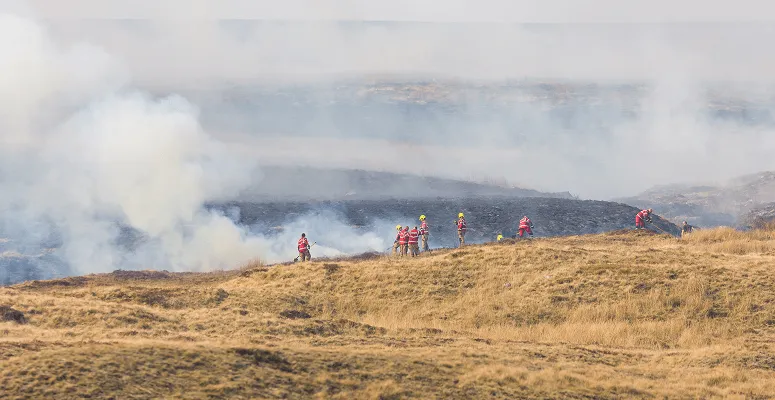
A grass fire that started in a field near Stourbridge Golf Club on Thursday 13 August raged across 500 acres of land, while more than 1,100 hectares of land are suffering in rural Wales.
In Stourbrudge, the wildfires destroyed a total of 19 homes, with a further 19 damaged, says West Midlands Fire Service. The ambulance service said 54 people were treated by paramedics across the county, while 19 were admitted to hospital.
The Tree Doctors, based in the West Midlands, has a contract with Stourbridge’s local authority.
Managing director William Boultan says, “we’re going to have to tackle the burnt trees, and think of the best way to deal with them PPE-wise and machinery-wise.”
The fires in parts of North and South Wales have also damaged land, forests and livestock. Victoria Bond, director of CLA Cymru, comments on the situation:
“These wildfires are a stark reminder of the growing challenges posed by extreme weather in our countryside. Our members, who manage much of Wales’ rural land, are working tirelessly and shoulder-to-shoulder alongside emergency services to protect lives, property, and the natural environment.”
Rhinogydd mountains of Gwynedd suffered one of the biggest blazes in Wales, burning an estimated 951 hectares, while another major incident in Blaenavon, Torfaen, scorched more than 220 hectares.
RSPB chief executive, Beccy Speight, also comments on the increasing wildfires:
“The scale and frequency of these incidents should serve as a warning. The UK’s wildfire challenge is growing, driven by a combination of climate change, prolonged dry periods, rising temperatures and human ignition sources. The question now is not whether we face a heightened wildfire risk, but how we adapt to it.
“We cannot keep chasing the flames from one fire season to the next. We have to build landscapes that are better able to resist them in the first place.”
Since this news story was published, areas of the UK have experienced rain downpours. However, expert and meteorologist Aidan McGivern says, “the wetter conditions won’t be nearly enough to reverse the weeks of below-average rainfall experienced in much of the country,” adding, “it’s not going to solve the drought situation overnight.”
Nature Unlocked launched in 2021 at Kew Wakehurst as a means of developing science-led solutions to climate change, nature recovery and biodiversity loss, which can be fed back for landscape development.
Wakehurst uses UK landscapes as living laboratories. Its scientists gather data from soil to sky, generating innovative solutions to enable collaboration between businesses, educators, policy managers, land managers and communities. A particular project dives into the pollinators at Wakehurst.
“I’ve been looking at resting nesting sites for wild bees, wild solitary bees and using different ways of collecting pollen that would otherwise be really difficult to obtain,” explains pollination research lead Dr Janine Griffiths-Lee. With around 110 species of bee spotted at Wakehurst, reveals recent research, she and her team are working towards being able to advise landscape architects and developers on how to bring more bees to urban areas.
Bees are vital because they pollinate a huge portion of the world’s crops and wild plants. “We have to think about the value of bees for ecosystem services, crop protection and food security,” Griffiths-Lee says. In tracking their routines, amongst other pollinators, they are able to understand their day to night activity. She comments:
“We collect pollen in a variety of different ways, then we do DNA metabarcoding on it to hopefully get some great information about the different trees and herbaceous plants that these bees are using and need for their young.”
Bee bank. Credit: Jim Holden, RBG Kew
In turn, the research creates a clearer picture of what bees are most attracted to. This becomes even more vital amid a warming and changing climate. It has recently been announced that almost three-quarters of England is officially in drought as conditions worsen after the driest July ever recorded. On top of this, record-breaking high temperatures have enveloped the UK this summer, with many landscapes suffering.
“We have to build climate resilience,” states Griffiths-Lee. “When we create a planting scheme based on our results, we will consider climate resilience as well. When I work with landscape architects, I always consider the climate resilience in the plants that we recommend.”
For example, the team has to consider how the plants will react when major cities such as London are experiencing soaring temperatures. “The planting will have to be monsoon resilient and heat resilient in a changing climate. We need to consider all sorts of different climate scenarios,” she adds.
So, as important as bees are to rural environments, “we also have to think about how we’re protecting them in urban environments as well,” Griffiths-Lee determines. “They’ve been relatively forgotten about in urban environments for many years. If you think about the need for food production, like within allotments in urban environments, we still do really need their pollination services.”
She advises the need for nesting sites and site management for successful landscape development. This could include the removal of any pesticide use or mowing less regularly. Nesting sites can be created with a bee bank, which can really enhance the biodiversity of a space. At Wakehurst, there is a nine metre bee bank which was visited by 45 species of bee within just two years.
Plants such as dandelions can be crucial for increasing biodiversity and attracting pollinators, but this would involve changing public perception on the so-called ‘weed’. “When the public visits a botanic garden and sees dandelions, it could slowly make them see the beauty of that dandelion and carry that into their own garden. We can change the public’s perception,” Griffiths-Lee argues.
Wakehurst engages with the public frequently. Now in its fourth year, the Trees for Bees project urges visitors to record pollinator counts on an app, with all data going straight to the scientists.
The botanic garden also welcomes all kinds of insects and species. From March to October 2023-2025, the team collected and identified 2,100 insects, including bees, moths and hoverflies, with pollen samples harvested from each one.
American Prairie, Credit: Jim Holden, RBG Kew
Scientists have recorded 27 species of hoverfly specifically, which have seen a dramatic decline in recent years. Wakehurst hosts resilient habitats such as the American Prairie, which brings benefits to UK landscapes and the wildlife that rely on them. Prairie Lead, Jack Harrison, comments:
“Over the past few years, we’ve seen it transform from blankets of yellow to a diverse display of over 80 species, a true representation of a native North American Prairie. As an experimental piece of horticulture, we’re continuing to add even more species, many of which have come from seed banked in the Millennium Seed Bank and grown in our Nursery, to create an even more balanced and diverse prairie.”
It is expected to reach its peak in August, as Wakehurst urges visitors to come and take a look. For more information, visit: www.kew.org/wakehurst.
The National Lottery Heritage Fund and Historic England have published a new study on how prepared historic parks and gardens are when fronted with climate change effects.
With 71.3% of England already in drought, the driest July on record and increasing temperatures, historic parks and gardens are already suffering from a changing climate.
Chiswick, The Royal Parks, Princes Street Gardens and Royal Botanic Gardens, Kew employ over 32,000 people and contribute £2.9bn annually to the UK economy from international visitors alone. “But they are also on the frontline of climate change, with all already impacted, and there has been no research done into how managers are coping with the changes,” says Historic England.
With more intense and unpredictable rainfall, storms and severe dry spells, pests and diseases are already thriving. These shifts are affecting all aspects of designed landscapes including features such as trees, plant collections, habitats, paths, terraces, drainage systems and bodies of water.
Drew Bennellick, head of land, seas and nature policy of The National Lottery Heritage Fund, says:
“It’s clear our historic parks, gardens and cemeteries are facing unprecedented challenges due to climate change, and without urgent guidance and advice, many of these precious landscapes will suffer and change beyond recognition. As an organisation we are known for saving historic buildings, but the natural landscapes they sit in are equally, if not more, vulnerable to the shifts we are seeing in our climate, and equally as valuable. We hope that research such as this will help to save them for future generations.”
Darren Share, director of parks at The Royal Parks, acknowledges the impacts. He says:
“Following the stark reports of our driest July on record, and consecutive heatwaves this summer, it is clear that this is a moment of urgency. A united approach and shared guidelines will enable us to collaborate at a national level to adapt and futureproof vital historic landscapes in the face of a changing climate, so they are always here for everyone to enjoy.
“The Royal Parks is focused on creating climate-resilient parks for future generations by taking decisive action now. This includes diversifying tree and plant species; using adaptive and innovative horticultural approaches; providing more shade and cool areas during hot weather; improving water management so that we are not reliant on mains water and pursuing our ambition to eliminate all greenhouse gas emissions from our direct operations by 2030.”
All sites are actively responding in practical ways where their resources allow including working with strategic plans and prioritising actions to adapt to climate impacts in relation to heritage significance.
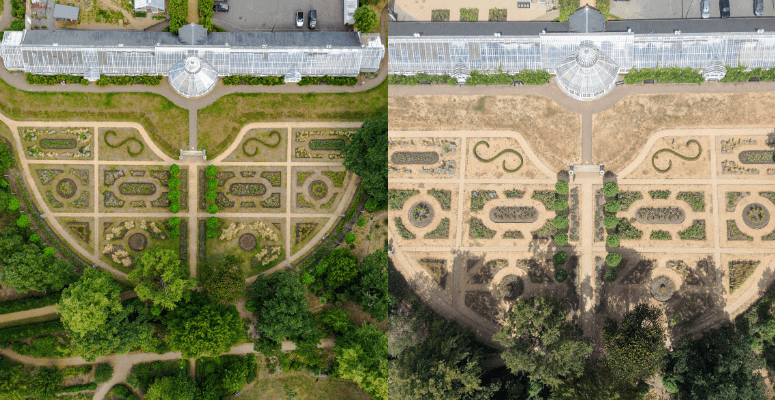
Chatsworth, however, has revealed that the drought has revealed the remnants of an ornate 17th century garden design normally hidden from view.
As I sit down to write this thought leadership piece for Pro Landscaper, the topic that I’m covering is an obvious one. With curtains drawn, shorts on, and iced latte in hand, an intense heatwave is once again upon us with little sign of letting up and I am doing my best to hide from the soaring temperatures and unrelenting sun. But aside from my inability to adapt to summer months, there is a bigger issue at hand. We’re consistently seeing higher temperatures and changing climate patterns with more drought, more flooding, and harsher weather conditions every year.
This is being compounded by 2026 being an El Niño year. For those that are unaware, El Niño is a climatic event where the Pacific Ocean warms beyond the typical, even under climate change, which has concomitant impacts on weather around the world. Unfortunately for us, this year’s El Niño has been predicted to be one of the most intense in recent history, with potentially devastating costs for the environment and human lives. Flooding, drought, food shortages, wildfires, heatwaves, and storms are all likely to be seen over the coming months around the world.
My purpose in writing about this exceptional event is not to scare everyone or incite panic, but to draw attention to the looming issue of climate change that we need to address across UK and the role of landscaping in addressing these challenges. It may seem that I am putting an inordinate amount of pressure on the industry to be able to fix arguably the greatest challenge of our lifetimes, but I genuinely believe that the landscaping sector has the tools to deliver so many environmental and social benefits which will help in our fight against climate change.
There is so much evidence which clearly shows how green spaces positively impact the environment, from enhancing biodiversity, to managing water and rainfall, increasing air quality, and cooling buildings and city streets. A study showed that London’s urban tree cover helped prevent 153 heat-related deaths between 2015 and 2022, and increasing the canopy cover would prevent even more going forward and that temperatures in parks are consistently lower than on streets. Similarly, green walls help regulate the temperatures of buildings, keeping them nearly 4°C cooler than other buildings without green living walls.
The landscaping sector does not need my help in understanding the benefits of the work they undertake. Every time I speak to a British Association of British Industries (BALI) member, I am floored by the innovative and forward-thinking approaches being taken to mitigate climate change and deliver environmental goods. It is my role to advocate for the industry to government officials and get more decision-makers thinking the way I do; that the landscaping industry must be an integral part of the solution to this challenge we’re facing as a society. The El Niño year we’re in is going to be formidable and will serve as a stark warning of our future if we do not change how we design and deliver our outdoor spaces, but meaningfully engaging with the industry is a vital place to start.
As temperatures reach new heights across the UK, the mayor of London, Sadiq Khan, has launched London’s first ever heat plan, Heat Ready London.
The new Heat Ready London vision focuses on priority areas where change is most needed, calling for the protection of those at highest risk of extreme heat, retrofitting of buildings, expanded access to cooling spaces and improved infrastructure resilience
“The need for action is becoming increasingly urgent as London experiences more frequent and severe heatwaves,” reads the plan. Since record-breaking temperatures in May 2026, and a red heat warning was issued by the Met Office in June 2026 when parts of the capital city experienced 36.4°C, Khan says:
“Rising temperatures are no longer a future threat – they are becoming a growing reality for Londoners. It is affecting our communities, from homes and high streets to schools, hospitals and care services.
“That is why I am proud to unveil Heat Ready London, London’s first ever heat plan. This is a new vision that will help tackle the huge obstacles we face with rising temperatures.”
Heat Ready London covers five objectives for a heat-resilient London:
1. Protect Londoners from the health impacts of high temperatures
2. Reduce inequalities by prioritising those most at risk
3. Ensure buildings, public realm, and green spaces are adapted to heat and provide shade
4. Maintain essential services and infrastructure
5. Support productivity and economic resilience
This comes as organisations such as The Woodland Trust, the Horticultural Trades Association (HTA) and the Royal Horticultural Society (RHS) are urging the government to act now to cool UK cities through green infrastructure with a new plea.
The Woodland Trust, the Horticultural Trades Association (HTA) and the Royal Horticultural Society (RHS) are urging the government to act now to cool UK cities through green infrastructure.
The organisations plea warns that repeated extreme heat is already reshaping daily life and risks becoming the new summer norm.
The UK has seen two record-breaking heats this year so far, with an all-time May high of 35.1°C before June hit highs of 37.7°C in some areas just last week.
Fran Barnes, chief executive of the HTA, comments on the latest plea:
“The evidence is clear that plants, gardens and trees can make a measurable difference to how hot our streets, homes and communities feel. In dense urban areas, where hard surfaces trap and retain heat, trees and green spaces provide shade, cool the air and reduce the heat absorbed by buildings, roads and pavements.”
The Mayor of London’s Heat Ready London plan warns that rising temperatures are already putting homes, schools, hospitals, care services and infrastructure under pressure. Launched last week, the plan outlines how people can tackle obstacles when temperatures rise.
The next iteration of the government’s England Trees Action Plan is due any day, so the organisations are calling for decisive action to maximise green infrastructure and support domestic tree production.
However, the HTA, RHS and Woodland Trust mention The Strong Roots report, published in October 2025, suggests that the UK government’s Net Zero Strategy, which requires 40,000 hectares of trees to be planted annually by 2030, is likely to be held back by barriers to domestic tree production, such as the lack of a designated action plan and a shortage of skilled workers.
In response, the organsations have sent minister for nature, Mary Creagh MP, a letter outlining recommendations, including conducting a feasibility study into what proportion of imported tree material could be produced domestically; and use the study to develop a dedicated action plan for increased productive and ornamental tree production in England.
Since the release of the Government Estate Nature Plan (GENP), Jennifer Pheasey, director of policy and public affairs at the HTA, also comments on the need for action:
“The GENP emphasises the importance of nature-based solutions; this is what environmental horticulture is about. However, it is disappointing not to see the connection made – that by greening government estates, investing in their green infrastructure, and adopting smarter public procurement, we could see a real boost to UK environmental horticulture businesses, the UK’s environment, and economic green growth.
“It is critical that across government, we see a renewed opportunity to work with the environmental horticulture sector to boost domestic production and habitat creation, and to contribute to ecological landscaping and restoration efforts.”
During the summer of 2022, Royal Botanic Gardens, Kew, lost 400 trees to the drought and extreme 40°C heat.
This London Climate Action Week – running 20 – 28 June 2026 – Kew has painted an oak tree which died in 2022 the colour red to raise awareness of the effects of climate change.
While other trees which failed during this time were felled, this oak ‘skeleton’ has been left.
As the weather is predicted to reach highs of 37°C in London this week, the Climate Changed Oak highlights urgent actions needed to mitigate the long-term effects of increasingly hot, dry summers on plants and trees.
The Kew Gardens Tree Collections and arboriculture teams have been working with the Greater London Authority to assess 1.2 million trees across London, finding 62% have low suitability and 10% are vulnerable.
By the end of this century, 72% of London’s urban canopy could be at risk, meaning there is plenty of work to be done to protect the capital city’s trees in the wake of a warming climate.
Richard Deverell, director of Royal Botanic Gardens, Kew, comments:
“Highlighting this Climate Changed Oak brings tangible evidence to help our visitors understand that climate change is here and now and is damaging our living landscapes. I hope it will give visitors an opportunity to reflect on how climate change is affecting our lives and what each of us can do to address this urgent challenge.”
Visitors are invited to reflect and listen to audio recordings from Kew’s staff and supporters closely involved in developing solutions to the changing climate.
Experts profess the vitality of featuring native and non-native planting in UK gardens in Pro Landscaper’s June issue.
Green space in the UK will often feature planting from across the entire world, not just those naturally occurring in Britain. In woodland, most commonly seen and often dismissed, the carpet of violet-blue on copse floors during April and May will host a mixture of the native bluebell and non-native Spanish bluebells. The UK is home to around half of the world’s bluebell population, and only one species is native.
While they may look similar upon first glance, a closer inspection reveals easy-to-spot differences between the two species.
The Hyacinthoides non-scripta, otherwise named common bluebells, English bluebells, British blueness, wood bells, fairy flowers and wild hyacinth, grows naturally in the UK. These feature narrow leaves and deep violet-blue, narrow, tubular-bell flowers with tips that curl back and bloom on one side of an often-drooping stem.
The Spanish bluebell, Hyacinthoides hispanica, on the other hand, has broader leaves with pale blue conical-bell flowers that grow around the entire stem positioned upright. A more vigorous plant, it threatens the British bluebell’s population as it outcompetes it for resources such as light and space. Also, over time, the non-native species can hybridise with the British bell, eventually changing the genetic makeup of the native species, therefore diluting its characteristics and weakening it before potentially evolving into something else entirely.
In fact, a study from Plantlife found that one in six broadleaved woodlands hosted hybrids or the Spanish bluebell. Hybrids spread underground and are known to push other species out while native bluebells can take up to seven years to germinate from seed. Voted the nation’s favourite wildflower, organisations such as Plantlife and The Wildlife Trusts encourage the public to choose the native variety to help prevent the spread of non-native, while providing food and shelter for native insects.
However, within gardens across the UK the combination of native and non-native species can also be incredibly productive for gardens across the UK. A diverse range leads to extended seasonal flowering and mixture of blossoms improves wildlife value, especially as the country’s climate changes.
Native vs non-native
“Native plants are vital to support our declining wildlife,” begins planting specialist and garden designer Susanna Grant, “not just for pollinators but also for habitat, breeding, nesting and food sources for larval stages of insects, many which have evolved to eat the foliage of one specific plant.”
Even if a garden is full of pollinator friendly plants, “it doesn’t matter if there’s nowhere for those pollinators to breed,” Grant explains. Wildflowers, for example, are in decline, with the UK having lost 97% of its wildflower meadows since the 1930s.
“Using non-natives for so long is a massive cause of habitat loss and biodiversity reduction. We’ve squeezed wildlife out of every corner, but we can change this situation by including native plants every time we add something to the garden,” she reasons.
The Royal Horticultural Society (RHS) has been researching how to garden for both pollinators and invertebrates. From planting British natives to focussing on wildflower meadows or extending the season with exotic non-native planting, the RHS encourages a mixture of flowering plants from different parts of the world. The more plants a garden can offer throughout the year, the greater number of bees, hoverflies and other pollinating insects it will attract and support.
Garden designer Dave Green of Dave Green Garden argues that “it’s not so much a distinction between native and non-native,” but instead “it’s more about plants and blooms being available for nature.”
However, native planting specifically is important for invertebrates, finds the RHS. Often dismissed as pests, invertebrates support populations of natural predators, which in turn helps to maintain a balance of invertebrates in general.
Grant sees native planting work well with non-native planting, “especially when we are putting together planting plans that we hope will withstand climate change,” she says. Green agrees, adding:
“Some of the native plants are not suitable for changing climates, and we need to think about resilient planting by including a more diverse range of plants.”
A changing climate
Not only does a diverse planting plan work for a changing climate, but “the mix of plants and blossoms for an extended season improves wildlife value,” says Green. As weather patterns become increasingly intense and unpredictable, there is a risk that native plants may not evolve quickly enough with the change of environment, notes garden designer Max Parker-Smith of Maximilliam design.
Designer of the Journey Beyond the Tracks: From Adelaide to Perth garden at RHS Chelsea Flower Show 2026, Parker-Smith featured an abundance of non-native planting in honour of the Australian landscape. “I think we should also embrace non-natives,” while also recognising the plants that have lived in the UK for 1000s of years.
His garden, built by Hardwood Landscapes, will be relocated to Kensington Gardens and Longleat. 98% of the planting originates from South and Western Australia and grown in southern Spain. “It’s going to be interesting to see how they fare in the UK,” he says. “I think we might surprise ourselves with some of these plants.”
For example, the Xanthorrea (Grass trees), which played a key role for the first nation inhabitants of Australia, “has a good chance of growing,” Parker-Smith explains. In need of sandy soils and low nutrients, the trees find a new home within the Royal Parks under the watchful eye of head of horticulture and landscape strategy, Matthew Pottage.
Trends amongst clients
Admittedly, Grant says she initiates the conversation on native planting with her clients and the importance of incorporating declining planting, such as wildflowers, within schemes. In comparison to five or so years ago, she’s seen a change: “I’ve had more clients interested in including more native plants into their gardens and if they want a lawn, they are happy to have clover turf or wildflower turf which they weren’t so much five years ago.”
Perhaps down to the increase of ‘wilder’ gardens at Chelsea, “there is a trickle-down effect which definitely does help,” Grant notices. “But equally those gardens show a snapshot of a perfect flowering moment in time which can be very unhelpful in managing client’s expectations.” In response, there is a level of education and communication needed to be relayed to clients.
“I don’t think a lot of people understand how important native plants are but they are usually very receptive to the idea when you can explain that a lesser knapweed will support up to 70 species or that kidney vetch is the sole larval food for a small blue butterfly as they might want to see that in their garden.”
Green has also seen a trend with more clients looking to connect with nature, and “a lot of people think that connection means having native plants,” adding, “I think there is a trend for ecologically rich planting, for example having more natives.” But, he argues, there is a risk that people believe in order to be more ecologically sound, they must have only native planting. “But that’s not the case. It’s about diversity, and the more we can tell people about that, the better,” he finishes.
Not to be ignored, the conversation on native and non-native planting should be pursued across planting and garden design. As the climate warms and threats to species continues, not only is it important to reintroduce declining native species, but by introducing non-native planting in combination, a garden is more likely to attract a range of pollinators and invertebrates all year round.
In the landscaping industry today, one question is becoming increasingly difficult to ignore: are the tree species we’re planting today suited to the climates they’ll experience in the decades to come? For nurseries, landscape architects, contractors and local authorities alike, this is no longer a theoretical discussion, but a practical consideration in how we plan, grow and specify trees for future landscapes. At Hillier Trees, we’ve held conversations with customers covering this shift over the past few years.
Last year in particular, a questionnaire was sent out to clients across the landscaping and public realm sectors that painted a clear picture: Not only is there growing interest in climate-resilient tree species, but there is also a strong desire for decisions to be grounded in evidence rather than speculation. Designers and contractors today are increasingly asking nurseries to focus on the bigger picture and understand how species will perform not just in today’s conditions, but also in the next 30, 50 or even 100 years. The truth we found is that the climate itself is already sending clear signals.
What the climate is telling us
In January alone, our field tree production operations at Andlers Ash recorded approximately 239mm of rainfall within a single month. Across the nursery’s 500 acres of field-grown trees, this equated to around 107 million gallons of water falling across the site in just four weeks.
Significant shifts in the climate such as this illustrate how weather patterns are becoming more extreme and less predictable. While heavy rainfall is one side of the equation, many parts of the UK are also experiencing longer periods of drought and heat stress during the summer months. For growers and landscape professionals, these changing conditions reinforce the importance of understanding how different species will perform over time.
Taking a science-led approach
To better understand how future climate conditions may affect tree suitability within the UK, we commissioned a study with Urban Plant Lab that examined seventeen commonly planted landscape tree species across 23 UK cities, analysing their current climatic suitability alongside projected future conditions using plant trait data, global species distribution records and climate modelling.
The results from the findings suggest that the outlook for many of the species currently used in UK landscapes remains positive. In fact, most of the species assessed demonstrated moderate or high suitability for both current and future climate conditions.
However, the research conducted also emphasized that climate change won’t have a universal effect on the UK. Instead, every region within the country will suffer in various ways, with northern and western areas expecting to remain broadly suitable for many existing species, while parts of the south-east may experience greater pressure as temperatures rise and summer rainfall becomes less reliable.
Additionally, the study also suggests that species such as Betula pendula, Prunus avium and Tilia cordata may become increasingly vulnerable in Southeast England towards the end of the century, highlighting the importance of considering regional differences when planning future planting.
Trialling the next generation of trees
Alongside the work we’ve put into our operations following this study by Urban Plant Lab, we’ve also been carrying out our own production trials over the past three years, evaluating species that aren’t currently a part of our commercial growing programme but may have potential for future production. As with any trial programme, some species have performed well while others have presented challenges in terms of growth rate, form or propagation.
But identifying species that may be suited to future climates is only part of the equation, as those trees must also be commercially viable to grow in UK nurseries, capable of being produced at scale and delivered to the market at the sizes required for landscape projects. Simply importing unfamiliar species from Southern Europe is unlikely to provide a reliable long-term solution if those trees cannot be successfully grown and supplied within the UK nursery system.
Research through collaboration
In the end, developing a climate-resilient tree supply will require collaboration across the entire sector. Fortunately, many world-leading research institutions within the UK are doing just that, studying plant science, urban forestry and climate change in detail. By bringing together researchers, commercial growers, landscape professionals and local authorities, the industry can develop practical solutions that can be delivered at scale.
Continued government support will also play an important role in enabling the research and trials needed to expand the range of viable tree species available to the market.
Working with clients and communities
At Hillier, we’re currently working with several clients on projects where the boundaries of traditional tree selection are being explored, enabling us to trial promising species within real landscapes while gathering valuable feedback on how they perform in different environments. As part of these efforts, we also recently partnered with Tree Musketeers, who are planting trial species across residential estates and public green spaces.
Projects such as these help researchers understand how newer species perform in urban environments while also engaging local communities in the long-term stewardship of their urban trees.
Looking ahead
The question of whether the trees we are planting today are fit for tomorrow’s climate doesn’t have a simple answer. While evidence suggests many of the species currently used in UK landscapes will remain viable for decades to come, climate change is also likely to reshape growing conditions in specific parts of the country, meaning diversification and forward planning will become increasingly important. For the landscaping industry, the key will be maintaining a balanced, science-led approach and continuing to plant proven species; all while gradually introducing new ones that may build resilience for the future.
Most importantly, these conversations need to start early. Engaging with nurseries during the planning stages of major landscape projects allows time to consider species selection, availability and potential contract growing opportunities. Because when it comes to trees, the decisions we make today will shape our landscapes for generations.
Lottie Delamain, garden designer and arbiter of positive change, has released a new book ‘Gardens That Can Save the World’.
The book has come out today, 12 March, which explores the many ways in which green spaces can be the solution to problems such as loneliness and climate change.
Featuring 365 colour illustrations, the book has been published by Thames & Hudsen, retailing for £30.
Written by Delamain with a foreword by Isabella Tree, the book includes 65 projects which demonstrate how gardens can “repair, heal, empower, nourish and reimagine,” explains Delamain.
“It’s no longer just about aesthetics, but about what the great outdoors can do – save water, transform mental health, bridge social divides, educate vulnerable children, reimagine polluting industries and provide much reason for optimism in a rapidly changing world.”
It also features ten green thinker profile pieces and a glossary of plants, materials and techniques which intends to encourage readers to apply the lessons learnt in their own garden.
Delamain has preciously exhibited at RHS Chelsea Flower Show with a garden confronting the environmental cost of the fast fashion industry, while most recently exhibiting at Kew Gardens in collaboration with Chelsea College of Arts.
The British Association of Landscape Industries (BALI) is hosting a new industry event focussed on helping businesses future-proof their organisations in the face of climate change, economic pressure and regulatory change.
Themed ‘Climate resilience: How to future-proof your organisation’, the event will be hosted by Mark Gregory, managing director of Landform Consultants and BALI board member.
The conference will take place on 26 March 2026 at The Royal Society, London, featuring keynote speakers such as Sir Tim Smit KBE, co-founder of the Eden Project who will discuss regenerative sustainability and environmental leadership an Trevor Williams, economist and former chief economist at Lloyds Bank Commercial Banking.
Amy Cobbett, head of policy and public affairs at BALI explains: “Every landscaper and garden designer in the UK is feeling the pressure right now – from the climate, from regulation, from the market. This conference exists because those pressures deserve serious answers, not just headlines.”
Attendees will also hear from Helen Nyul, director of ecology at Verna, who will explore how biodiversity strategy and ecological thinking can be embedded into landscape design and delivery.
The conference will also host breakout discussions covering plant health, biodiversity data, economic risk and developing future industry talent, the BALI team invites landscape professionals from across the UK to join them in London.
Tickets start from £175 per person, and can be available to buy here.
Businesses across Cornwall recount the havoc caused by Storm Goretti and what they’re doing to deal with the damage left in its wake.
At the start of January Storm Goretti ripped through the British Isles, bringing with it an onslaught of heavy snowfall, strong winds and significant rainfall. The impact of what the Met Office is calling a multi-hazard event was felt most acutely throughout the southwest, Wales, the Midlands, and parts of northern England.
The aftermath of the storm saw many businesses in and around the area’s most badly effected left without power, damaged stock, and a great many trees in need of clearing after being brought down by the high winds.
“The result of this storm was close to annihilation,” reveals Mark Lea, owner of Primal Plants nursery.
Based in Townshend, Cornwall, Lea, his family and his business are based in the next town over from St Ives where wind gusts reached up to 111mph. As a result, Lea details that whilst he had a structurally engineered wind break in place, the tunnels could not survive the storm. From bent frames, torn plastic coverings and posts that have been torn out of the ground, “it’s just come out as a financial loss to the business,” he says.
As a nursery that supplies to garden designers competing in horticulture shows, the impact of the storm has left Lea worried, saying: “they’re going to get marked for not looking their best”, which as a result could set the nursery back in terms of sales until as far as next season, further adding to his worries.
After absorbing the impact of Storm Goretti into his business, Lea admits that he wanted to throw in the towel. “They wouldn’t let me,” he says in reference to his team that encouraged him to keep going. “They all said, ‘no, there is nothing you can do, and we will believe in you.’ They wanted to just keep going. So, I didn’t put any more thought into it as I didn’t want to let the team down because it’s a brand that I created and really believe in.”
With most houses left without power or water, and the streets adorned with fallen trees swept over by the wind, many landscaping and arborist businesses were committed to remaining open amidst the dangers of the storm to offer aid in the cleanup.
Tom Preddy from Newquay-based tree surgeons T P Tree Services offers his perspective: “It’s a mess down here. I’ve never seen anything like it.” Dealing with surrounding commercial and private jobs, Preddy and his team were working 15-hour days after the storm hit.
From clearing roads, driveways and working on removing a fallen tree upon a rooftop, “I don’t think we’ll see the end of this for a long time. People will probably hang around until the main bulk of jobs are finished”, Preddy predicts.
“You have got to feel bad that is happening just after Christmas. Not many people have got the money after Christmas, and this happens.” Determined to help those affected, Preddy and his team are continuing to work hard across the area.
Across the way in Saint Austell, contracts manager David Bird from Mid Cornwall Landscaping also describes the storm’s influence on the company: “It has really slowed us down when trying to get to site. On site, we’ve had some trees fall down, too.” With road closures and stock damages; landscaping projects have seen an impact, too.
Reeking further devastation, Goretti was also responsible for the collapse of nearly 100 trees at St Michael’s Mount. The historic tidal island in Mount’s Bay near Penzance, hosts a historic castle and garden terraces looked after by the National Trust. Head gardener Darren Little reveals, “we’ve almost stopped counting now because there’s trees under trees – the domino effect – so we don’t know”.
Credit: St Michael’s Mount and Henry Mathews
Trewithen Gardens, an estate and garden site located near Grampound Road, has also suffered from the wrath of Goretti. Trewithen, meaning house of the trees, saw a quarter of its large mature trees felled, some of which were 250 years old.
Garden design and landscaping company Muddy Wellies Gardens which is located down in Falmouth, where the storm also cut through towns and villages. “We’ve had to prioritise clients who have needed work to free up access,” explains director Helen Fresson.
During a quieter time of year for the company, Fresson says the team have still been cautious when travelling to site as clients request new fences after immense wind speeds.
Horticultural charity Perennial aims to help people across the industry in the face of challenges. Since the storm, the charity urges those suffering to reach out:
“At Perennial, we see first-hand how events like this effect people working in horticulture, not just physically, but emotionally too. Supporting those professionals, whatever challenges they face, is at the heart of what we do.”
The charity understands the personal impacts to gardeners, and the urgent and complex work of a tree surgeon in the days that follow a storm of this magnitude. Perennial’s services can be accessed via online or phone.
While the wind has settled and Goretti has passed, the Met Office is warning that more storms of this calibre could be on the horizon as the climate continues to change, prompting the question, what protective measures can be put in place to protect not just our streets and green spaces, but businesses too?