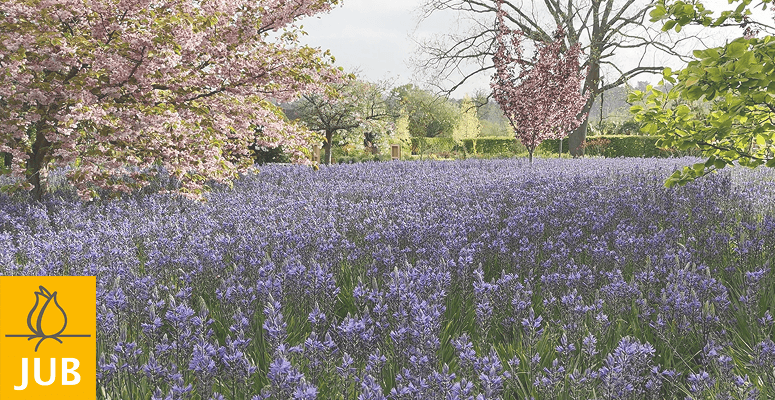
Last autumn, JUB Holland’s bulb planting machine moved steadily along Eliot footpath at the University of Kent. Within just a few hours, 60,000 bulbs were planted beneath the grass along one of the busiest walking routes on the campus. Early spring, the transformation became visible. Daffodils were first to emerge, followed by tulips, camassias and alliums. And now, as summer gives way to autumn and the campus community returns for the new academic year, crocus and colchicum bring the flowering season back to life.
The planting forms part of The River, a two-kilometre trail created for the University’s 60th anniversary and celebrating six decades of growth across its distinctive parkland campus. The bulb scheme adds a new seasonal dimension to that story – one designed to deliver much more than a burst of spring colour. At an early stage of the project, the scheme was visualised using JUB Holland’s FlowerDesigner App, helping to explore how the planting would work along Eliot footpath and how the flowering sequence would unfold through the seasons.
Credit: University of Kent
Flowering beyond spring
JUB Holland’s Kent Mixture provided a fitting starting point for the project – not least because of its name. Its succession of spring-flowering bulbs already creates a long and varied display from March to June. For the University of Kent, the mixture was taken a step further with the addition of autumn-flowering crocus and colchicum, extending both the flowering season and the visual impact well beyond spring – all mechanically planted in one go.
The colour palette shifts with it: from fresh whites, yellows and reds early in the season to cooler purples and blues towards summer, before soft lilac and white return in autumn. Rather than one concentrated display, the planting creates a sequence of distinctly different seasonal scenes along the route.
For the hundreds of students, staff and visitors using Eliot footpath every day, that means a landscape that continues to change and surprise. For pollinators, it means a succession of flowering plants at key points in the season, including periods when other food sources are scarce.
Emily Mason, sustainability officer (biodiversity and natural spaces), University of Kent, says:
“The River is about celebrating the plant communities that make our campus distinctive. The bulb planting brings a strong seasonal experience to one of our busiest routes and helps us extend the flowering opportunities available for pollinators across the year.”
The bulbs sit alongside ancient woodland, grassland meadows, orchards and ornamental trees, adding a new flowering element to an already varied network of habitats.
A mixture shaped by the site
Successful bulb planting begins with understanding the landscape it has to work in. For JUB Holland, species selection goes far beyond colour. Soil conditions, grass growth, flowering period, long-term performance and the mowing regime all influence the final mixture. At Kent, the brief combined three clear ambitions: a long flowering season, lasting value for pollinators and a planting that works with less intensive grass management.
Job van Eeden, sales manager, JUB Holland UK, says:
“The strongest bulb schemes start with the site. We look at when colour is needed, how the planting can support pollinators, which bulbs will perform well in grass and how the area needs to be managed afterwards. That is what turns a bulb mixture into a landscape solution.”
The autumn-flowering species are an important part of that thinking. Rather than allowing the display to finish in June, they bring renewed colour and flowering later in the year, when fewer plants may be in bloom elsewhere.
Credit: University of KentCredit: University of Kent
Managing with the flowering cycle
The success of a naturalising bulb scheme depends as much on what happens after flowering as on what is planted. Once the main spring display has finished, foliage needs time to die back naturally and return energy to the bulbs for the following season. At Kent, the current guidance is to allow around eight weeks, depending on growing conditions.
That creates a defined mowing window in high summer. Once the spring bulbs have completed their cycle, the grass can be cut before the first shoots of the autumn-flowering bulbs appear. The approach fits naturally with Kent’s wider grassland management, including No Mow May and its new Let it Bloom June trial.
Lee Ballard, landscape, grounds and biodiversity manager, University of Kent, says:
Credit: University of Kent
“The timing of this flower bulb mixture gives us a clear way to manage the area through the season. It supports the planting, works with our wider biodiversity goals and still allows us to keep the campus looking cared for and purposeful.”
From flowering to biodiversity
The ecological life of Kent’s Canterbury campus is actively monitored. Its annual BioBlitz brings together students, scientists, wildlife organisations and the local community to record the species found across the grounds.
Ongoing biodiversity monitoring has now brought the campus total to 1,800 recorded species, placing Kent second among participating UK university campuses for recorded species diversity. These observations provide a valuable evidence base, helping the University track how changes in landscape management are reflected in the wildlife found across the campus.
A particularly interesting discovery came on 1 June, when students from Kent’s Durrell Institute of Conservation and Ecology recorded a Fiery Clearwing Moth (Pyropteron chrysidiformis) among the grass and alliums – a first recorded sighting for the campus. The rare and protected species has traditionally been associated with coastal habitats in Kent, but recent monitoring shows that its distribution is shifting further inland. Its appearance on campus provides an intriguing new data point in Kent’s ongoing biodiversity monitoring. Continued recording will help reveal whether this was an isolated sighting or part of a wider change in how the species is using the campus landscape.
Next spring starts this autumn
Kent was the first of many UK locations mechanically planted by JUB Holland during the 2025 planting season. Its first full flowering year is also a reminder of an important principle: the best spring landscapes are planned well before spring arrives.
Early autumn planning gives landscape managers a wider choice of species and mixtures, more opportunity to match planting to site conditions and maintenance, and greater flexibility when scheduling installation. Planting within the right autumn window (from mid-September to mid-December) also gives perennial bulbs the opportunity to establish before winter and perform strongly in the seasons ahead.
So where could the flowering season be stretched further in the landscape already under your care? Where could grass deliver more colour, more ecological value and a more purposeful management regime? With the right bulbs, in the right place, under the right management, an ordinary stretch of grass can become one of the hardest-working parts of the landscape.
Next spring’s impact starts with the choices made this autumn.
PROJECT AT A GLANCE
Location: University of Kent, Eliot footpath (project The River) Flower bulbs mixture: 60,000 bulbs, 2-phase naturalising bulb mixture “Kent Mixture”, featuring various daffodils, tulips, camassias and alliums, with added autumn-flowering crocus and colchicum. Service: Project visualisation with the JUB FlowerDesigner App Planting method: mechanical planting by JUB Holland Planting stretch: approx. 400m2 Plant timing: October Key aims: extended flowering, pollinator value, colour and reduced mowing Management: approx. eight weeks of rest after spring flowering, followed by a short summer mowing window before autumn-flowering bulbs emerge.
JUB Holland goes into detail on the quiet strength for late spring landscapes.
Elegant, resilient and full of natural character
There is a particular moment in late spring when Camassia comes into its own. The early narcissi have softened, many tulips are reaching their final flourish, and herbaceous planting is beginning to gather pace. In that transition, Camassia brings something highly valuable to the landscape: height, rhythm, freshness and a calm, natural presence.
Also known as the prairie lily, Camassia has its origins in North America, where it is associated with open, often moisture-retentive meadow and prairie landscapes. That natural character explains much of its appeal today. It feels relaxed and informal, yet its upright flower spikes give planting schemes a clear sense of structure.
For JUB Holland, Camassia is much more than a beautiful late-spring bulb. It is a reliable, long-lasting genus with strong potential for estates, parks, gardens and public landscapes — especially where planting schemes need to combine seasonal beauty, biodiversity value and resilience across changing conditions.
Extending the traditional bulb season
One of the great strengths of Camassia is its timing. Flowering throughout May, Camassia extends the bulb season beyond the classic early spring display. It creates a natural bridge between spring-flowering bulbs and the first real volume of summer flowering bulbs, perennials and grasses.
That makes it especially useful in mixtures and layered planting schemes. While earlier bulbs bring the first colour of the season, Camassia adds a later wave of height and movement, keeping the scheme alive for longer.
Naturalistic, but with structure
Camassia has a relaxed, almost meadow-like quality, yet its upright flower spikes give the planting definition. This combination is particularly valuable in larger landscape settings, where the desired effect is natural and immersive, but still clearly visible at scale. This is one of the reasons JUB Holland’s Jos Smit is particularly fond of Camassia.
Planted in generous drifts, Camassia creates movement and repetition. Used more selectively, it can act as a vertical accent among lower bulbs, emerging foliage or early perennials. Depending on the variety and growing conditions, bulbs can also produce more than one flowering stem, adding extra volume and a fuller effect once established.
Jos Smit:
“Camassia brings together late-spring elegance, pollinator value and naturalising strength — making it a highly relevant bulb for UK landscapes where biodiversity, climate resilience and seasonal continuity matter.”
Reliable in the right place
Camassia is often described as elegant, but its reliability is just as important. In suitable conditions, Camassia can return year after year, gradually settling into the character of the site. It performs well in sunny to lightly shaded positions and is particularly useful in moisture-retentive soils, provided the ground is not waterlogged. This makes it well suited to a wide range of UK landscape settings, from estate lawns and parkland edges to meadow-style planting, generous mixed borders and informal grassland schemes.
As with all naturalising bulbs, success depends on early planting, good site selection and appropriate aftercare. The foliage should be allowed to die back naturally after flowering, so the bulb can store energy for the following year. In grass settings, this means mowing should be timed carefully.
A valuable bulb for biodiversity-led schemes
Biodiversity is no longer a secondary consideration in landscape planning. With Biodiversity Net Gain shaping conversations around developments, estates and public spaces, planting schemes are increasingly expected to contribute more: more seasonal value, more habitat variety and more food sources for pollinators.
Camassia can play a useful role within that wider approach. Its open, star-shaped flowers are attractive and accessible to pollinators, while its late-spring flowering period helps extend the availability of nectar and pollen between early spring bulbs and summer perennials.
For estates and landscape professionals, this makes Camassia a practical and visually rewarding choice: refined in appearance, natural in character and useful in schemes where biodiversity, seasonal continuity and lower-maintenance planting all matter.
Camassia at RHS Wisley
A strong example of Camassia’s long-term, naturalising value can be seen at RHS Wisley Garden, across the beautiful sloping meadows surrounding the Bowes-Lyon Rose Garden. JUB Holland supplied bulbs for the planting at Wisley in the early 2020s, and in 2026 the Camassia is still performing beautifully. That is precisely the kind of result that matters in professional landscape schemes: not a one-season effect, but a planting layer that settles in, returns and continues to contribute to the display over time.
For anyone working with bulbs in designed landscapes, seeing Camassia in context is far more powerful than looking at a catalogue image alone. At Wisley, its value becomes immediately clear: the height, the colour, the way it catches the light, and the way it sits between surrounding planting without overwhelming it.
Camassia in flower at RHS Wisley
Assortment highlights
Camassia leichtlinii Caerulea The classic blue Camassia for naturalistic impact
Camassia leichtlinii ‘Caerulea’ is the classic choice for a soft, natural blue effect in late spring. Its upright spikes of star-shaped flowers bring height and movement to grassland, meadow-style planting and mixed borders.
This variety is particularly effective in generous drifts, where it creates a calm blue haze without feeling too formal. It combines beautifully with late narcissi, emerging perennials, ornamental grasses and later-flowering Allium.
Camassia leichtlinii Sacajawea Creamy-white flowers with striking variegated foliage
Camassia leichtlinii Sacajawea brings something slightly different to the Camassia palette. Its creamy-white flowers are elegant and subtle, while the variegated foliage — green leaves edged with pale yellow to cream — adds ornamental value even before the flowers open.
This makes Sacajawea especially interesting for designed borders and more refined naturalistic schemes, where foliage quality matters as much as the flowering moment. It works well as a light, fresh accent among soft greens, blues, creams and early summer perennials.
Camassia cusickii Pale blue height with a strong meadow character
Compared with taller Camassia leichtlinii varieties, Camassia cusickii has a more modest height, making it especially useful where a softer, lower late-spring layer is desired. It sits beautifully in meadow-style planting, parkland edges, estate lawns and generous mixed borders, adding movement and colour without becoming too dominant.
From left to right: Camassia leichtlinii Caerulea, Camassia leichtlinii Sacajawea and Camassia cusickii
Breeding and selection at JUB Holland: the NEW Camassia mix
At the JUB Holland breeding department, Camassia is selected with professional landscape use in mind. Colour, flowering time, height, naturalising potential and performance in real planting conditions all play a role in how we assess its value.
That practical approach has led to the NEW Camassia mix: an exclusive selection combining shades of blue, purple, white, silver and soft pink accents. As the flower spikes open from the bottom upwards, the mix brings movement and variation to the border over several weeks.
For landscape professionals, this means more than a beautiful display. The mix offers rhythm, reliability and seasonal continuity — ideal for estate lawns, meadow-style planting, generous borders and public landscapes where a relaxed yet considered effect is desired.
Camassia Mix from JUB Holland
Combining Camassia with other bulbs and plants
Camassia is highly versatile in combinations. It works beautifully with later-flowering narcissi, late tulips, Allium, Hyacinthoides, ornamental grasses, early perennials, meadow-style planting and soft groundcover.
In borders, Camassia can be used to create height before perennials reach full volume. In grassland, it can appear as a natural seasonal layer, especially where mowing can be delayed until the foliage has ripened down.
Colour combinations can be calm and understated — for example white Camassia with pale yellows and fresh greens — or more atmospheric, using blue Camassia with purples, deep tulips or later Allium.
The second phase of Mixture Volendam
Thinking about Camassia for your next project?
The JUB Holland UK team would be happy to advise on Camassia varieties, mixtures and planting approaches — with attention to flowering succession, biodiversity value, site conditions and long-term performance.
Whether you are looking for a naturalistic meadow effect, a refined estate border, a long-flowering bulb scheme or a bespoke mixture for a specific location, we can help you select the right bulbs for the right setting.
JUB Holland has unveiled its 2026 theme for the annual design at Keukenhof as The Field of Gold.
An ode to light, movement and a warm glow, the theme has been conceptualised by garden and landscape designer Carien van Boxtel.
The theme draws inspiration from Sting’s song Fields of Gold and the works of Van Gogh in Wheatfield with Crows.
Throughout the entire Keukenhof opening period, from 19 March to 10 May, a selection of tulips and naturalising bulbs will succeed another in a careful sequence.
Both van Boxtel and JUB intend for the display to result in “an early, sparkling spring glow, followed by apricot and epoch tones that add depth to the gold, culminating in a finale of contrasting near-black and deep blue accents that make the composition vibrate”.
Using seven million bulbs, the annual design at Kuekenhof will be hand planted by a team of 40 in-house gardeners.
From compact verges to sweeping estates – efficient planting at any scale. As autumn approaches, local authorities, estate managers, landscape architects and contractors prepare for another planting season. Across the UK, demand for naturalising bulb displays is growing – vibrant verges, biodiverse parks and colourful public spaces that delight communities year after year. Yet bulb planting at scale – whether along a verge, across a park lawn or throughout an estate – comes with its own challenges: time pressure, labour costs, and the need to minimise disruption to the landscape. That is where mechanical planting proves its worth.
FROM DUTCH PIONEERS TO UK PRACTICE
Over 25 years ago, JUB Holland introduced the very first bulb planting machine – pioneering a method that has since become the gold standard for professional bulb planting, from modest public spaces to extensive landscapes. What began as a practical solution to the labour-intensive nature of bulb planting has evolved into a refined system that balances efficiency, sustainability, and design.
Today, JUB brings this expertise to the UK in collaboration with our partner Beechwood Industries LTD, offering a fast, efficient, and precise way to plant millions of bulbs every season. Each autumn, the team and machine travel the UK – from city parks in England to the rolling hills of Wales and the rugged landscapes of Scotland – planting bulbs with precision and care. With the capacity to plant up to 25,000 bulbs per hour, the machines combine speed with accuracy. Bulbs are placed directly under the turf, the surface sward is neatly restored, and disruption to soil and surrounding vegetation is kept to a minimum, depending on soil conditions.
For public landscapes, this means less disturbance, lower labour costs and a clean, professional result – one that allows naturalised bulb schemes to establish successfully and deliver lasting seasonal colour.
MECHANICAL PLANTING: A SMART SOLUTION GOT PARKS, VERGES AND ESTATES
The UK’s public and private landscapes are under increasing pressure. Local authorities are tasked with achieving more impact with fewer resources, while simultaneously meeting ambitious biodiversity and climate goals. At the same time, country estates, heritage gardens and private landowners are seeking ways to enhance visitor experience and strengthen their ecological value.
Naturalised bulb planting offers an answer: it extends the flowering season, supports pollinators, and enhances community wellbeing through visible greening. Yet realising these schemes at scale can be daunting. Hand planting tens of thousands of bulbs is time-consuming and costly. Parks staff and estate teams, already stretched with routine maintenance, rarely have the capacity to dedicate weeks to bulb planting.
Mechanical planting overcomes these barriers:
Efficiency – Areas – from small verges to sweeping lawns – that would take weeks to plant by hand can be completed in a single day.
Minimal disruption – Grass is lifted and restored in one smooth motion, keeping sites safe and accessible.
Flexibility – Planting can follow precise design schemes, from bold swathes to carefully composed mixes.
Biodiversity – Specialised bulb mixes provide a stable food supply and habitat for pollinators, extending ecological value from early spring into summer.
Cost-effectiveness – By saving time and labour while keeping sites accessible, mechanical planting delivers greater value for every budget.
FROM TURF TO BLOOM: THE PLANTING JOURNEY
Even before the machine arrives, JUB Holland carefully surveys each site. Soil type, light conditions and landscape character are all taken into account, allowing the specialists to select and tailor creative bulb mixtures to suit the location. A typical day of mechanical planting begins with careful site assessment. Soil depth and turf quality are checked to ensure optimal conditions. The machine – a compact tractor with planting unit – is loaded with bulbs. As it moves forward, vertical blades gently slice the turf, lifting it just enough for the planting shoes to create a furrow. Bulbs drop precisely into place via conveyor belts before the turf is folded back and rolled flat.
Did you know: Bulbs find their way to the surface themselves, even when they are upside-down!
Job van Eeden – sales manager at JUB Holland UK, explains: “The result is immediate without visible disturbance. The grass remains intact, ready to root again within days, while the bulbs beneath begin their silent preparation for spring. Because the process is minimally invasive, it not only protects the bulbs but also preserves soil ecosystems – a point increasingly valued in sustainable landscape management.”
A striking example can be found at Willen Lake, where JUB Holland carried out a large-scale project for the Milton Keynes Parks Trust. The challenge here lay not only in the scale of the work, but also in the timing.
Rather than opting for an early spring display, the team curated a bulb mix designed to flower later in the season – perfectly in sync with the park’s visitor peak. The selection included narcissus recurvus, various allium varieties and camassias, delivering waves of white, purple, and blue tones just as footfall reached its highest.
“In a couple of hours, the machine planted tens of thousands of bulbs seamlessly across meadows and lakeside lawns. What would have taken weeks of manual labour was completed in a fraction of the time, with a small crew and minimal disturbance to the park.” says Luke Nixon, area landscape manager at The Parks Trust. “Turf was lifted, bulbs precisely placed beneath the surface, and the sward restored immediately – leaving no visible trace of the work carried out.”
For Milton Keynes and The Parks Trust, this efficiency was crucial: planting could be carried out without park closures, heavy disruption or large teams. The precision of the machines also ensured that the bulb mix was planted at the right depth and density throughout, guaranteeing a uniform and professional result across the rolling terrain.
“The impact has been fantastic – the timing of the flowering really matched the needs of our site,” adds Luke Nixon. “We could welcome our visitors with an extended, colourful display that felt perfectly integrated into the park’s natural rhythm.”
This project illustrates a key advantage of mechanical planting with JUB Holland: not only efficiency in execution, but also precision in bloom timing, thanks to JUB’s deep expertise in bulb mixes and flowering succession. The ability to match bloom peaks with community use adds significant value – transforming bulb planting from an aesthetic gesture into a strategic design tool.
Willen Lake, Milton Keynes
SPRING AND SUMMER – YEAR-ROUND POSSIBILITIES
Mechanical planting is not limited to spring bulbs alone. The same method can be applied to summer-flowering bulbs, extending seasonal interest well beyond spring. With this approach, parks, estates and public spaces can be quickly transformed into vibrant summer displays – planted with the same speed, efficiency and minimal disruption as spring bulb schemes. For country estates, land managers and designers, it opens the door to year-round colour highlights that keep landscapes attractive throughout the calendar.
The success at Willen Lake is part of a broader trend. Across the UK, councils are recognising the value of naturalised bulb planting in roadside verges, parks and civic spaces. Country estates and heritage gardens are also adopting the technique to animate large parklands and create memorable visitor experiences.
What once might have been a strip of mown grass can now become a seasonal attraction – offering colour, ecological benefits, and civic pride with minimal ongoing maintenance. With urban areas seeking cost-effective greening solutions and new biodiversity targets shaping policy, the role of naturalised bulb displays is set to grow.
Mechanical planting makes this possible at any scale – whether a compact verge, a park meadow, or a country estate. For contractors, this means opportunities to deliver impactful projects efficiently; for councils and estate managers, it means making the most of limited budgets while achieving visible results.
THE IMPORTANCE OF TIMING
While mechanical planting accelerates the process on site, planning and ordering ahead remain crucial. Bulbs need time to root before winter sets in, ensuring robust growth and reliable flowering. Ordering early also allows greater availability of specific bulb varieties and flexibility: with the UK’s weather becoming increasingly unpredictable, having bulbs in hand provides room to adjust schedules around wet spells or cold snaps.
Job van Eeden points out: “Our experience shows: on time ordering is on time planting. By planning ahead, councils, contractors and estate managers not only secure their preferred mixes or specific varieties, but also safeguard the best possible results on the ground.”
LOOKING AHEAD
Mechanical planting has come a long way since its Dutch origins over two decades ago. What once was a niche technique is now an essential tool in sustainable landscape management. With its combination of efficiency, precision, and ecological value, it offers a compelling solution for the UK’s public and private landscapes alike.
For councils, contractors and estate managers, the message is clear: mechanical planting is not just about saving time. It is about delivering better, more resilient landscapes – ones that flower when communities most need them, support biodiversity across the seasons, and provide visible value for years to come.
Ready to bring colour to your landscape with precision planting?
JUB Holland welcome enquiries from councils, contractors, estate managers and landscape professionals. Discover how mechanical planting can deliver efficient, sustainable, and well-timed bulb displays for your next project.
Contact: Job van Eeden – Sales Manager UK T +31 6 4397 8319 | Ejob@jubholland.nl
In an era where the demands on public green space have never been greater, landscape professionals face an increasingly complex brief: deliver vibrant, sustainable planting schemes that satisfy aesthetic ambitions, support biodiversity, and engage communities.
For many in the sector, spring bulb planting has long been a go-to strategy to achieve these goals efficiently. Now, thanks to the rise of specialist tools like the Flower Designer App, developed and deployed by JUB Holland, bulb planting is entering a new, more visual and collaborative chapter.
A tool built by specialists, for specialists What sets the Flower Designer App apart is not just the digital innovation — it is the specialist expertise that drives it. Created by JUB Holland, a Dutch royal warrant holder and family business with over a century of experience in bulb breeding, cultivation, and supply, the app is a professional tool used by JUB’s expert advisors to co-develop tailored planting schemes.
“The strength of this tool lies in its integration with our horticultural knowledge,” explains Job van Eeden, sales manager at JUB Holland UK:
“We don’t just plug in pretty pictures. Before any visualisation is made, we visit the site, assess soil conditions, sunlight, moisture levels, and practical aspects like planting logistics — including whether a mechanical or manual planting method is most suitable. The app then helps us translate that technical knowledge into a compelling image our clients can respond to.”
In practical terms, the process begins with a photograph of the actual project site. This image is uploaded into the app, where JUB specialists digitally define the planting zone and apply proposed bulb mixes, adjusting for density, species, and site characteristics.
The resulting visual gives councils, contractors, or stakeholders a realistic preview of the final effect — supporting more confident decision-making and clearer communication throughout the planning process.
WATCH THE FLOWER DESIGNER APP VIDEO ►
Responding to today’s green space challenges As expectations for public landscapes evolve, so too must the tools and processes used to design them. Increasingly, landscape professionals are being asked to:
Deliver visual impact with seasonal interest
Support biodiversity and pollinators
Meet environmental performance goals
Involve communities in shaping their green spaces
Do all of this within tight timelines and budgets
The Flower Designer App, in combination with JUB’s UK-based support, offers an answer. By clearly communicating the future effect of planting schemes, the tool accelerates decision-making and fosters co-creation. It is particularly helpful in mechanical planting projects, where density, timing and spatial consistency are crucial.
JUB Holland’s expertise in naturalising bulb mixes, extended flowering combinations, and climate-resilient species also ensures that visualisations are not only attractive, but rooted in best horticultural practice and designed to last.
Turning plans into petals: UK projects in bloom Several UK projects in recent years have demonstrated how visualisation supports participation and quality. At the University of Leeds, the Grounds & Gardens team worked with JUB Holland to introduce thousands of spring bulbs across campus, with students and staff invited to vote on preferred mixes using app-generated previews.
For a project in Milton Keynes, bulb displays in public parks were designed with a strong focus on flowering timing. Working closely with local authority teams, JUB used the app to test species combinations and synchronise bloom periods to maximise seasonal interest. In both projects, the ability to preview bulb performance on site helped align objectives across departments and support effective implementation.
Partnership, not just a product While the app is a useful visualisation tool, it is not a stand-alone product. It is embedded in a wider advisory service that JUB Holland offers to UK clients. From initial site visits and soil assessments to species selection and flowering schedules, the app is one part of a comprehensive support model.
“We often say: the app doesn’t just spark ideas — it helps turn them into clear decisions,” says van Eeden. “It’s a tool that brings clarity early in the process. Our clients benefit from having a dedicated expert to walk through the details — what works where, which bulbs are best for pollinators, how to design for successive flowering. The app makes the vision visible, but the expertise makes it possible.”
This combination of technical support and digital design is proving particularly valuable to local councils, landscape architects and large contractors tasked with delivering seasonal colour in public spaces, housing developments, campuses, and parks. It also supports broader ambitions around biodiversity net gain and sustainable place-making.
Looking ahead As climate pressures increase and planting budgets tighten, tools that combine ecological function with visual clarity will become ever more essential. JUB Holland’s Flower Designer App points the way forward: a practical solution grounded in deep planting knowledge, used not to replace design skill but to enhance it.
With an expanding presence in the UK and a commitment to long-term collaboration, JUB Holland is helping professional landscapers turn their spring visions into living, lasting impact.
________________________________________
Interested in visualising your next bulb project? JUB Holland UK welcomes enquiries from landscape professionals, councils, and contractors. Get in touch to explore how the Flower Designer App and JUB’s expert team can support your spring display planning. Visit the JUB Holland UK website or contact Job van Eeden – sales manager UK: T +31 6 4397 8319 / job@jubholland.nl
The planting has been designed to act as a colourful still life portrait, while the border was created by garden and landscape designer Carien van Boxtel.
Drawing inspiration from artist and painter 17th century Willem van Aelst, van Boxtel used deep reds, gold, yellows and porcelain white.
The planting is in full bloom now, featuring dark-toned tulips such as ‘Sarah Raven’, ‘Queen Rania’, Tulipa acuminata, ‘Rem’s Favourite’, and the late-blooming Narcissus poeticus recurvus.
van Boxtel explains it’s like composing with time, adding:
“I treat flowering moments like notes on a score – a slow crescendo, culminating now, in this final week, in a visual climax.”
Referred to as an RHS bulb expert, van Boxtel also plays with height variations and uses foliage such as anemones and daffodils.
JUB Holland’s Bulb Mania Mix sits next to this display at Keukenhof, featuring bulbs and perennials co-developed by JUB and Rijnbeek Perennials.
The Dutch company has recently been developing its vibrant verge concept, currently featured at Lamport Hall, Northamptonshire, UK.
Hosted by the JUB Holland team, its first roadshow saw its mechanical planting in real time demonstrated by Beechwood Industries.
“We invented this machine to be able to plant large amounts of bulbs underneath the grass,” says Job Van Eeden, a JUB UK sales team member. The mechanical planting is designed to have minimal damage on the grass, depending on its conditions.
Job says the perfect conditions are “dry weather and flat terrain.” They also have a machine used specifically for challenging locations such as slopes and inclines up to 30-35 degrees.
Job Van Eeden showcasing the mechanical planting machine
First created in the Netherlands by JUB in 1991, the machine has since evolved. The Bulbs are loaded into a hopper and conveyed to the planting feet, which are rotating blades that cut through the grass. The bulbs are dropped, and the glass lies flat again.
“October and November are the best times to plant bulbs,” explains Job.
A time efficient process, the machine can plant up to 15,000 bulbs in an hour, and across 1,000m – 1,600m a day.
The Dutch company has partnered with Beechwood Industries across projects in the UK. Its machine was used to plant bulbs at Lamport Hall, where the roadshow took place.
The team explains there must always be two team members controlling the process, for safety and accuracy.
Dutch company JUB Holland says it focuses on colourful distributions and minimal maintenance to improve biodiversity and a longer flowering time with its bulb mixes and vibrant verge concept.
Seen at Lamport Hall and Gardens, Northamptonshire, JUB Holland stimulates biodiversity through bulb distribution. Working with the Dutch Beekeepers Association and the Butterfly Foundation, the company explored with bulb varieties attract both bees and butterflies. JUB has created this pollinator mix for cities, parks and public spaces.
Jonathan Ralling, a JUB UK sales team member, describes the work as “creating something that works in the environment.”
Bulb distribution is also important for its display time. By mixing up the bulbs, flowers will grow in different directions, as Jos Smit explains each flower has a different lifespan. “This lengthens the display time,” says the UK sales representative.
The flower bulb mix includes early, mid and late-flowering bulbs creating a multi-layered habitat to attract a range of insects and pollinators.
Vibrant verge at Lamport Hall, Northamptonshire
Working with Lamport Hall’s former head gardener on a vibrant verge, Jake Croft says after working with JUB, “It’s the first time ever that we actually had people ringing up the estate to say how beautiful and amazing the bulbs looked.”
Advised to mow once a year, the verge’s minimal maintenance can also save costs, says JUB.
Tulipa clusiana ‘Peppermintstick’ and crocus vernus ‘Jeanne d’Arc’ are amongst JUBs favourite pollinator friendly bulbs in 2025.
Three flower companies will be donating their perennial ‘garden’ to a national children’s hospice garden charity after its showcase at the upcoming Garden Press Event.
JUB Holland, Keukenhof and Rijnbeek Perennials will be exhibiting an array of their early flowering varieties through a mini ‘perennial meadow’ display at this year’s event .
Post-event the meadow will be donated to the Greenfingers Charity, where it will be replanted at Demelza Hospice in Sittingbourne, Kent, which is home to the charity’s first-ever garden, planted 25 years ago.
Featuring over 120 plants, including Crocus ‘Aqua’, Helleborus orientalis, Muscari ‘Baby’s Breath’, Primula vulgaris, Viola odorata ‘Königin Charlotte’ and Centaurea montana ‘Tini’s Pink’®, the ‘garden’ is the blueprint of the border that the companies have planted together at Keukenhof in Lisse, Netherlands.
Director of fundraising and communications at the Greenfingers Charity, Linda Petron, says the meadow will be a “welcome addition to the existing garden at Demelza Hospice.”
She goes on to say: “Even on the darkest days, these flowers will play an important role, often being adopted as flowers of remembrance for those to whom we’ve said goodbye.”
Planting will be overseen by Tammy Woodhouse, Greenfingers Trustee and managing director of Millbrook Garden Centres.
The official handover of the garden will take place at the Garden Press Event (20 February) at 11:30am at stands H141/142.