by Holly Chapman | 13 Aug 26 | Nature & Biodiversity, News
The National Lottery Heritage Fund and Historic England have published a new study on how prepared historic parks and gardens are when fronted with climate change effects.
With 71.3% of England already in drought, the driest July on record and increasing temperatures, historic parks and gardens are already suffering from a changing climate.
Chiswick, The Royal Parks, Princes Street Gardens and Royal Botanic Gardens, Kew employ over 32,000 people and contribute £2.9bn annually to the UK economy from international visitors alone. “But they are also on the frontline of climate change, with all already impacted, and there has been no research done into how managers are coping with the changes,” says Historic England.
With more intense and unpredictable rainfall, storms and severe dry spells, pests and diseases are already thriving. These shifts are affecting all aspects of designed landscapes including features such as trees, plant collections, habitats, paths, terraces, drainage systems and bodies of water.
Drew Bennellick, head of land, seas and nature policy of The National Lottery Heritage Fund, says:
“It’s clear our historic parks, gardens and cemeteries are facing unprecedented challenges due to climate change, and without urgent guidance and advice, many of these precious landscapes will suffer and change beyond recognition. As an organisation we are known for saving historic buildings, but the natural landscapes they sit in are equally, if not more, vulnerable to the shifts we are seeing in our climate, and equally as valuable. We hope that research such as this will help to save them for future generations.”
Darren Share, director of parks at The Royal Parks, acknowledges the impacts. He says:
“Following the stark reports of our driest July on record, and consecutive heatwaves this summer, it is clear that this is a moment of urgency. A united approach and shared guidelines will enable us to collaborate at a national level to adapt and futureproof vital historic landscapes in the face of a changing climate, so they are always here for everyone to enjoy.
“The Royal Parks is focused on creating climate-resilient parks for future generations by taking decisive action now. This includes diversifying tree and plant species; using adaptive and innovative horticultural approaches; providing more shade and cool areas during hot weather; improving water management so that we are not reliant on mains water and pursuing our ambition to eliminate all greenhouse gas emissions from our direct operations by 2030.”
All sites are actively responding in practical ways where their resources allow including working with strategic plans and prioritising actions to adapt to climate impacts in relation to heritage significance.
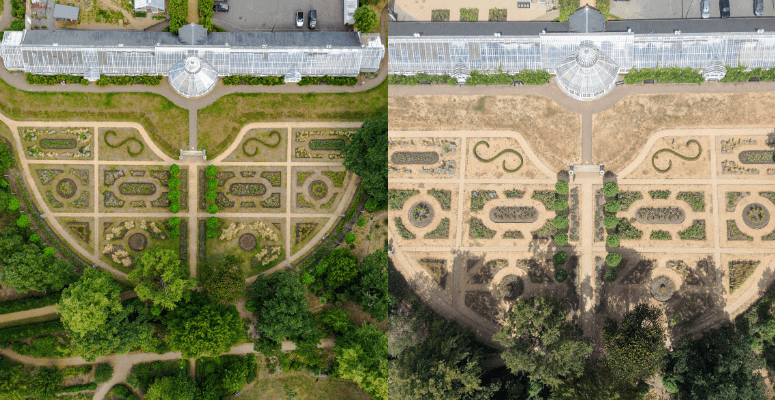
Chatsworth, however, has revealed that the drought has revealed the remnants of an ornate 17th century garden design normally hidden from view.
Explore the complete findings here.

by Holly Chapman | 25 Sep 25 | Long Reads, Sustainability
How do our clothes connect us to nature? How can they become part of a future that restores rather than depletes? These are the exact questions Kew’s latest festival explores.
Developed within the iconic glass walls of the Temperate House, Material World is the latest exhibition at Royal Botanic Gardens Kew, and its first devoted to fashion and textiles. Transformed into a bold and hopeful exploration of plant, fungi and fashion, the installations delve into the stories between the threads through art and design as a means to create influence on the fashion industry.
Material World is more than a festival, it’s a call to action
Between 80bn and 100bn new clothing garments are produced globally every year whilst 87% of the materials and fibres used to make clothing end up in landfill or incinerators. The festival vocalises why our relationship with how we wear clothes, as well as how we make them, needs to change.
Across the festival, submissions from artists such as Nnenna Okore and designer Lottie Delamain explore the history of what we wear and its relationship with what we grow.
As you step foot into the largest surviving Victorian glasshouse, Between Earth and Sky decorates the ceiling, installed by Australian-born Nigerian artist, educator and environmentalist Okore. Adorned with colour and crafted from biodegradable materials in the form of a vast wing-like form, the vibrant installation intends to inspire reflection on ecological responsibility.
Curated using organic cotton, hessian and cheesecloth, the bespoke commission floats above Kew’s collection of rare and endangered plants to create an interactive spatial experience. Okore aims to form “deeper connections between fashion, design and the ecosystems that sustain us”.

Global Threads by Lottie Delamin
Located within an octagonal chamber of the glasshouse, award-winning garden designer Delamin has transformed the space into a haven of plants and fabric. “I wanted there to be plenty of colour, and for it to feel like a coherent garden,” says Delamin.
Collected from Traid, a second hand clothes shop warehouse in Wembley, Delamin and her team collated 150 kilos of unwanted clothing after hours of sifting and searching through its vast wardrobe. The organisation encourages second hand clothing to go back into the system, before they reach incineration or landfill sites in areas such as Ghana.
From Primark to Pokemon, the piles of textiles in the warehouse “felt like a drop in the ocean” when trying to reuse and recycle all of the unused materials across the world due to shopping habits, says Delamin.
“It shows the relationship between plants and textiles. We should be looking at plant based solutions for lots of these things so they don’t end up in rivers. It’s to do with waste and our obsessions with new consumption,” explains Delamin.
Material World will reveal the stories within our wardrobes
Other commissioned pieces include a takeover by London College of Fashion (part of University of the Arts London) which explores how the plant world can help the fashion industry achieve sustainable style named Flourishing Features: Growing the Next Era of Fashion.
Threads of the Canopy is another collaborative piece within the festival, where over 50 individuals at Kew’s Community Open Week created a large-scale textile dye map of Kew Gardens.

Flourishing Features: Growing the Next Era of Fashion
Elsewhere, an audio installation curated by Michael McMillan, a writer, playwright and artist, has considered the complicated history and environmental impact of cotton.
Hosting After Hours events with DJs, poetry demonstrations and costume performances, to industry-led talks on sustainable styling and hands-on workshops, Material World connects natural materials with fashion for Kew’s visitors.
Supported by Cazenove Capital, Material World is available to visit from 20 September until 2 November.

by Holly Chapman | 25 Aug 25 | News
This week, volunteers, families, architects and Kew Gardens staff have broken ground on the construction of Royal Botanical Gardens Kew’s new Shafran Learning Centre.
The first net-zero educational building at Kew, it will be constructed to low-energy building design benchmarks according to Passivhaus standards.
Designed to inspire and educate a diverse range of audiences, the centre intends to enhance Kew’s educational offerings on-site and remotely through live-streamed sessions on plant and fungal science.
The new centre aligns with Kew’s Manifesto for Change, which focuses on inspiring the next generation.
Equipped with education labs, lecture theatres and classrooms, the learning centre will support young people to learn about climate and nature crises amongst the most pressing issues.

Render of Shafran Learning Centre at Kew. Credit: Jerram Falkus
Over the next five years, Kew aims to train 3,600 teachers while the centre will also be a space for weekend science and gardening clubs for young children and families.
Julia Williamson, director of learning and participation at Kew comments:
“This is Kew’s first ever learning centre and will signal a step change in how we engage people in learning about plant and fungal science and how we can work towards managing the Earth’s resources more sustainably.”
The Shafran Learning Centre is expected to be completed and opened by October 2026, with construction being led by Kew’s capital projects team.

by Holly Chapman | 18 Aug 25 | Nature & Biodiversity, News, Sustainability
The department for environment, food and rural affairs (Defra) has appointed three new trustees to the board of Royal Botanic Gardens, Kew (RBG Kew), which means women now account for over 50%.
Dame Dervilla Mitchell, Dr Fiona Pathiraja and Sarah Greasley will serve four-year terms, taking the places of departing trustees Krishnan Guru-Murthy, John Scanlon, and Jantiene Klein Roseboom van der Veer who left back in 2023.
Dame Amelia Fawcett, chair of the trustees, comments on the new appointments:
“They all bring strong and diverse expertise and experience to the Board, and I very much look forward to working with them. This is an important time for RBG Kew at the halfway point of our ambitious ‘Manifesto for Change’.”
The new Trustees will play an important role is RBG Kew’s mission to end the extinction crisis and help create a world where nature is protected and managed sustainably.
There is currently an ongoing search for a new chair of the board as Fawcett has previously announced that she will be stepping down from the role in January 2026 after six years of service.

by | 25 Jul 25 | Commercial Landscaping, Nature & Biodiversity, News, Sustainability
The newly unveiled Carbon Garden at the Royal Botanic Gardens (RBG), Kew has officially opened to the public today in London.
Now a permanent feature at Kew, the garden aims to raise awareness of the role carbon plays in sustaining life on Earth, as well as bringing to attention the scale of the climate crisis.
Telling a story of the role nature-based solutions play in tackling climate change, the garden boasts over 6.5k plants and 35 trees.
At its centre, inspired by fungi, resides a bespoke pavilion made of natural fibres, a further reminder to role of plants and fungi in supporting ecosystems.
The garden also features interactive binoculars that teach the process of photosynthesis, and a soil wall explaining how carbon reaches underground.
Richard Wildford, head of garden design at RBG Kew, comments:
“By 2050 London is expected to have the same climate as Barcelona. The plants in this garden are expected to live over 100 years, absorbing lots of carbon over that time. This can slow down the rate of climate change through carbon capture.”
He hopes that the garden will encourage visitors to become advocates for nature, supporting plant health and the planet in their everyday lives.

by Holly Chapman | 16 Jun 25 | News
Seedscapes at Wakehurst will be open to the public from 4 July – 14 September, showcasing an immersive arts programme inspired by Kew’s Royal Botanic Garden, Wakehurst’s Millennium Seed Bank.
Built at Wakehurst in 2000, Kew’s Millennium Seed Bank has safeguarded nearly 2.5bn seeds from over 40,000 wild plant species.
The largest wild plant seed conservation project, the seed bank hosts the Seedscapes alongside six artists bringing science to life.
Adam Ceramic, Kristina Pulejkova, Cristina Ochoa, Shiraaz Ali, James Tapscott and Ed Carter have been working with Kew scientists to feature immersive art features throughout the exhibition.
For more information on the arts programme: kew.org/wakehurst/whats-on/seedscapes

by Holly Chapman | 29 Apr 25 | News
Kew’s wild botanic garden, Wakehurst reopens this summer across its landscape to host numerous events in Loder Valley, Coronation Meadow and the Millennium Seed Bank.
Loder Valley reopens on Saturday 3 May after two and a half years, introducing a new and refurbished 3.7km route across ancient woodland and Wakehurt’s oldest meadow; Hanging Meadow.
Coronation Meadow celebrates its 10th anniversary, also reopening on Saturday 3 May. Featuring native wildflowers, the meadow is a landmark on the Wakehurst map.
In late May, the expansion of the Children’s and Community Garden will open featuring wide buggy-friendly paths, an edible meadow, new vegetable beds and bug beds.
A free Trees for Bees project has launched allowing visitors to discover the pollinators at Wakehurst. Supporting Kew Science, this trail is open until September.
Later this month, the entire botanical garden will host a three-day festival featuring free workshops and activities aimed at charities and community groups. Spring into Community will be celebrated on 24, 25 April and 3 May.
Throughout July and September, Seedscapes exhibits art, sculpture and sound set throughout the gardens alongside research carried out daily at the Millenium Seed Bank celebrating its 25th anniversary.

Wanderwild dancers, Visual Air © RBG Kew
Wanderwild takes place during the evenings of 17 – 19 July. Featuring live music, international cuisine, and circus-inspired performance, tickets go on sale in May.
On various dates in May, June and July, willow weaving workshops will be available to beginners guided by Dominic Parrette. There are also forest bathing workshops, inspired by the Japanese practice of Shinrin-Yoku.

Dog walking at Wakehurst, Visual Air © RBG Kew
Alongside a twilight nature tour, there will be numerous other guided tours across the gardens throughout the summer.
Wakehurts’ woodland is open everyday for dog walking in secure off-lead areas. The Wakehurst 5k parkrun is free to join every Saturday morning.
Wakehurst is open from 10am to 6pm everyday.

by Holly Chapman | 29 Apr 25 | News
The Royal Botanic Gardens, Kew (RBG Kew) has signed a 10-year agreement with the Chinese Academy of Sciences (CAS) on Thursday 24 April. The Memorandum of Understanding is designed to foster research, innovation, and a knowledge exchange between the scientific institutions.
CAS is a research development network, previously in a 20-year partnership with RBG Kew. Director Richard Deverell says they are “delighted” to extend this partnership. He adds:
“Through this collaboration we hope to foster new relationships, make new discoveries and accelerate progress towards a greener future.”
China is one of the most biodiverse countries in the world; home to 10% of the world’s plant species, 14% of animals and 20% of fish.
The partnership has resulted in the Mapping Asia Plants (MAP) project, Kew’s Millennium Seed Bank, and a collaboration on research in China’s caves with Guangxi Institute of Botany.
This agreement will expand research, as well as ongoing access to data in Kew’s library and economic botany collections.

by Aidan Williams | 21 Oct 24 | News
Christmas at Kew returns next month with a showcase of new installations and world premieres which will feature two world premieres, in the form of Ombre by TILT and Threshold by Studio Vertigo.
The former is a series of giant plants in bloom, springing up from the landscape in a spectrum of vibrant shades, while the latter is an illuminated helix-like shape, bathed in golden yellow light to evoke the warmth and joy of the festive season.
This year’s trail will feature perennial favourites including towering pea lit trees, a festive funfair and the charming Christmas Cathedral.
“Christmas at Kew is always a much-anticipated highlight of the year, and this year’s trail is already shaping up to be a truly magical seasonal spectacle,” says Sandra Botterell, director of marketing and commercial enterprise at Royal Botanic Gardens, Kew.
“With a selection of brand-new installations alongside firm favourites which have become iconic parts of the Christmas at Kew experience, we’re looking forward to welcoming visitors to enjoy the beauty of Kew Gardens by night later on this year.”
Camellia Walk will be transformed into a snowy lane, showcasing the spectacular tree canopy and evoking a wintery wonderland at the start of the trail.
Other highlights include Fish are Jumping by Dutch artists TOER and Mist Arches by Culture Creative creating an atmospheric ambience across Kew’s Lake Crossing.
Other highlights on the trail include the spectacular light show on the Temperate House, evocative Fire Garden and seasonal selfie-spot Christmas Cathedral.
As part of our 2021-2030 Sustainability Strategy, every year Kew works closely with its event partners and suppliers to design and deliver a beautiful Christmas light trail in a way that is as sustainable as possible.
In 2005, Kew Gardens became the first World Heritage Site in the world to achieve ISO 14001 accreditation. ISO 14001 is an internationally agreed standard for environmental management, helping organisations to improve their environmental performance through more efficient use of resources and reduction of waste.
Also as part of its aims, this year all Christmas at Kew generators are being run on renewably sourced biofuel.
At Wakehurst, Kew’s wild botanic garden in Sussex, Glow Wild celebrates its 11th year with charming bespoke installations and the world’s largest living Christmas tree. Tickets for Christmas at Kew and Glow Wild are available to purchase now.
The Royal Botanic Gardens, Kew, is dedicated to harnessing the power of plants and fungi to end the extinction crisis and secure a future for all life on Earth.
Elsewhere, Kew Gardens have been involved in a study that has praised the potential for paramotoring to be involved in conservation efforts.

by Aidan Williams | 17 Sep 24 | Nature & Biodiversity, News
David Lammy, secretary of state for foreign affairs, chose Kew Gardens to be the venue for his first major speech, where he announced the government’s approach to tackling climate issues.
In a live-streamed address inside the Temperate House, Lammy pledged to put the nature and climate emergency at the forefront of foreign policy.
Lammy also committed to unlocking more climate finance and reverse the decline in global biodiversity.
“The threat of climate change may not feel as urgent as a terrorist or an autocrat. But it is far more fundamental. It is systemic, pervasive and accelerating towards us,” says Lammy.
After the speech, he visited Kew’s Herbarium to learn more about scientific research and to digitise, Norantea Guianensis, a plant specimen from Guyana, the birthplace of his parents.
Professor Chris Gilligan, the King’s trustee, deputy chair and one of the science trustees at RBG Kew, welcomed the foreign secretary to Kew.
“Kew’s experts in horticulture and science are working at the frontline of the biodiversity and climate crises internationally, in partnership with governments, scientists, and communities,” says Gilligan.
“They do this to provide the evidence and monitoring to shape much needed solutions, before it is too late.
“We share the belief that reaching net zero by 2050 won’t be possible without working with nature, but at the current rates of biodiversity loss, we risk losing nature’s secrets before they can be unlocked, and with that we lose ways of mitigating and adapting to climate change.”
It is not the only big announcement Kew has had over the past week, as it revealed that its orchid festival is set to return early next year.

by Aidan Williams | 12 Sep 24 | Nature & Biodiversity, News
Kew’s iconic orchid festival returns in 2025 to brighten up the last throes of Winter in the Princess of Wales Conservatory at Kew Gardens.
Drawing inspiration from the unique flora and fauna of Peru, the 29th orchid festival will take place from 1 February to 2 March.
From beaches and rainforests to deserts and mountains, Peru offers a varied landscape which is home to over 3000 species of orchid.
This beauty and biodiversity will inspire a series of stunning horticultural displays and living sculptures. Alpacas, flamingos, and a cornucopia of biodiversity will be created in floral form.
For anyone who is a recipient of: Universal Credit, Pension Credit, Legacy Benefits or is an asylum applicant entry will be available for £1.
“We are thrilled to bring the biodiversity of Peru to life in this year’s Orchid festival. From the towering peaks of the Andes to precious fog oases and beyond, the rich tapestry of Peru’s flora and fauna provides an endless source of inspiration,” says Solene Dequiret, supervisor of the Princess of Wales Conservatory.
“Our team work tirelessly to create breathtaking displays that not only celebrate the beauty of orchids but also highlight the importance of conservation efforts globally.”
As visitors step inside the glasshouse, the spectacular scenery of Peru will be recreated in floral form.
A breathtaking cornucopia sitting on a grass island will take over the central pond, reminiscent of Lake Titicaca and inspired by one of Peru’s national symbols.
Flamboyant flowers will tumble out, representing the abundance of biodiversity found in Peru, whilst in a smaller pond floral flamingos stand proud in front of the iconic Machu Picchu.
Kew works with partners across Peru on several vital scientific and research projects, including mapping ecosystems, forest restoration, conserving and restoring crop wild relatives.

by Aidan Williams | 27 Aug 24 | Nature & Biodiversity, News
Kew Gardens will start a month-long celebration of the world’s most threatened plants in October.
In the Rare and Extinct display, visitors will be able to see some rare species at the Temperate House, some of which are never publicly displayed.
In two rooms, one devoted to plants that are rare, endangered or critically endangered and one for those that are considered extinct in the wild, as classified by the International Union for Conservation of Nature (IUCN).
All plants that are set to be displayed are usually grown away from public view in Kew’s state-of-the-art tropical nursery.
Cracking the puzzle of how to cultivate and care for rare plants sits at the heart of conservation efforts.
The exhibition will be a celebration of the work of the dedicated horticulturists who care for these specimens at Kew.
Visitors will learn how Kew’s experts use their knowledge and skills to cultivate and care for rare plants and halt biodiversity loss.
The full story of each plant will be told through a curated selection of artefacts alongside bespoke films featuring Kew horticulturists that will offer a closer look at these important plants and the people who care for them.
Elsewhere, Kew have revealed that they will be debuting a Halloween light trail this year.

by Aidan Williams | 22 Aug 24 | News
Visitors to Kew Gardens in London can expect tricks and treats as it opens a Halloween light trail.
It is the first time the gardens have done such an event and will take place between 18 October and 3 November.
Kew are known for hosting a Christmas light trail each year, but Halloween will see the gardens transformed with eerie illuminated trees, ghoulish installations, fire performers among other attractions.
Adam Thow, head of commercial activities at the Royal Botanic Gardens, Kew, says: “We are delighted to be able to unveil Halloween at Kew, a chilling new light trail around the Gardens to celebrate the spooky season.
“We hope to see families really get into the spirit of Halloween, dressing up and creating some spooktacular memories.”
A band of actors will haunt the Gardens and bring family-friendly thrills as the light fades, creating a spooktacular evening out for everyone to enjoy.
Three sessions each evening offer visitors the option to choose their level of fear that suits them: Daylight, Twilight and Moonlight and each session will have a slightly different feel.
The Halloween at Kew trail is curated by Raymond Gubbay Limited and Culture Creative who design the ever-popular Christmas at Kew.
Tickets for Halloween at Kew can be purchased online.

by Bethany Vann | 11 Apr 24 | News
Kew Gardens is inviting community groups and individuals who face barriers to visiting to sign up for this year’s Community Open Week.
Providing free taster sessions of Kew’s Community Access and Learning Programmes, this year’s theme is Networks, featuring workshops, talks and games across five days.
Events include a talk on the mycelium network, games and activities to learn more about the world of plants, developed by Kew Science students, and the exploration into the world of soil.
As well as a grounding meditation and forest bathing activity, guided sensory tours for those with a visual impairment, dementia or who are neurodiverse, and a comic book workshop with Kew’s Youth Forum, where attendees can design a biodiversity themed comic book.
Now in its fifth year, Kew’s Community Open Week aims to invite communities to learn more about Kew Gardens and its Community Access and Learning Programmes.
“Access to nature should be for everyone, to improve our mental and physical wellbeing, as well as to help us really appreciate the wonder of the natural world and why it so urgently needs our protection,” says Julia Willison, head of Kew’s Learning and Participation.
Community Open Week runs from 22 to 26 May at Kew Gardens. Thursday 23 May is designed for visitors who need a calmer environment and for those who are planning to attend specific activities due to accessibility requirements.
All events are open to community groups new to Kew Gardens and existing Community Access Scheme members. There is no pre-booking required for the activities, but the activities are subject to availability.
Community groups attending Community Open Week are free to explore the gardens independently and can also get creative with a range of self-guided activities and resources, including scavenger hunts, art packs and more.
To find out how to sign up for a session visit: www.kew.org/learning/community-and-access/community-open-week

by Bethany Vann | 20 Nov 23 | Nature & Biodiversity, News
In a ceremony last week at the Tropical Nurseries in Kew Gardens, London, Sir David Attenborough donated a collection of seeds from Rapa Nui (Easter Island) to the Kew nursery.
Dr Sonia Haoa Cardinalli, a Raoa Nui archaeologist and author of Cultural and Environmental Changes of Rapa Nui presented 31 seeds of Sophora toromiro to Sir Attenborough, who then donated the seeds to his ‘friends at Kew’.
Sophora toromiro, commonly known as the toromiro tree, is a plant from the legume family that is endemic to the remote Pacific island of Rapa Nui.
The plant has been classified as Extinct in the Wild by the International Union for Conservation of Nature (IUCN) since the 1960s.
Its place on the IUCN Red List of Threatened Species has been attributed to human activities, such as deforestation and the introduction of agricultural animals to the island in the 18th and 19th centuries.
Norwegian ethnographer Thor Heyerdahl found one surviving toromiro tree in the 1950s, which were subsequently sent to Gothenburg Botanical Garden in Sweden, with specimens later cultivated at a botanical garden in Mention, France.
And while the last surviving specimen on Rapa Nui has long vanished, with the toromiro plants still in cultivation in botanic gardens around the world.
Director of gardens at RBG Kew, Richard Barley MBE, says: “Faced with the dual crises of climate change and biodiversity loss, botanical gardens across the world are on the frontline of the battle to protect our natural world, and as the shepherds of the world’s most biodiverse collection of living plants, RBG Kew will be a perfect new home for the seeds.”
Attempts to reintroduce the plant to Rapa Nui have seen some degree of success with a number of specimens now growing on the island.

