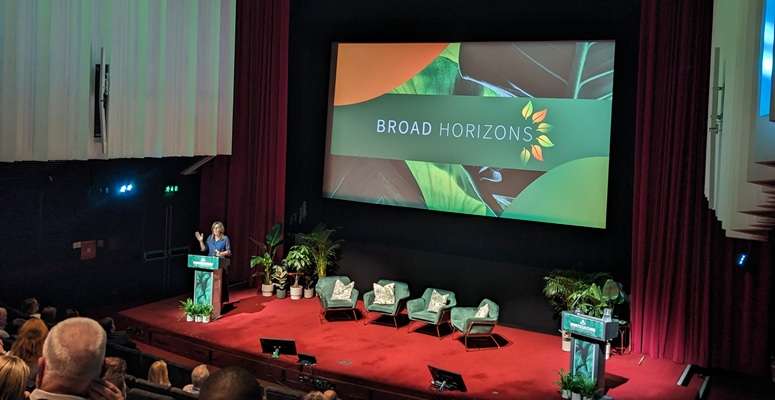
The Horticultural Trades Association’s (HTA) Horticulture, The Conference took place at London’s Barbican Centre on Thursday 24 September 2026. The Conference aims to inform and support environmental horticulture businesses as they prepare for the future.
Industry experts, political figures, a meteorologist, an economist, and experts in global foresight, communication, and organisational behaviour make up the speaker lineup.
Here are Pro Landscaper’s key takeaways.
The opportunities within the volatility
Although there are constant uncertainty in the geopolitical sphere, Pippa Goodman, leading expert in global foresight from NextUp, said there are also opportunities. Devolution, which puts “power in every postcode”, Goodman said, could create more localised opportunities in terms of creating spaces that are better for well being.
Ageing, health and livability also strengthen the case for plants and green spaces as social infrastructure. Singapore introduced an national Age Well programme and central to this is therapeutic gardens with a target to create 30 by 2030. Goodman shared 14.5% is the potential proportion of UK GDP for public health spending by 2073-74, compared to 7.9% today.
Climate volatility may reshape what can be grown and how the sector operates, but Goodman added that the growing adaptation investment could increase demand for plants landscapes and nature-based solutions. She advising leveraging the focus on cooling as new research across nearly 9,000 global cities has shown trees counter nearly half of the extra heat caused by dark roofs, asphalt and concrete.
A changing climate
We know all too well after this summer that the weather is getting warmer, but Laura Tobin, Fellow of the Royal Meteorological Society, stressed the impact of this. This year, for the climate change stripes, a new burgundy colour had to be added because it was so hot.
Compared to our climate in 1990, by 2070 winters will be between 1 and 4.5°C warmer and up to 30% wetter. Summers will be between 1 and 6°C warmer, up to 60% drier and between 4 and 7°C warmer. An increase in 4°C would mean hot days where temperatures exceed 25°C are likely to become more frequent at 37 days per year compares to 10 days per year at present. Cold conditions will likely become less frequent at 12 days per year compared to 50 days per year at present. Heavy rainfall is likely to increase, and occurrences of severe drought will increase becoming 146% more frequent. The warmer winters also mean the growing season is extended by over a month requiring year-round lawn care in some southern areas.
Nature’s Rights Bill
On a panel discussion, Baroness Bennett argued that the climate threat is a threat to food security and that the government needed to be more transparent with the public about that. Bennett recently launched a Bill to recognise Nature as a legal subject. Among its goals are to establish and protect the rights of Nature and establish a legal duty of care for public bodies, businesses, and individuals. It is currently in the committee stage.
Bennett added that the reason it is difficult to get joined up thinking is that the treasury is “all about money” and believes it has no attachment to the physical world and that Defra is one of the lowest ranking cabinets.
To prioritise nature, regulation could come through rental properties, as they need to be attractive and healthy places.
Broad Horizons programme launched
The horticulture development scheme, for HTA members, “Broad Horizons” is a fully funded, year-long programme to see business across the sector, understand how Westminster policy making works and how to influence it, how to market and promote their business and how to recruit, create and retain successful teams. It will be open for applications on 5 October.
HTA Chief Executive Fran Barnes says:
“The businesses that thrive are the businesses that invest in their people… The best ideas often come from seeing things differently. The best leaders are usually people who have broadened their horizons, challenged themselves and learned from others.”
Economic outlook
Matthew Swannell, associate director at Oxford Economics, shared that GDP growth will remain modest in 2027. He suggests that the growth in 2026 will be around 1.2%. It is predicted this will be lower in 2027 but higher in 2028. He added that energy bills are set to rise, putting pressure on consumers and businesses. Planning reforms and housing supply will also remain constrained.
Horticulture is not a “nice-to-have”
Opening Horticulture the Conference 2026 at London’s Barbican, Barnes said the extreme conditions had underlined the need for more gardens and parks, trees, green infrastructure and resilient landscapes. While she supported the prime minister, Andy Burnham, highlighting the importance of the hard hat, Barnes stressed that gardening gloves are equally as important.
Rejecting the idea that gardens and green spaces are luxuries, Barnes says:
“2026 has underlined the fact that horticulture is not just a nice-to-have. It’s gone beyond being quite important. It’s now tipped into an absolute requirement for a government to plan for. The future is going to need what you grow and sell. For shade, for flood mitigation, for biodiversity and for our health.”
Barnes Fran added that recognising the value of environmental horticulture also meant creating the conditions for businesses to invest in it for the long term.
“Businesses need certainty to make confident decisions to invest… We’re not asking for certainty about the weather. None of us can control that. Nor certainty about global events. None of us in this room can control those either. But it is legitimate to ask for certainty about the things government can – and does -control. Taxes. Regulation. Environmental policy. Employment policy. Planning. Trade.”
Attract, engage and retain workers
Dr Anthony Klotz, professor of organisational behaviour at the UCL School of Management, explained that in order to attract, engage and retain workers employers should invest in them – through good pay, benefits, development and working conditions – and notice and respond when jolts cause workers to pause and rethink their relationship with work.
Klotz also argued that employers shouldn’t be afraid to hire someone who has “job hopped” as research suggests they get up to speed more quickly. Similarly, he advised to keep an open mind when it comes to “boomerang” employees who leave the company and come back as they too will get up to speed more quickly.
Grower of the Year announced
Allensmore Nurseries Ltd scooped the title of overall Grower of the Year.
Eleven other awards were presented across six categories, with Allensmore also receiving top honours for Employer of the Year, Peat Transition Initiative of the Year, and Sustainability Initiative of the Year.
Frank P. Matthews Limited was recognised with the Best Use of Technology Award, and Robin Tacchi Plants received high praise from the judges, winning the Biosecurity Initiative of the Year award.
Marie Curie, a UK end of life charity, has revealed figures from its latest poll detailing the importance of nature and outdoor space when processing grief.
The charity has found that seven in 10 people who have experienced loss finds that spending time in nature helps them to process their grief and remember someone that has died.
Almost four in five UK adults agreed that spending time in nature clears their mind during the stressful times (78%) and provides an ‘escape’ from daily pressures (79%). Nearly half (47%) say it helps them navigate difficult life moments more than listening to music or podcasts (35%), exercise or physical activity (29%) or watching TV (24%).
Sophie Leo, this year’s RHS Young Designer of the Year, designed a garden at RHS Badminton Flower Show based around grief. Learn more about her garden here.
However, 25% of people have said they don’t have access to adequate green spaces or gardens where they live.
Jane Murray, bereavement counsellor at Marie Curie, says, “I’ve seen firsthand the restorative power spending time in nature can have for people at the end of life and their family and friends who may be experiencing overwhelming emotions.” She adds:
“Gardens can be a powerful healing space, offering a quiet sanctuary for people to process their feelings after a terminal diagnosis or bereavement and escape from the pressures of daily life. For people who have been bereaved, nature reminds them life goes on – new beginnings emerge in time and grow into something beautiful.”
The National Garden Scheme, which opens its 2027 community garden grants from 229 September to 30 October, gives visitors unique access to over 3,300 private gardens in England, Wales, Northern Ireland and the Channel Islands.
Dr Richard Claxton, chief executive of the National Garden Scheme, says, “we’re proud to have been supporting Marie Curie for 30 years, donating over £12 million in that time to fund vital end-of-life and palliative care. The longevity of the partnership is testament to the generosity of our garden owners and enduring love of gardens and garden visiting across the UK.”
Recently, rural school pupils visiting Trees for Life’s Dundreggan rewilding estate near Loch Ness have been helping shape a nature-based research programme to boost young people’s mental health and wellbeing.
International design office OMGEVING has completed the strategic renaturalisation plan for Benidorm, commissioned by the city council.
Both an iconic and densely built tourist city in the Mediterranean, it faces increasing temperatures and urban heat island effects, soil sealing, fragmented ecological systems and growing pressures on natural resources.
The plan proposes a new model of blue and green infrastructure that reconnects the city with its surrounding natural systems.
Landscaping and urban planning department at OMGEVING explains:
“By strengthening ecological connectivity, enhancing ecosystem services and improving climate resilience, the strategic renaturalisation plan positions Benidorm as a forward-looking Mediterranean city where urban development, tourism and nature can coexist in a more balanced and resilient way.”
Rather than treating green spaces as isolated elements, the plan organises them into a continuous, multifunctional ecological network linking coastal landscapes, ravines, peri-urban agricultural areas, and urban public spaces. This system integrates core natural areas, ecological corridors, urban green nodes and a fine-grained urban green grid that brings nature closer to everyday life.
Introducing ecological connectivity and quality green spaces within walking distance, while creating shaded routes between neighbourhoods across Benidorm.
While the plan has already been approved in a municipal plenary session, it is still pending public exhibition and evaluation.
The 250,000m2 mixed-use urban regeneration project, Cloud 11, has been built in the South Sukhumvit in Bangkok, Thailand.
Created as a precedent for future climate adaptation in Southeast Asian cities by landscape architecture firm Snøhetta, in collaboration with A49 Architects, the park intends to champion environmental resilience and community wellbeing.
“Cloud 11 is envisioned as a new creative hub for Asia — a place where talent, ideas, and culture can thrive,” says Onza Janyaprasert, project founder and chief executive project development of Cloud 11.
“We feel a deep responsibility to give something back to Bangkok. The elevated park reflects that belief: a generous green space for the community, designed to bring people together and offer comfort, inspiration, and possibility.”
Featuring green space, sociable spots and cultural spaces, the park fosters intergenerational and intercultural exchange in the capital city of Thailand.
The project is set to open to the public in March 2026.
International landscape architecture firm Snøhetta has moved to a new studio office in Hong Kong that is designed to foster collaboration, openness and meaningful engagement.
Featuring a large outdoor entrance, the studio reflects Snøhetta’s commitment to creating inclusive environments that nurture human connection.
“Our new Hong Kong studio reflects Snøhetta’s core approach – one that embraces an interactive design process with the whole team, and focuses on contextual sensitivity, human interaction, and environmental and social sustainability,” says Richard Wood, managing director Asia at Snøhetta.
Framed by greenery and street-facing windows, the studio has been created using recycled wood, stone and aluminum.
Evoking the experience of mountain hikes, the design concept reflects a shared reverence for the outdoors that is woven into both Norwegian and Hong Kong’s cultures.
New data released this week shows that a majority of Britons support politicians who advocate for nature-integrated developments.
The All Under One Roof report carried out by More in Common for the RSPB reveals that two-thirds (67%) of British people think politicians are ‘out of touch’ with their nature values.
While 43% say they are more likely to vote for a party that prioritises nature conservation, compared to the 10% who say they’re likely to vote for one prioritising housebuilding.
Results also showed that over 70% of the public think more positively of politicians who advocate for nature-integrated developments.
UK director at More in Common, Luke Tryl comments on the findings:
“The challenge for policymakers is that while only four in 10 people feel economic growth benefits them personally, nearly eight in 10 say access to nature is vital for their mental health.”
Tryl goes on to say that the political risk doesn’t lie in protecting nature, but rather sacrificing it.
The RSPB’s chief executive, Beccy Speight adds:
“It’s clear from More in Common’s research that people don’t see nature as a barrier to housebuilding. Poor planning, unaffordable homes, and a lack of services are the real problems. The public wants better, affordable homes built with nature, not at its expense. This isn’t homes vs. habitats, it’s about creating places that work for people and wildlife, with communities meaningfully involved from the start.”
The government-led Nature Returns programme has formed an understanding about how to tackle climate change through nature-based solutions.
Using new methods to measure carbon in hedgerows using 3D laser scanning, the report reveals that hedgerows can store as much carbon as some woodlands.
The programme is led by Nature England in partnership with the Environment Agency, Forestry Commission and Royal Botanic Gardens Kew.
Projects also funded through the programme also revealed how fungi can be used as an indicator species for how much carbon is stored in soil and how species rich grassland can take up significant amounts of carbon whilst supporting important wildlife.
Over the previous four years, six local partnership projects across England have planted over 95,000 trees and shrubs, restored 16km of hedgerows and improved 2.5km of watercourses.
Dr Pete Brotherton, director of science and climate change at Natural England says “well-designed nature-based solutions championed through this programme show how we can help tackle the climate crisis”.
The programme will continue monitoring sites for 10 years to track long-term changes in carbon storage and biodiversity to inform climate change decisions.
Analysis of these findings will be used to inform the development of England’s Land Use Framework and support the scaling up of nature-based solutions across the country.
Nature Returns has also seen communities getting involved to restore nature, with over 7,000 people joined in community activities with more than 400 volunteer days recorded.
As part of Jewon’s environment sustainability strategy, it has opened a sustainability house at its Luton branch which showcases its full Building for the Future range including materials for Homes for Nature hedgehog shelters.
The UK building merchants opened its new, first-ever sustainability house on 5 September which also offers a learning space and information on the latest regulations and environmental standards.
As part of Jewson’s sustainability strategy, the Homes for Nature campaign encourages local schools, community groups and tradespeople to build hedgehog shelters as they get ready for this winter’s hibernation.
Collectable from any UK branch, Jewson is donating free materials such as recycled wooden pallets. The merchant, a member of the STARK Building Materials UK Ltd, is also offering advice on how to create biodiverse habitats to help wildlife in the colder months, and throughout the year.
Sabrina Passley, head of sustainability at STARK UK comments:
“The Homes for Nature initiative reflects our commitment to sustainability and empowers communities to take simple, impactful steps toward a nature-positive future.”
Dylan Allman
Dylan Allman, hedgehog champion and founder of Hedgehog Aware says that “it’s great to see a company engaging small, local wildlife charities and young people – this can be such a powerful force for change”. Allman was recognised with an award by former prime minister, Rishi Sunak, for his work in raising awareness for hedgehog conservation in 2024.
Jewson’s sustainability strategy has also seen sustainability ambassadors and sustainability centres distributed across the company’s network of over 400 local branches.
German architecture studio LAVA has revealed the masterplan for the 2030 World Expo in Riyadh near King Salmon International Airport which has been inspired by the country’s landscape.
Featuring rock-like buildings arranged around a central river, the designs include petal-like groupings that are connected by bridges. Each district is intended to act as a unique village.
Chris Bosse, co-founder of LAVA says the studio has “anchored the design firmly in nature,” adding:
“The master plan exemplifies how nature and technology, environmental restoration and urban innovation can effectively coexist.”
The plan supports the Green Riyadh Project and the city’s expansion of walking and cycling infrastructure.
The masterplan design comes in preparation of the World Expo, which is currently hosted in Japan for Expo 2025 Osaka.
Expo 2030 Riyadh takes place between 1 October 2030 and 31 March 2031.
Greenwood Plants has announced that its Plant Healthy certification has been renewed for its second year.
Conducted by Grown in Britain, the audits took place across five of its UK nursery sites in June and July.
The audits ensure that Greenwood is maintaining the highest standards of biosecurity while complying with the regulations set out by the Plant Healthy Certification Scheme.
With an extensive British and European supply chain, Greenwood explains “biosecurity is an incredibly important topic to us”.
First receiving the certification in March 2024, Greenwood is able to continue its ongoing commitment to biosecurity.
The Gardeners’ House in Penzance, Cornwall has officially opened after a nine year restoration completed by the Architectural Heritage Fund, featuring a new sensory garden.
Located within Morrab Gardens, The Gardeners’ House has been transformed from a derelict building into a welcoming community space which will host wellbeing workshops, green projects and a brand-new sensory garden to be used by the local residents.
Offering an accessible and therapeutic space, the sensory garden is a new space for visitors to reconnect with nature. It is especially targeted at those living with dementia in Penzance.
Featuring a mix of shapes, colours and scents, the garden incorporates special plants such as the existing lime tree, as well as climbers and colourful diosma ‘sunset gold’ and eryngium ‘magical purple stars’ flowers.
Local craftspeople were tasked with recreating Pengarth Day Centre’s patients’ artwork in stone, metal and wood, which now also feature within the garden.
Matthew Mckeague, chief executive of the Architectural Heritage Fund says the improving public and green spaces such as The Gardeners’ House “provides an excellent example of how our early stage support and funding provides the foundations to allow successful projects to grow”.
Miki Ashton, director at The Gardeners’ House also comments:
“Since opening our doors, it’s been a joy for our team to see the people of Penzance and beyond visiting us to discover the Gardeners’ House and what we’re about.”
This project was made possible by two grants gifted by the Architectural Fund, the first from 2018 and the second in 2021. The charity has also transformed areas in Carmarthenshire, Wales and Glasgow, Scotland for the wellbeing of local communities.
Pride in Nature is celebrating LGBTQIA+ communities for the fourth year on Saturday 6 September, hosted by the Royal Horticultural Society Garden Bridgewater in Salford.
The day consists of a variety of events, from talks and Drag Queen story times to Drag Queen Gardeners Question Time featuring a panel of professional gardeners.
Intended to provide a sober alternative to the typical “party vibe of Pride celebrations,” says the RHS, the event has received positive feedback in previous years.
A talk hosted by MyCo Manchester Mushroom Cooperative will discuss how other species transform to adapt to environmental changes, which will link to LGBTQ+ existence, gender boundaries and the role of queerness in society.
Finishing the day with a parade, visitors have a chance to showcase any artwork made throughout the day during workshops.
Celebrated in the natural environment of RHS Garden Bridgewater, the event is free to attend for members and runs from 10:30am to 4:45pm. Normal garden admission applies for non-members.
Royal Botanical Garden, Kew, has issued a statement regarding the false autumn phenomenon, which is when trees shed leaves prematurely in response to heat and drought stress.
Ahead of September, a surge of autumnal colours have been surfacing earlier than expected. False autumns are triggered when trees shed their leaves to conserve resources due to extreme heat or lack of water.
Thomas Freeth, head of living collections support at Kew, describes this as a “survival response”.
Whilst not a major concern, explains Kevin Martin, head of tree collections at Kew, it can become one if false autumns are more frequent. He says:
“Repeated shortened growing seasons reduce the energy trees can store for producing new buds in spring and weaken their natural defences against pests and pathogens.”
Back in 2022, Kew lost over 400 trees due to the summer heatwave, which suggests that false autumns are becoming more frequent.
Martin explains false autumns are a warning sign, and Kew will continue researching tree diversity, resilience and future planting strategies to mitigate risks.
The results of the £13m investment from the Species Recovery Programme’s Capital Grants Scheme have now been revealed to have benefitted threatened species.
The scheme ran from August 2023 to March 2025, which saw Natural England invest in targeted threatened species such as water vole, oystercatcher, lady’s slipper orchid, hazel dormouse and Atlantic salmon a chance to thrive.
Spanning across 63 projects and involving 78 partners, the transformed landscapes supported the recovery of 150 species which were on the brink of natural extinction.
More than 15,000 individual animals and plants were translocated to expand species territories.
“Nature recovery work needs more projects, more volunteers and more money to flow from all sources, particularly the private sector.”
Over 80,000 members of the public participated in 465 educational events and activities, and volunteers contributed nearly 100,000 hours of conservation work worth over £1 million.
Designers using the tool have reported up to 50% reductions in carbon emissions, improved biodiversity outcomes and greater social value.
Supporting professionals in assessing and improving projects, elemental has been sponsored by Nicholsons, Society of Garden and Landscape Designers (SGLD), Landscape Institute (LI), the Royal Horticultural Society (RHS) and British Association of Landscape Industries (BALI).
Assessed across six key areas, materials, soil, water, biodiversity, people and carbon, the tool encourages more informed and responsible design choices.
For example, from specifying peat-free growing media and UK-grown timber, to minimising soil movement and enhancing habitat connectivity.
Nicholsons says, “elemental is fast becoming a vital tool in designing for a more resilient, nature-positive future”.
The carbon module has also proven essential in guiding cost-effective, low-impact decisions at all project stages.