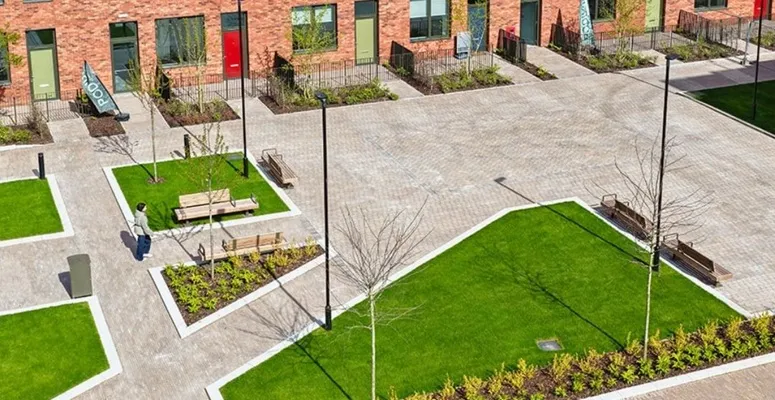
Wright Landscapes and Origin Green-tech were part of a Build-to-Rent regeneration development in Trafford, Manchester.
Lumina Village forms part of a wider 120-acre civic quarter regeneration masterplan, delivering approximately 4,000 homes alongside commercial space, infrastructure, and an enhanced public realm.
The Podium phase is a key part of this regeneration and comprises a 440-home Build-to-Rent development, including apartments and townhouses, with extensive podium landscaping, a half-acre rooftop garden for residents, and 5.4 acres of public realm.
Origin Green-tech supported Wright Landscapes with the supply of 350m³ of Green-tree Intensive Roof Garden substrate for the podium and roof level landscape construction.
The roof and podium structures required a specialist growing medium that would meet strict technical criteria, including:
Reduced load to comply with structural loading limits
Consistent drainage performance for roof build-ups
Long-term plant health and rooting stability
Suitability for intensive and semi-intensive roof planting systems
Compliance with the approved landscape specification and design intent
Joe Jeavons, group marketing manager for Domis Construction, says,
“Completing Lumina Village is a significant achievement for everyone involved in delivering the scheme. As one of Trafford’s most ambitious developments, we are proud to have delivered this project alongside Glenbrook Property and to see it now forming a lasting part of Trafford’s regeneration.
The commitment shown throughout has been exceptional, and the collaboration, technical expertise and reliable supply chain support have all played an important role in the successful delivery of the podium and roof landscape elements.”
The regeneration of York Central has seen significant progress with the submission of a planning application for a large proportion of the first phase development.
The proposal plans submitted include the first tranche of homes, commercial space and parkland within the development, as well as extensive public realm and a brand-new western entrance to the railway station.
The £2bn has already secured outline planning approval, which is being brought forward by joint venture development partners McLaren Property and Arlington Real Estate, Homes England and Network Rail in collaboration with key stakeholders, the City of York Council and the National Railway Museum.
Tom Gilman, managing director of McLaren Regeneration says “this represents another milestone in the planning and delivery process and demonstrates the continuing momentum of this exciting project”.
The latest designs for York Central are being delivered by a team of architects including Allies and Morrison and renowned landscape specialists Grant Associates, to design the scheme.
Peter Chimel, director at Grants Associates also comments:
“We’re looking forward to continuing our collaboration with the partners and communities to help deliver a vibrant, green and resilient new neighbourhood for York – one that celebrates interconnectedness and focuses on community and inclusivity.”
As Manchester’s high streets have already seen major investment, other schemes are also being brought forward for regeneration.
Across the city, areas such as Moston, Gorton, Withington and Wythenshawe have already seen major investment for public realm improvements, new homes and active spaces.
Strangeways and Cheetham Hill regeneration plans are now beginning to unfold, with 7,000 new homes, increased commercial floorspace and public space improvement.
The first developments within the Strangeways area are already on site, including the Brewery Gardens project by Clarion on Trinity Way, providing 505 new homes.
Communities in and around the Strangeways and Cambridge area were consulted during a nine-week period earlier this year. Respondents supported the regeneration vision to create a safe, vibrant and sustainabile community.
Councillor Gavin White, Manchester City Council executive member for housing and development comments on the regeneration plans:
“Manchester City Council are bringing forward an ambitious programme of investment across the local high streets in our city. Already there are some great schemes underway.”
There are also focussed neighbourhood management interventions in Fallowfield, Longsight and Rusholme.
Since two major regeneration proposals have been unveiled for Moston Lane in Manchester, the council invites interest from the development market to deliver affordable housing and a new public square.
Underpinned by the Neighbourhood Development Framework (NDF) adopted in 2023 that looks to enhance the area to support the community.
Central to the proposal, the public square is expected to allow markets and community events, with new seating, lighting, trees and planting.
The framework also indicates 80 new homes, including social and genuinely affordable tenures.
Bev Craig, leader of the council, explains “currently missing is a space that creates a proper focal point on the high street and the new public square will be somewhere local people can come together, put on events and take pride in their district centre”.
A £25m investment in the Moston community, the Manchester projects are part of a pipeline worth around £90m.
Rainton Construction Scotland has begun works on the £220.5m transformation of Glasgow’s George Square and surrounding streets.
Part of the Glasgow Avenues Programme, the regeneration has been funded through the Glasgow City Region City Deal.
Works across the project will include upgrading all surfaces with natural stone products, installing sensory play areas with new seating and rain gardens, installing a raised lawn platform and introducing new tree species such as gingko, rowan and sweetgum.
New lighting will also be fitted to create flexible event space for local communities.
Neil McCallum, managing director of Rainton says the project promises to deliver “a revitalised George Square blending heritage, sustainability and modern civic life”.
Home to a new amphitheatre area and Phoenix fountain, the space is expected to be an ideal event space.
Tudor Evans, council leader, says the opening of the first phase of this project shows “a sense of meticulous workmanship on show and the thought that has gone into the planting”.
Carried out by contractors Morgan Sindall, the public space features wildflower beds, granite paving, new stonework and a new cycle route.
To celebrate the opening, Plymouth City Centre Company is organising an Amphitheatre Fun Day on Saturday 9 August 2025.
The finished scheme is on target to be completed in early summer 2026.
Leeds City Council has launched the Elland Road 2025 Informal Planning Statement outlining regeneration plans for the 30 acres of land surrounding the football stadium.
The regeneration could deliver a multi-billion pound boost to the city’s economy, including 2,000 new homes, community sports arena, hotel accommodation and work spaces.
Promising a high quality public realm, the area’s new facilities will be integrated within the surrounding existing communities.
The proposal also outlines the relocation of the temporary park and ride with the introduction of a new multi-storey car park, subject to demand, to improve parking restrictions.
The council also proposes to improve interconnectivity between Elland Road and the city by introducing walking and cycling routes.
Councillor Jonathon Pryor, deputy leader and executive member for economy, transport and sustainable development comments:
“Our proposals for Elland Road represent a once-in-a-generation opportunity of national significance to create a new neighbourhood, carefully integrated within South Leeds.”
The development of the site could take up to 20 years, while the council will begin writing to local residents to understand their expectations regarding any concerns.
City Quays Garden opens as part of Belfast’s waterfront regeneration, designed by international landscape architects Gillespies.
The 2-acre garden opens as the centrepiece of Belfast’ Harbour’s City Quays development, reimagining the city’s docklands.
The biodiverse garden has been transformed from an underused car park, with 89 new trees and integrated rain gardens with seasonal planting that help manage storm water on-site.
Featuring open lawns with amphitheatre-style seating, picnic areas, the garden offers a space for local residents, workers and visitors.
Graeme Johnston, Belfast Harbour’s property and place director, comments:
“Our vision for the Gardens was to create a vibrant green space to transform the public area around the City Quays development and better connect the Harbour Estate to our neighbouring communities.”
The ‘Gateway Nest’ structural pavilion stands at the centre of the garden, featuring lighting to aid wayfinding.
The waterfront regeneration project marks the first public space in Northern Irelands to achieve One Planet Living recognition.
Planit has been appointed by the Hull City Council to lead the development of a future vision for the city centre.
The creation of a new vision will be a key milestone in the delivery of Hull’s Community Plan 2024-34 and its ambition to build Hull’s role as a regional hub for enterprise, investment and growth.
Over the next six months, Planit and its wider team, will engage with Hull businesses, residents and stakeholders to develop a plan designed to stimulate the economy, respond to climate change and develop sustainable neighbourhoods.
“We want residents of our city to have a say in its future, a city they can feel proud of and a place where people want to live and visit,” says councillor Paul Drake-Davis, portfolio holder for regeneration at the council.
“Alongside ensuring our communities thrive, our city centre must thrive alongside it. We have set out to create a new long-term vision for the heart of our city that makes the most of its assets.
“The new vision will build on existing plans to use the city’s strengths to create a thriving economy with job opportunities for everyone and a healthy place to live with access to affordable housing, green spaces and great opportunities to experience our culture and heritage.”
The master planning work has been funded by a £19.3m government programme which aims to unlock target areas and continue with the regeneration of the city centre.
Director of urban design at Planit, Andy Roberts, adds: “It’s such an exciting time for this legendary maritime city which has great historical significance, not only for the UK, but the rest of the world.
“Committed to a regenerative future, we are passionate about preservation and building cities that can adapt. We’re delighted to play a central role in Hull’s development.”
Hull is not the only city Planit have been involved in lately, with public consultations having closed at the end of September on plans for a former retail site in Manchester.
Solihull Council and placemaker Muse have signed a development agreement to regenerate Mell Square, following council approval last month.
The proposals include new public spaces, leisure facilities and homes as part of the wider Solihull Town Centre Masterplan.
Muse were chosen as the preferred development partner back in October 2023, and the council praises Muse for having an enviable reputation for regeneration and development across the UK.
“This is really great news for Solihull and the future of our town centre,” says councillor Ian Courts, leader of Solihull Council.
“This development agreement means that we are entering a crucial phase of the regeneration.
“I’m really pleased to see a strong focus on new housing as part of Muses’ proposals. It’s so important that we can provide a range of properties for our residents, from starter homes onwards.
“Bringing more people into our town centre can only be a boost to our local businesses and the wider economy.”
A series of public engagement activities took place earlier this year, including online surveys to gather input from Solihull residents and businesses on the future of Mell Square.
This engagement is ongoing, with an in-person event on 16 November from 10:00 to 17:30, while feedback can also be submitted online.
Elsewhere, Muse have recently been announced as part of a public-private partnership to deliver 3,000 low-carbon, low-energy affordable homes for the rental market.