David Keegan reflects on RHS Chelsea Flower Show 2026 calling for more recognition for landscapers and debating the presence of AI.
It’s that time of year again – the pinnacle of the horticultural calendar: the RHS Chelsea Flower Show. And yet, I find myself thinking about MasterChef.
Specifically, what the programme would look like if we stripped out the part where chefs select their ingredients and craft their dishes – if we were shown only the final plate. Beautiful, immaculate… but entirely disconnected from the process that made it.
Because that, increasingly, is what Chelsea feels like.
We are presented with finished masterpieces – sumptuous, polished, photogenic – but the people who physically build them, whose skill transforms a muddy plot into a show garden in just two weeks, remain largely invisible. The landscapers quite literally make the show, yet they are rarely seen or meaningfully acknowledged.
Speak to almost any landscape professional and they will tell you: building a garden at Chelsea is the pinnacle of their craft. And yet, for those achieving it, the recognition is minimal. This is especially puzzling given that judging weighs heavily on the quality and precision of the build itself – the translation of design into reality.
I saw this firsthand in 2005, working on one of Diarmuid Gavin’s Chelsea show gardens as part of the BBC2 Garden School programme. As a complete novice, I was struck by the sheer level of craftsmanship required to create the illusion of permanence – gardens assembled in a matter of days that appear to have settled for years. Plants stood in hidden pots, hard landscaping was meticulously detailed, and every element contributed to a seamless final impression.
It was, quite simply, extraordinary work. And yet, that work remains largely in the background.
This year, Peter Gregory Landscapes – who build most of my own projects – completed their seventh Chelsea show garden and were awarded Best Construction for this year’s install: a significant achievement by any standard. But even with multiple builds and awards to their name, Gregory readily acknowledges that landscapers at Chelsea – and across RHS shows more broadly – receive little public recognition. The spotlight remains fixed on the designer.
What makes this even more striking is the scale of what’s being achieved. The garden that won Best Construction in 2026 was built by just two people: Gregory himself and his assistant, Thomas. Around them, comparable gardens were delivered by teams of up to ten.
Of course, it’s also worth noting that most gardens are planted by teams of specialists who swoop in once the hard landscaping is complete – and they, too, receive little mention or attention. But that’s a whole other article, and one that doesn’t resonate with me to the same degree, given I do my own plant selection and set out on all my projects.
That disparity matters – because it speaks directly to a broader issue.
As a designer, it might seem counterintuitive to champion landscapers so strongly. It’s not though as I started out as a designer builder myself installing and working on the install of my early designs. But the reality is also this: we are facing a serious shortage of skilled landscape professionals. Demand for high-quality garden builds continues to grow, but the workforce is not keeping pace. That should concern everyone in the industry – from the RHS and the BBC to designers, contractors and professional bodies.
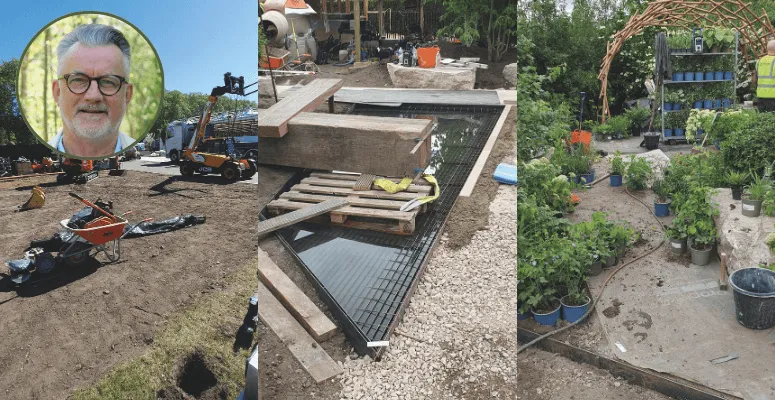
What’s missing from Chelsea – and from much of its media coverage – is the how. How are these gardens built, never mind the fact that they are then deconstructed in just three days? What challenges are faced on site? What problem-solving, collaboration and expertise are required?
I would say there’s a whole untapped program in there of itself, but surely, at the very least it’s not too much to ask that daily coverage includes even a short segment dedicated to the build process – profiling the teams behind the scenes, documenting the pressures, and giving proper credit to the craft. Because the reality is far from glamorous.
During build week, delivery lorries can wait hours for site access, sometimes leaving altogether before unloading. Schedules are tight, conditions demanding, and the margin for error almost non-existent. These are not just aesthetic achievements – they are feats of logistics and technical skill.
And yet you would struggle to find more than a passing mention of this in the RHS official Chelsea Flower Show guide. Yes, landscapers are credited – but no more prominently than any other contributor, despite their central role in realising the gardens themselves. This was my main concern – until another, not disconnected, issue emerged: AI designed gardens.
In the days leading up to the show, headlines announced that AI-designed gardens would feature at Chelsea. When one designer was asked to respond, the reported reaction was bleak: “Point me to the nearest job centre.” My response is different – but no less serious.
The debate around AI in garden design is not just about creativity – it is also about consequence. At a global level, the environmental cost of AI is significant, driven by energy-intensive data centres and resource-heavy polluting infrastructure. Closer to home, there are practical implications too.
Take the argument that AI opens garden design to a wider public – those who may not otherwise engage a professional. On the surface, it is an appealing idea. But in an industry already struggling with a shortage of skilled landscapers, increasing demand without increasing capability creates a dangerous imbalance.
That gap will not remain empty for long. It will be filled – often by less experienced or less scrupulous operators, cutting corners and compromising standards.
Even now, AI struggles with the fundamentals. It cannot reliably produce detailed planting plans or construction drawings – the very elements that underpin a successful garden. Design is not simply about visual composition; it is about buildability, context and long-term performance. And then there is the question of originality.
Garden design is a creative discipline. Ideas are shaped by experience, observation and intent – not assembled from datasets. The risk with AI is not just inefficiency – it is dilution: a gradual erosion of authorship, replaced by iterations of what has already been done. Garden and landscape design is an emotional and contextual creative process that no AI can replicate.
Perhaps I am placing too much weight on this year’s AI debut. Chelsea has always embraced innovation, and not every idea endures. Last year’s concepts have already faded quietly from view. This one may follow the same path. But it may not.
By allowing AI into the showground, the RHS is signalling acceptance – if not endorsement. More broadly, we risk drifting into a passive acceptance of technology as inevitable. It isn’t.
There are already examples of resistance – communities pushing back against the environmental cost of AI infrastructure, challenging the assumption that progress must come at any cost. The same principle applies here.
AI has its place – but not everywhere. And certainly not, in my view, at the expense of skilled craftsmanship and creative integrity.
Because in the end, Chelsea is about more than spectacle. It is about people – their expertise, their judgement, their hands. And that is something no algorithm can replicate.
May marks Skin Cancer Awareness Month, but for those working outdoors across landscaping, construction and the wider built environment sector, the issue extends far beyond a single campaign window.
At Long Rake Spar, this year’s awareness initiative has been inspired by the experiences of group sales director, Shane McCormick, a three-time skin cancer survivor whose personal journey has helped highlight the importance of better UV protection awareness across outdoor industries.
Having spent years working outdoors earlier in his career, often without sunscreen or adequate UV protection, McCormick understands first-hand the risks many people in the industry still unknowingly face every day. Sun protection simply was not something routinely discussed when he started out.
Hard hats, steel toe caps and high-vis became standard PPE. Sunscreen did not.
That mindset is something Long Rake Spar wants to help change.
Throughout May, the business has been supporting a wider awareness initiative focused on encouraging better UV protection habits across outdoor industries. The message is simple: prevention matters, early detection matters and protecting yourself at work should not be seen as optional.
Throughout the month, Long Rake Spar will also been sharing skin cancer facts, prevention advice and educational content across its platforms to help raise awareness of the risks associated with prolonged sun exposure for outdoor workers.
As part of the initiative, the business has partnered with LifeJacket Skin Protection, whose SPF 50+ SunGel products are being distributed throughout the campaign. LifeJacket has supplied both bottles and sample sachets of sunscreen to support awareness events and encourage better sun protection habits across the industry.
The campaign has already gathered momentum through several industry events and awareness activities.
On 11th May, McCormick attended the RHS Chelsea Flower Show during build, handing out sunscreen awareness flyers alongside LifeJacket sample sachets of SunGel and speaking directly with landscaping professionals about the importance of skin protection for outdoor workers.
As part of the wider awareness initiative, McCormick appeared on national morning television before travelling to Parliament later that day to continue raising awareness of occupational sun exposure and the need for greater education and policy change around skin cancer prevention.
That same evening, McCormick saw a more light-hearted, but equally meaningful, part of the initiative take place, as Long Rake Spar faced Tippers in a charity football match aimed at raising both funds and awareness for the cause.
Shane McCormick says:
“If this campaign encourages just one person to get a mole checked or start protecting their skin properly at work, then it has done something worthwhile. Landscaping and construction professionals spend huge amounts of time outdoors and too many people still underestimate the risks.”
Funds raised from the match and during skin cancer awareness month will support Cancer Research UK through the campaign’s JustGiving page.
For Long Rake Spar, the campaign is about using its platform to encourage conversations that could genuinely help save lives.
Around 86% of skin cancer cases are considered preventable, yet skin cancer rates continue to rise in the UK and outdoor workers remain disproportionately exposed to prolonged UV radiation through the nature of their jobs.
The hope is that initiatives like this help shift the culture. Last year, Long Rake Spar installed sunscreen stations across its production sites, allowing outdoor workers to apply and reapply sunscreen throughout the working day. Sunscreen is also made available to drivers arriving on site.
The business hopes more companies across the landscaping and construction sectors will follow suit in taking practical steps to help protect their workforce.
Whether that means keeping sunscreen in vans, encouraging teams to wear hats and UV-protective clothing, recognising suspicious skin changes earlier, or simply reminding colleagues to take sun exposure seriously, small changes can make a significant difference over time.
As an industry, we are very good at looking after one another when dangers are visible. Skin cancer is often less obvious, slower developing and easier to dismiss. That is precisely why awareness matters.
As artificial intelligence grows its presence across many creative professions, Andrew Duff, chair of the Society of Landscape Designers (SGLD) makes it clear how important garden designers remain to be in spite of AI.
“Garden design is an art form,” Duff starts, and while technology may offer useful tools, “it cannot replicate the insight, empathy and personal engagement that comes from working with a skilled garden designer to create a living, evolving natural space within the home.”
As new technologies bubble ahead of RHS Chelsea Flower Show 2026, including Spacelift, a new AI-assisted garden design platform for homeowners, Duff admits “AI may become a useful tool for inspiration, visualisation and concept exploration, much as CAD evolved to support the design process,” but makes it clear:
“It [AI] cannot replace the human understanding, creativity, accountability and experience that sit at the heart of successful garden and landscape design.”
Launching at Chelsea, Spacelift has announced its founding retail partner has been signed by Hillier Nurseries and Garden Centres.
Other AI-powered technologies across the industry include Nick Ruddle’s Landscape AI Assistant, designed to help landscaping businesses unlock practical, achievable growth.
While AI has a potential to replace creative professions, it also enhances risk of unrealistic expectations spread across platforms such as social media. According to a study undertaken by tech and AI researcher Everypixel Journal, 34 million images are generated using AI every day. Standing at 1.4 million images an hour and 23,333 images every minute, the amount of content flooding the algorithm is growing as 71% of images on social media are now AI-generated. Garden designers such as Rachel Platt and Elohim Tisserand explore how they’re maintaining expectations amongst the surge, while planting specialist Rae Wilkinson discusses the environmental concerns that follow in tangent on pages 53 – 55 in Pro Landscaper’s May issue.
Recent global environmental research that finds AI has released as much carbon dioxide into the atmosphere in 2025 as the whole of New York City, as its water usage overtakes that of the entirety of the global bottled-water demand.
As the UK’s professional body for garden designers, the SGLD “will continue to champion the standards, skills and value of the profession while supporting members in navigating a changing landscape,” finishes Duff.
Entitled ‘Beautiful Biodiversity’, the garden intends to demonstrate that ecological integrity and refined aesthetics are not competing priorities, but natural partners.
Created collaboratively between SGLD members Eliza Gray and Bo Cook, the installation invites visitors to reconsider how beautiful planting and materials can work hand-in-hand with biodiversity.
Built by Landesign, the garden will feature Zinc planters, limestone, reclaimed timber, the design increase planting density per square metre while creating a textual landscape.
A diverse range of habitats will be integrated across the garden, including log piles, leaf litter, aggregates, a gabion bench and manmade insect habitats.
Cook says the “random colour palette, messy edges, and scrubland style that tends to be associated with biodiverse landscapes is wonderful, but we want to show that aiming for a biodiversity rich garden needn’t mean having something overwhelming, or that requires a large space. It can be balanced as well as environmentally friendly.”
Gray also comments:
“We want to demonstrate that biodiversity doesn’t have to look wild or chaotic.“With careful design, thoughtful plant selection and considered materials, you can create a garden that feels refined and uplifting — while genuinely supporting wildlife.”
The design pair are also exploring the possibility of introducing a soundscape to create a more immersive experience.
If you’d told me – as a fresh-faced 18-year-old – that one day I’d work in the landscape industry, I’m not sure I’d have understood you. And if you’d revealed that at age 40 I’d have a garden at RHS Chelsea Flower Show, I’d have laughed you out of town.
At that age I was following the path expected of me. A Levels, then a degree in an unimaginative extension of two subjects I’d been studying for years: English and French. At graduation I went straight into public relations, worked in Paris for a bit, and then continued on that route until I’d had enough 12 years later.
Just before our son was born, my husband and I bought a house with a garden in east London. It was then my interest in plants and green space developed. I worked with a designer to transform the space and the process really intrigued me.
I did a quick course at City Lit to see if I enjoyed the subject (and was any good at it). And in 2017 decided to study garden design at Capel Manor College. I was keen to quickly grow my portfolio, network and learn on the job. So I started designing small London gardens, joined the RHS as a volunteer and had my first show garden (a 9m² border) at BBC Gardeners’ World in 2018. I had a minuscule budget and borrowed my plants from the very generous Ed at Cotswold Garden Flowers.
When Covid hit, it was a difficult time. But it’s hard to argue that it didn’t also bring a boon to the landscape industry. As people spent more time – and money – outside, I was able to grow my business. Then never keen to sit still, in 2021 I enrolled on the planting design diploma at London College of Garden Design (LCGD) to continue the studies I’d started at Capel Manor.
This really changed things for me. Led by Andrew Fisher Tomlin, we learnt so much about how to design with plants. Best of all, my final project – an imagined planting design for Sadler’s Wells East in the Olympic Park – later turned into that Chelsea garden, sponsored by Project Giving Back.
Now that was an experience I will never forget. Despite the sleepless nights and the odd frustrated tear, it introduced me to so many great people: contractors like Big Fish who built the garden, the team at How Green who grew most of the plants and all the designers, makers and artists I collaborated with on the project or got to know around the show ground.
Since then I’ve focused my business on planting design, collaborating with garden designers, landscape architects and contractors. Planting design is my favourite piece of the landscape puzzle so after graduating from LCGD I decided to develop that niche. Over the past few years I’ve worked with the likes of McWilliam Studio, Lucy Conochie Design, Garden Design Collective, Dutch Landscape Architects, Joanna Archer Garden Design and Rigden Studio on stunning projects across the UK. And I’m now also a visiting tutor on the Garden Design and Planting Design diplomas at LCGD.
Thinking back, I’m not sure I’d have told 18-year-old me to stop what she was doing. Careers are rarely a straight line these days and so many of things I learnt in my first career are relevant to this one. My piece of advice for anyone early in their working life is just keep your eyes open to the opportunities and don’t be scared to try things you’d never dreamed of before.
After five years of funding gardens at RHS Chelsea Flower Show, Project Giving Back (PGB) marks its final year at the show with a feature garden designed by James Basson.
The feature garden intends to celebrate PGB’s legacy after working with numerous charities across the UK.
Basson of Scape Design brings a landscape never seen before at RHS Chelsea, featuring towering red sandstone cliffs, coloured by natural ochre pigment with climate resilient planting.
Basson explains the garden takes inspiration from the ochre mines of Roussillon in Provence, Southern France. “The garden presents a powerful image of quiet regeneration. These mines were once heavily damaged landscapes but over time, through natural succession and soil regeneration, an extraordinary landscape has emerged.”
To be built by Mark Whyman Landscapes, Basson also looks forward to working Kelways Plants for the garden, too.
“I wanted to bring a little of its drama and raw beauty to RHS Chelsea, and I feel that its unique story provides an appropriate backdrop for Project Giving Back to celebrate its legacy and inspire others to give back in their own way.”
Hattie Ghaui, chief executive of PGB also comments on the garden at this year’s show:
“This garden reflects what Project Giving Back set out to do – and what we are proud to have achieved in a relatively short period of time.”
Clare Matterson, director general of the RHS says “we are proud to have partnered with Project Giving Back and look forward to seeing how its legacy continues to inspire new approaches to supporting gardens and communities in the years ahead.”
The garden designer was last at RHS Chelsea in 2017 for M&G Investments, winning RHS Gold and Best in Show.
Landscape and garden designer, Patrick Clarke is making his return to RHS Chelsea Flower Show next year with a garden in support of children’s mental health.
Announced at the RHS Autumn Press Conference this week, Clarke will be partnering with The Children’s Society to create The Children’s Society Garden, a space that is wholly usable for teenagers and children.
Speaking on why he chose this garden to make his return, Clarke says:
“When I heard about what they were doing, what [the society’s] story was, I was just utterly inspired by its work, because by its assessment, there is a happiness rescission amongst young teenagers and young people in the country at the moment.”
In response to this the society has been establishing Time for Young People hubs in areas of need across the UK, where teenagers and children can access mental health support immediately.
The design – which takes inspiration from the Japanese concept ‘wabi-sabi’, the recrafting of discarded materials – is “essentially the outdoor version of [those hubs]; a garden of safety,” says Clarke.
“They get to essentially retreat, in one sense or another, into a space that we’re creating where they can be by themselves, they can be in a social space, or they can receive gentle mental health support as well.”
When speaking about his partnership with the society, Clarke says the project is something he feels is wholly “worthwhile” and “incredibly important”; raising awareness and advocating for the younger generation.
The Children’s Society Garden – which is being sponsored in park by Project Giving Back and built by Yoreland Design – marks Clarke’s return to RHS Chelsea.
His last garden at the show, The QVC Garden, exhibited in 2008. It was inspired by poetry and highlighted for its experimental combination of material and plants.
Planting will also have a prominent presence in Clarke’s 2026 garden, with a scheme that is divided into three areas – sunny, transitional and shade – each one featuring a variety resilient species.
Landscape and garden design practice, Studio Ikram will be taking the lead on the garden’s planting – many will recognise designer Humaira Ikram from her on-going ‘Comeback Kings’ series in Pro Landscaper magazine, where she shines a light on species she feels have gone overlooked for some time.
The Children’s Society Garden will be featuring at the RHS Chelsea Flower Show on the 19 – 23 May 2026, after which it will be relocated to a youth support centre in Leighton Buzzard, Bedfordshire.
Part of the landscaping company, The Outdoor Room, for over 15 years, James Sponder helped build the Avande Intelligent Garden at RHS Chelsea Flower Show in May. The director is next to sit in the hot seat for another round of quick fire questions as part of our Little Interviews series.
James Sponder Director at The Outdoor Room Built the Avande Intelligent Garden at RHS Chelsea Flower Show
If you could work anywhere in the world, where would it be?
It would have to be Australia as I have always wanted to go and love the outdoor living over there.
If you could tell your younger self one thing, what would it be?
Let your dreams grow as you do.
What would the title of your biography be?
Landscaping Legacy.
Who would play you in a film?
My wife would say it’s Jude Law, but growing up my friends always thought I looked like Ivan Drago from the Rocky films.
One thing that would make the industry better?
Try to work more environmentally friendly and reuse materials when possible. Also, use technological advancements such as AI. I recently used forms of AI for the Avande Intelligent Garden at RHS Chelsea which will help save plants and trees.
Who has been your biggest inspiration?
I have been inspired by working alongside a variety of amazing people in day to day landscaping projects. I’m also inspired by the innovative creations at RHS Chelsea.
What’s your go-to karaoke song?
Mr Brightside by The Killers.
All time favourite film?
American Sniper.
What is your favourite RHS garden this year?
Avande Intelligent Garden at RHS Chelsea Flower Show that The Outdoor Room built for Tom Massey. It was amazing to build, with some incredible craftsmanship and on top of this, I loved the plants because they tasted of beef flavoured crisps.
After earning a Silver-Gilt Medal at RHS Chelsea Flower Show back in May, the ADHD Foundation Garden has now found a new home at the University of Liverpool.
Relocated to the University’s south campus next to the Yoko Ono Lennon Centre and Brett Building, the garden intends to provide a space for visitors, students and staff.
Professor Tim Jones, University of Liverpool’s vice-chancellor opened the garden, highlighting “this is more than just a green space – it’s a symbol of inclusion”.
“I hope this space provides neurodiverse individuals with a moment of calm and the freedom to be themselves.”
The University also hosts the ADHD Foundation’s Neurodiversity Umbrella Project featuring a display of over 100 umbrellas located on University Square.
The nature of writing for a magazine is that my piece is written sometime ahead of publication. As such, I am writing this shortly after press day at RHS Chelsea Flower Show. You may well have visited or seen the show on TV and have your own opinions on this show and probably shows in general. I attend most of the larger flower shows each year to see clients, support gardens and designers that we have produced plants for and connect with friends and colleagues in the industry.
Often work is picked up for shows a year away during these visits, which is a good time to start the process allowing for plant growth and accounting for space on the nursery. I enjoy shows particularly for the nurseries and new plants being show-cased. I like the gardens, but after visiting shows for nearly two decades, a lot of what I see, I have seen before. That isn’t a criticism of designers; there are, after all, only so many ways you can build or use plants. I think RHS Chelsea 2025 was a good show for a number of reasons, with interesting and innovative uses of resources and construction techniques in particular.
Matthew Butler and Josh Parker’s rammed earth building in the Garden of the Future I thought was particularly successful. I followed the planning and development of this garden, and my eyes were opened to the possibility of using rammed earth construction in the UK. The Eden Project has utilised this construction technique for over 20 years, so there clearly is a place for it in the UK generally.
This along with other approaches to construction and plant selection showcased an approach to environmentally sustainability well beyond simply a focus on rewilding being the only or best strategy for managing land. I’m not advocating against rewilding at all, but I think it is only part of the picture for an ecologically balanced future of land use. I think the balance between designed spaces and a clear focus on the environment was better realised than ever before at this show.
The Seawilding Garden by Falkirk-based designer Ryan McMahon undertook a very difficult challenge of being the first Chelsea garden (possibly any show garden, anywhere) to create a marine aquatic environment and show sea grass as a highlight to rewilding projects undertaken in Scotland. If you know me, you’ll know that I am a big advocate for rewilding the seas as a hugely impactful environmental need.
As a garden coming out of Scotland I loved it. As an example of strong message design, I loved it and as a design I thought it was excellent, also showcasing lots of interesting and in some cases endangered native flora.
Show gardens can be hugely controversial and indeed I agree that some gardens get way more publicity and airtime on tv and in the media than others for no good reason. I do think that shows have a constant question to answer on sustainability, legacy relocation, and their carbon footprint to construct. I think that much of these issues are better handled than ever before, but there is still more to do. For me, show gardens are important to raise issues, to showcase charities and organisations and to progress our knowledge of plants, gardens and design aesthetic.
Three more things I would like to showcase in this piece are;
Scotland was very well represented in this Chelsea, with Fettercairn Wilderness Retreat (Amazing Whisky!), Seawilding Garden, Hospitalfields Arts Garden and my favourite of all for their joyous message and wonderful people, the Down’s Syndrome Scotland Garden (the celebrations gave me a lump in my throat). Nurseries including Kevock Nursery and Letham Plants and more putting on stunning displays. Well done Scotland for representing so brilliantly at the show.
The amazing stand and displays in the Floral Marquee, with my top three being the Meconopsis Group’s superb communication of how to grow and maintain as well as explain the genus. The Caley Brothers’ incredible display of mushrooms, which was really something to behold. Finally, (though there were a great many superb stands), the incredible display of Protea in The Cape Floral Kingdom South Africa display by Leon Kluge was jaw-droppingly beautiful.
The Plant of the Year competition delivered a great result for horticulture, with a unique, pink-flowered and sweetly scented Philadelphus ‘Petite Perfume Pink’ winning the award. A great new introduction to our plant palette, but also a celebration of the amazing plant breeder Alan Postill of Hillier Nurseries. Postill has been quietly introducing plants for a long time and many are excellent, well-known and widely grown in UK gardens. Plant breeders like Pstill never get enough credit, quietly working away on plants that can define a decade (Geranium ‘Rozanne’ for example in the 2010s).
Whether you love or hate shows, I’m sure you have good reasons, but I will argue that we need shows to highlight what horticulture and landscaping bring to the economy, the green economy in particular, to health and well-being, to sustainability, environmental and climate mitigation, to food production, and so much more. If we want higher wages, better recognition for the industry and general investment, we need shows, so the most important thing I believe we can do is steer them to communicate industry messages and engage rather than ignore.
As the curtains on major Royal Horticultural Society shows close for another year, there have been a few garden designers that caught our eye after excelling at different flower shows.
From winning Gold medals and People’s Choice Awards, we can expect bigger things coming next from this group.
Zoe Claymore
Making her debut at RHS Chelsea Flower Show in May, Zoe Claymore received a Silver gilt medal for The Wildlife Trusts’ British Rainforest Garden. Based on the depleting numbers of temperate rainforests, the garden also picked up People’s Choice Best All About Plants Garden. Voted by the public, her garden proved popular with Chelsea spectators.
Another fan favourite, the garden was also voted People’s Choice Award winner.
Landscape architecture graduate from University of Gloucestershire, March runs his own garden design business, BH Studios, with Hallie Abbott Trangmar.
Last year, March and Abbott Trangmar and Adam Rowley picked up a Gold medal and Best Long Border for A Pocket of Peace at RHS Flower Show Tatton Park.
Credit: RHS/Sarah Cuttle
Rachel Platt
Once a Pro Landscaper 30 Under 30: The Next Generation award winner in 2022, Rachel Platt designed a feature garden at RHS Wentworth Woodhouse. RHS Teenage Dirt Park is a skate park designed for young people, surrounded by meadow planting.
Runner-up for RHS Young Designer of the Year at RHS Tatton Park in 2022, Platt also continues to run her own garden design company; Rachel Platt Garden Design.
One to watch, Platt has been climbing the ranks for a few years now, we are seeing her reaching the top.
Ryan McMahon
Gold medal winner and Best All About Plants garden designer Ryan McMahon came out very successful at RHS Chelsea in May. His garden, Seawilding, was inspired by the landscape found at Loch Craignish on the west coast of Scotland.
After moving back to Scotland from Australia five years ago, McMahon continues his passion for garden design and is definitely one to keep an eye on.
Luke Coleman
RHS Young Designer of the Year, Luke Coleman sought success at RHS Wentworth Woodhouse with his garden, Drakkars Drift. Not only did he score above the other two young designers in his category by the judges, he also received People’s Choice Best Garden Designer.
Scooping up a Gold medal and Best Construction seals the deal for Coleman; a success in the making.
Currently based at his design studio in Edinburgh, he has previously contributed to other RHS gardens such as Tom Massey’s Resilient Garden at RHS Hampton Court 2023, and the Gold medal winning WaterAid Garden at RHS Chelsea 2024.
With the RHS Chelsea Flower Show in full swing, our readers take a moment to reflect on their favourite Chelsea garden from the last seven years.
A Letter from a Million Years Past 2023 Show Garden
Designed by Jihae Hwang, built by Botanic & Terra
“For me as an RHS judge, I was privileged to be able to walk onto the garden and suddenly feel myself immersed in an ancient landscape. The attention to detail made the garden feel authentic as if you were transported to the very mountainside that it represented.
“Moreover, I feel the underlying message of how we must protect earth’s biodiversity not just for the benefit of nature but for the benefit of humankind as well is a message that we ignore at our peril.”
Liz Nicholson, managing director, Nicholsons
Credit: RHS/Neil Hepworth
Arcadia 2021 Balcony Garden
Designed by Martha Krempel, built by The Landscape Consultants
“I know there are bigger gardens and vaster budgets, but this garden was about an escape from the bustle of city life, and it just sucked me in – not a horticultural technical term I appreciate but sometimes, a garden quite simply does that.
“The doors in the background were a standout feature, Krempel uncovered them from a dusty lock-up in Surrey, previously rescued from a palace in India destined for demolition and in storage for more than 20 years.”
Peter Donegan, garden and landscape designer
Credit: RHS/Sarah Cuttle
A Rewilding Britain Landscape 2022 Show Garden
Designed by Lulu Urquhart and Adam Hunt, built by Landscape Associates
“From the artistry that they did at the beginning, that black and white concept image, I thought was so provocative; to the fact it was such a freeing design. And I think sometimes modern life is too constraint, too boxy. I enjoy the garden’s aesthetic because I think we all need to be a bit more wild.”
Zoe Claymore, garden designer
Credit: RHS/Neil Hepworth
The M&G Garden 2018 Show Garden
Designed by Sarah Price, built by Crocus
“It’s hard to narrow it down, but Sarah Price’s gardens always stand out to me, because I’m really interested in the artfulness of the horticulture, not just the functionality, and that’s what she brings to her designs, and this one was very Mediterranean in style.”
Credit: RHS/Neil Hepworth
Nigel Dunnett, professor of planting design and urban horticulture in the Department of Landscape at the University of Sheffield
Editor’s choice
WaterAid Garden 2024 Show Garden
Designed by Tom Massey and Je Ahn, built by Landscape Associates
I know it’s a journalism sin to lay claim to a favourite anything, but this garden was one from recent years that stuck out to me. Water is a precious resource, and as our climate continues to change, we are often left with either too little or too much. Massey and Ahn’s exploration and demonstration of water conservation made this a standout garden at last year’s show for me, from the rainwater harvesting pavilion to the wildlife pond.
To celebrate Bridgerton season three, which debuted last May, the garden was designed by Holly Johnston in partnership with Netflix and Shondaland.
Now, the garden finds a permanent home at The Rosie Hospital and Addenbrooke’s wards at Cambridge University Hospitals (CUH) with the help from WT Partnership and Stewart Landscapes.
Period water fountain
Echoing the story of season three’s protagonist, the garden was “designed to tell a story of personal growth,” says Johnston. She is proud to open the fully accessible garden available for patients, staff and local communities with the intention of offering moments of calm and connection.
The original garden path has been widened to accommodate wheelchair users, while refining the plant selection. Capable of coping in high traffic environments, she has chosen to include lower maintenance shrubs, ornamental grasses and long-season perennials.
Johnston explains, “it was important to Netflix and I that this garden went on to have a community impact.” Planted with an annual spring bulb display, the garden intends to pursue local volunteers in its maintenance.
The moongate and and period water feature is positioned in the centre of the garden, with a hard carved stone sculpture at the rear.
During the ribbon-cutting ceremony on Thursday 15 May, both Johnston and director of corporate affairs at CUH, Ian Walker were accompanied by Britten Sinfonia; an orchestra that contributed to Bridgeton’s soundtrack.
Working together since its initial planting back in March, Walker describes the new garden as “a really important point of solace and support for visitors and staff in what can be a really sort of hectic environment.”
In “awe” of Johnston, Chandler thanks her and the landscaping team for bringing the garden to CUH.
Award winning garden and landscape designer, Zoe Claymore, marks her upcoming debut at the RHS Chelsea Flower Show with the publication of a new British rainforest gardening guide.
The book, British Rainforest – How to Guide, offers a step by step walkthrough to creating your own garden sized rainforest.
In the guide Claymore delves into three planting projects, each inspired by these precious habitats; including, planting lists and steps, through to the design rules Claymore followed to bring a slice of Dart Valley, Devon to RHS Chelsea.
The Wildlife Trusts’ British Rainforest Garden, which is set to feature at the show next week (20 – 24 May) in the All About Plants category, is inspired by temperate rainforests, native to the British Isles.
These woodlands once covered around 20% of Britain, but after years of deforestation their coverage has diminished to a mere 1%.
Claymore and The Wildlife Trusts are using the garden at next week’s show to spread awareness of the conservation charity’s work with Aviva to restore thousands of hectares of these habitats.
A portion of proceeds from every sale of the guide will go towards The Wildlife Trusts conservation efforts.
To purchase a copy and to get 15% off moss from Highland Moss, click here.




 Zoe Claymore


 Ryan McMahon


