by Holly Chapman | 07 Oct 26 | Commercial Landscaping, Domestic Landscaping, Landscape Architecture, Long Reads
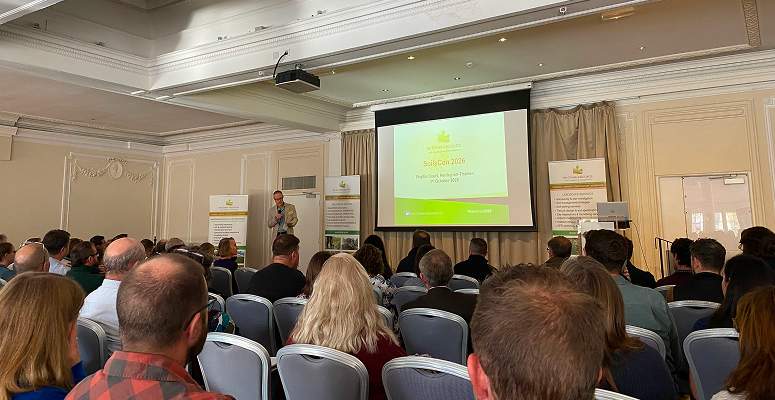
This year’s SoilsCon welcomed eight speakers who covered a variety of different topics, backed with case studies and personal expertise.
The event took place on 1 October 2026 at Phyllis Court in Henley-on-Thames, also hosting several exhibitors such as Bury Hill and the Woodhorn Group.
The seventh industry soils event organised by Tim O’Hare Associates (TOHA) invited landscape architects and specifiers, landscape contractors and designers, housebuilders and developers, ecologists, soil suppliers, local government officers, and professionals from across the wider industry for a day of discussion, debate and networking.
Co-founder and co-executive director of Sustainable Soils Alliance, Ellen Fay, kicked off the day with a discussion about closing the soil policy gap between farming and the built environment, before TOHA senior soil specialist Gill Shaw took to the stage to discuss all things Predictive ALC map.
Other sessions included TOHA’s Tim White, who spoke about best practice in soil management, while Gareth Phillips discussed amenity turfgrass and soil health.
Tim O’Hare and HTA Design’s James Lord outlined details of the Queen Elizabeth II Memorial Garden, which recently opened in The Regent’s Park.
On top of this, Chris Bridgman spoke about the importance and growth of green roofs, while director of Robert Bray Associates Kevin Barton spoke about biomimetic approaches to soils in sustainable drainage systems.
The day closed with a talk from Frosts Landscapes managing director Alistair Bayford, who let out a few ground truths in regards to the success of landscapes, which ultimately leads back to soil.
A few attendees outline their key takeaways of the day:
Paul Greenyer, new regional manager of the Association of Professional Landscapers (APL), says:
“It’s a fantastic event, firstly. Managing soil on site is a key thing which we need to do on all domestic gardens, and something the contractors may or may not be aware of the damage that we do when we start building gardens and the importance of protecting those soils. That starts with assessing the job site in the first place.”
Tony Benger of Tony Benger Landscapes says:
“I was very impressed by Tim White, and I 100% agree with what he spoke about. One item was pulling subsoiling wet clay and when I thought about what he was doing, I was really impressed. Of course that’s the right thing to do – so ripping the wet subsoil, then leave it to dry out, and then ripping it again, you can get a perfect tilth. So, I’ve learnt something! Which is great news.”
Oli Magnuson, design manager at Frosts Landscapes, says:
“Every site is different and soils need to be considered early to get the most out of the project and the planting schemes. Planting schemes can change and be developed for different soils, but if you know certain information initially, you’ve got a better chance of the project being successful.”
O’Hare also comments on the event:
“As the organiser of the event, I’m delighted that we’ve had such a big take up. We’ve got over 120 delegates here today and they represent such a broad range of the landscape industry, which is really rewarding. This emphasises the fact that soils are a big topic and it’s going to get bigger and bigger especially with the summers we’ve had, meaning its even more important to get the most out of our soils.
The biggest thing I’ve learnt from the day is that there is still a passion to learn, listen to expertise, ask questions and also challenge it. There’s no one way of doing anything and I think these sorts of events where people with different experiences, backgrounds and knowledge can come together and share that, while also challenging one another. It makes for good debate.”

by The Pro Landscaper Team | 18 Feb 26 | From the Mag, Long Reads, Nature & Biodiversity, News, Sustainability
Requiring developers to achieve biodiversity net gain (BNG) is a positive step towards protecting existing wildlife and creating new habitats.
But the UK government’s Statutory Biodiversity Metric is not a guide to habitat creation, rather a tool for quantifying a site’s biodiversity based on the distinctiveness and quality of the habitats present. It also factors in the difficulty of creating each habitat type.
Metric Condition Assessment criteria for many habitats set a high bar to achieve. A new sward, for example, needs to be a good representation as defined under the UK Habitat Classification System (UKHab) – so no more general purpose ‘Heinz 57’ seed mixes.
Other criteria put limits on the presence of suboptimal species, and the complete absence of certain non-native invasives. We have to assume that local authorities will audit BNG systems, with consequences for developers based on their findings, so new habitats need to be well planned and executed to avoid being rated ‘poor’, a la Ofsted.
In this context, the importance of soil fertility status for new and existing species-rich grasslands and the consequences of high fertility soils, whereby nutrients encourage the growth of aggressive plants, are well understood.
“Designing a scheme to match the in situ soils will always be easier than trying to change their inherent properties.”
Phosphorus seems to act like a growth steroid, boosting many plants to triple or more their normal size. It then becomes impossible to fit more than two or three plants per square metre, rather than the 10 per square metre required for a ‘good’ rating.
Understanding this limitation at an early stage and moving towards habitats that thrive on fertile soils, such as woodland and scrub, can prevent costly efforts to manage weeds. Beyond soil fertility, many UKHab habitats have specific soil requirements in terms of drainage, pH, carbonate, and soil thickness.
Beech woods prefer shallow, well-drained, alkaline, chalky soils, whilst neutral grasslands are found on heavy, non-calcareous, slightly acid soils with restricted drainage.
Designing a scheme to match the in situ soils will always be easier than trying to change their inherent properties so, for both on site BNG developments and off site BNG mitigation schemes, these wider soil factors should be determined early to inform the design.
A site-specific soil survey should be undertaken by a soil scientist – this includes digging small trial holes to examine the soil conditions and collecting representative samples for laboratory testing – to provide an interpretative report with the findings, enabling a clear understanding of a site’s soils.
Whilst generic soil data is available via on-line mapping services, this can be completely wrong and definitely would not pick up local variations that could, once identified, reveal opportunities to further enhance site biodiversity.
It is possible, in some circumstances, to create distinctive habitats using materials such as crushed brick and/or concrete, sand, and other demolition fines. These opportunities are best explored to create new, rather than replace existing, habitats.
Read the full February edition of Pro Landscaper here.
Tim White
Tim White, a professional soil scientist since 1999, is senior associate at Tim O’Hare Associates. He leads a specialist team providing technical soils input for BNG and has co-authored with nationally recognised Forest Research the Best Practice Guidance (BPG) document on ‘Soil Preparation for the Creation of Species-rich Grassland Habitats’. He has also contributed to several other BPG documents for specific grassland types.

by Holly Chapman | 01 Aug 25 | News, Supplier News
Environmental consultancy Tim O’Hare Associates (TOHA) has expanded its Oxfordshire team with the introduction of three new soil specialists.
Neema Kumar has joined TOHA’s in-house programme and will undertake duties across departments, ranging from desk-based research, site work and data collection after just completing her masters in soils and sustainability.
Set to deliver TOHA’s soil testing services, Ebony Gheorghe joins the team working on soil resource surveys, stockpile assessments and biodiversity net gain (BNG) projects. She also holds a masters, but in geological and environment hazards.
After working as an associate professor at Lviv National University in Ukraine, Nataliia Lahush now works in TOHA’s soil testing department classifying soils, determining their different characteristics and in-depth laboratory research.
Tim O’Hare, principal consultant at TOHA says the company’s new additions have “undoubtedly strengthened the knowledge and expertise we offer our clients”.
TOHA is set to host SoilsCon 2025 on Friday 26 September at Phyllis Court.

by Holly Chapman | 14 Jul 25 | Nature & Biodiversity, News, Sustainability
SoilsCon 2025 is taking place on Friday 26 September at Phyllis Court in Henley-on-Thames, Oxfordshire, with guest speakers and talk topics covering gardening, soil science and soil health in a landscape context.
Speakers include Tim O’Hare and Tim White from Tim O’Hare Associates, Max Aughton from Studio Egret West, BBC Gardeners’ Question Time panellist Bunny Guinness, Martin Knight of Studio Knight Stokoe, Cristina Refolo of Refolo Landscape Architects Ltd, SoilBioLab’s Simon Parfey and John Coles from Bury Hill Landscape Supplies.
The industry leaders will use live case studies to evidence the importance of soil health, building biodiversity, sustainable urban drainage systems and embracing the circular economy to achieve project success.
Tim O’Hare will discuss the practical applications of soil science for landscaping, while Max Aughton will talk through Mayfield Park and its design.
Bunny Guinness will talk about the need for simplifying gardening and how o improve space with maintenance and new techniques.
The conference will also include a soil surgery, held during the day’s networking periods.
Running from 9am until 4:30pm, lunch and refreshments will also be provided throughout the day, with tickets available to buy here.

by | 13 Sep 23 | Nature & Biodiversity, News
The red fire ant, Solenopsis Invicta, has been identified across 88 ant nests spread over 12 acres in the city of Syracuse, Italy.
The invasive non-native ant species is thought to have spread from the US or China. Now established in Italy, studies warn of its rapid spread through Europe and the UK as it is one of the most invasive and destructive species.
The red fire ant has a ravenous appetite, with the ability to destroy crops and known to pose a risk to native ecosystems, farming, and human health.
With a painful sting, injecting venom to its victim if disturbed, they can rapidly form “super colonies” with multiple queens.
The red fire ant is the fifth most costly invasive species in the world. It is able to live in urban environments using concrete to build their nests under.
Causing structural issues with buildings, these ants have also been known to attack electrical equipment after being shocked.
The EU has banned the export of soil from the UK.

