The Royal Parks charity has released its very first Horticulture Vision, set to reimagine the eight Royal Parks across London reflective of a changing climate.
Led by head of horticulture and landscape strategy, Matthew Pottage, the Vision identifies Central London’s heat island effect, and how the parks can be tailored into resilient spaces with a focus on soil health.
The heat island effect has produced a microclimate closer to the Mediterranean than the rest of the country, meaning the city is more susceptible to unprecedented weather such as drought, wetter winters and hotter summers. In response, the parks and their planting must change, whereby the Vision sets out a shift from the Victorian palette they once inherited, towards a more modern, exotic and climate-resilient one.
As part of the Vision, which extends until 2031, four horticultural projects have been revealed. Hyde Park’s Rose Garden will welcome 500 Rosa persica varieties, planted among 20,000 diverse plant varieties and up to 10,000 bulbs in pink and purple tones.
The Green Park will take inspiration from its former River Tyburn with a cascading flood of blue flowers throughout the park, planting thousands of camassia. Planted this autumn, the park’s first bloom will take place next April.
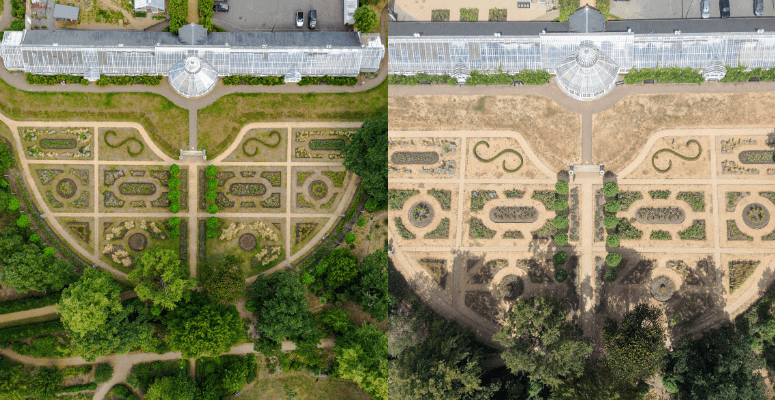
The Italian Gardens in Kensington Gardens will draw on historical photographs of planting, with heat-loving plants and a pool of waterlilies and lotus.
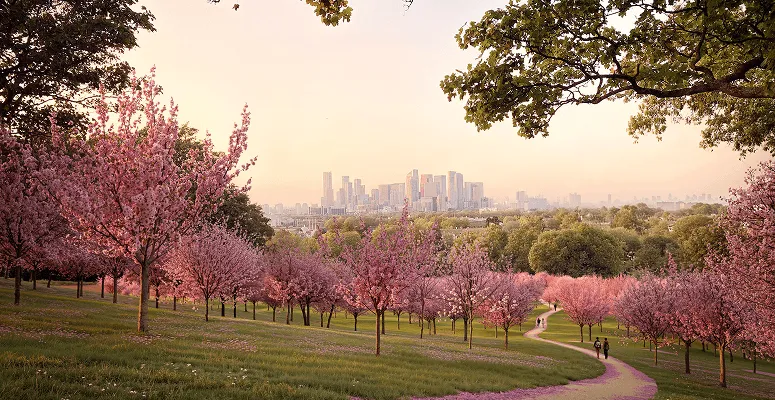
In Greenwich Park, a field of 130 Prunus ‘Sekiyama’ cherry trees will mature into a valley of blossom, set to give visitors a two-week spectacle of pink every spring.
Green ParkHyde ParkKensington GardensGreenwich Park Credit: KIN CREATIVES
Pottage comments on the Horticulture Vision:
“We are taking bold steps to adapt to a changing environment, diversifying species and experimenting to find what copes with extremes of heat, drought, frost and flooding. Central London gives us growing conditions found almost nowhere else in Britain, and we intend to use them.”
The Vision also features five key objectives: everyday wonder, creating iconic horticulture, diverse planting, respecting heritage and a sustainable future. “At its heart, the vision seeks to create moments of everyday wonder through beautiful, inspiring and distinctive planting that celebrates the unique character of each park,” adds Dr Linda Yueh, chair of The Royal Parks.
The National Lottery Heritage Fund and Historic England have published a new study on how prepared historic parks and gardens are when fronted with climate change effects.
With 71.3% of England already in drought, the driest July on record and increasing temperatures, historic parks and gardens are already suffering from a changing climate.
Chiswick, The Royal Parks, Princes Street Gardens and Royal Botanic Gardens, Kew employ over 32,000 people and contribute £2.9bn annually to the UK economy from international visitors alone. “But they are also on the frontline of climate change, with all already impacted, and there has been no research done into how managers are coping with the changes,” says Historic England.
With more intense and unpredictable rainfall, storms and severe dry spells, pests and diseases are already thriving. These shifts are affecting all aspects of designed landscapes including features such as trees, plant collections, habitats, paths, terraces, drainage systems and bodies of water.
Drew Bennellick, head of land, seas and nature policy of The National Lottery Heritage Fund, says:
“It’s clear our historic parks, gardens and cemeteries are facing unprecedented challenges due to climate change, and without urgent guidance and advice, many of these precious landscapes will suffer and change beyond recognition. As an organisation we are known for saving historic buildings, but the natural landscapes they sit in are equally, if not more, vulnerable to the shifts we are seeing in our climate, and equally as valuable. We hope that research such as this will help to save them for future generations.”
Darren Share, director of parks at The Royal Parks, acknowledges the impacts. He says:
“Following the stark reports of our driest July on record, and consecutive heatwaves this summer, it is clear that this is a moment of urgency. A united approach and shared guidelines will enable us to collaborate at a national level to adapt and futureproof vital historic landscapes in the face of a changing climate, so they are always here for everyone to enjoy.
“The Royal Parks is focused on creating climate-resilient parks for future generations by taking decisive action now. This includes diversifying tree and plant species; using adaptive and innovative horticultural approaches; providing more shade and cool areas during hot weather; improving water management so that we are not reliant on mains water and pursuing our ambition to eliminate all greenhouse gas emissions from our direct operations by 2030.”
All sites are actively responding in practical ways where their resources allow including working with strategic plans and prioritising actions to adapt to climate impacts in relation to heritage significance.
Chatsworth, however, has revealed that the drought has revealed the remnants of an ornate 17th century garden design normally hidden from view.
First opened in 2000, the Diana, Princess of Wales Memorial Playground in Kensington Gardens has undergone a £3m renewal.
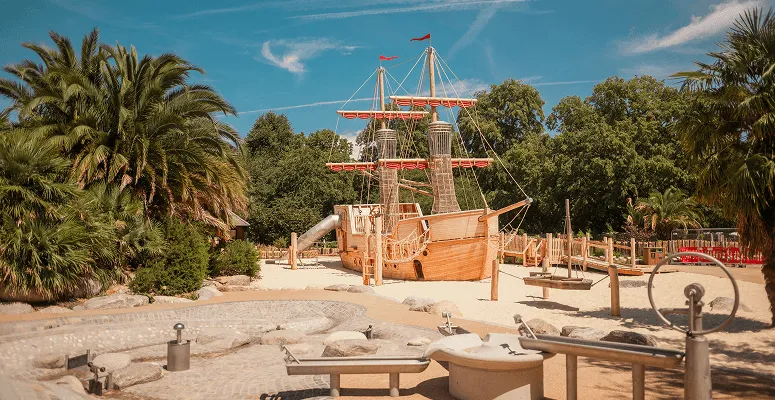
The Peter Pan inspired playground has been refurbished to include new equipment such as a 12-metre Galleon moored on a sandy beach, a treehouse and crocodile-themed waterplay area.
The playground’s team has been led by Royal Parks senior landscape architect Rhona Harley, working alongside principal contractor Ground Control.
Every aspect of the playground now has improved inclusivity and accessibility, featuring wheelchair accessible slides and areas inside the treehouse and Galleon, picnic benches and waterplay areas.
Sustainability has also been an important feature of the newly refurbished playground. New wooden play equipment uses timber from sustainably managed European forests, constructed by Timberplay, while the new waterplay feature allows runoff water to be collected and used for irrigation.
Surrounded by an array of biodiverse planting and landscaped areas, the playground also creates a space for wildlife, too.
Andy Williams, park manager for Kensington Gardens, comments on the new playground:
“This playground has been thoughtfully designed so that children of all abilities and interests can find something that appeals to them. Children can once again splash, swing, climb and hide in this almost two-acre playground set amongst sub-tropical planting.”
Open to the public from today, the playground has a capacity of 450 people, featuring toilets and a access to the cafe.
Jack Aldridge steps into the role of horticultural curator next month – the first-ever to do so with The Royal Parks charity.
Focussing on delivering exceptional horticulture for park’s millions of visitors every year, Aldridge will work across all 5,000 acres of historic parkland.
The Royal Parks charity currently manages London’s eight Royal Parks, including Hyde Park and St James’s Park, both of which hold iconic memories in British history. From hosting the Lionesses winning homecoming parade after the Women’s European Championship in 2025 to holding the first park run or Suffragettes meetings, the Royal Parks act as important green spaces in London.
Aldridge holds a wealth of horticultural experience, including working at RHS Garden Wisley and managing the four-acre woodland Oakwood. He says:
“I am looking forward to working with the team to support the shared aim of delivering wow-factor horticulture and developing a world-class plant collection throughout the Royal Parks.”
As he approaches the role in the coming weeks, he looks to diversify the planting “in response to the changing climate offers us an exciting opportunity to push the boundaries and experiment with what we plant within a variety of interesting microclimates, bringing joy to visitors and putting The Royal Parks firmly on the global horticultural map.”
Matthew Pottage, head of horticulture and landscape strategy at The Royal Parks also comments:
“We have no doubt that Jack’s [Aldrdige] extensive plant knowledge will help us create extraordinary displays that are not only beautiful, but also resilient, as we adapt to meet the challenges of a changing climate.”
In a special one-hour BBC Gardeners’ World episode hosted by Monty Don, viewers will be taken through the story of the Queen Elizabeth II Garden as it nears opening.
Airing this evening, Friday 17 April at 8pm, on BBC Two, the programme will document the two years of transformation the garden, located within The Regent’s Park, has undergone.
Soon opening to the public to coincide with the late Queen’s centenary year, London’s newest green space features a two-acre garden which was formally an unused plant nursery.
Created by The Royal Parks in collaboration with HTA Design and Blakedown Landscapes, the garden also includes a wildlife-supporting circular pond and a central flower garden planted with species significant to Queen Elizabeth II.
Fiona Pack, head gardener for the garden, comments:
“Having the Gardeners’ World team with us over two years, from the very first days on site to the final planting, has been incredibly special. We hope the episode gives viewers a real sense of the care, craft and passion that have gone into every corner of this garden, and that it inspires them to come and visit when we open on 27 April.”
The garden opens to the public on Monday 27 April.
A busy year for The Royal Parks, the charity has also recently introduced 130 Prunus ‘Sekiyama’ cherry trees, thanks to the support of the Sakura Cherry Tree Project, to Greenwich Park.
Hosted by The Royal Parks in The Regent’s Park, almost 200 members of the public planted thousands of spring bulbs in the new two-acre memorial garden for Queen Elizabeth II.
Still under construction, the garden welcomed guests for the first time for a behind-the-scenes tour whilst planting a variety of bulbs including tulips, alliums and grape hyacinths.
Fiona Packe, head gardener for the new garden says “planting these bulbs allows the community to leave a lasting mark on a space that will honour Queen Elizabeth II”.
The garden has been designed by the Royal Parks landscape team alongside HTA Design, with Blakedown Landscapes as the official landscape contractors.
Since its opening quarter of a century ago, the Princess of Wales Memorial Playground will undergo a major £3m regeneration, set to improve accessibility and inclusivity.
The Diana, Princess of Wales Memorial Playground is due to close on 3 November to make way for the improvement works, and is set to reopen in the summer 2026.
The Royal Parks charity, which manages London’s eight Royal Parks – including Kensington Garden where the memorial park is located – recently welcomed its millionth visitor to the park at a celebratory event where it revealed the renewal plans to the public.
Plans for the park, announced back in May, include the installation of a new replacement Galleon (the large sailing ship), which will now boast ramped access to the main deck.
As well as a new Treehouse made up of three towers at varying heights to provide climbing opportunities for different ages and abilities.
Both the Galleon and Treehouse will be constructed from timber from sustainable managed European forests, while some of the timber from the existing structures will be repurposed to create new fencing and seating.
Paying homage to its literary inspiration, a new stone covered crocodile structure, measuring in at around 12 metres long, will be take centre place in the redesigned water player area.
Additional play equipment such as a new seesaw, sandpit and more playships will also be built as part of the redesign.
Improvements will also be made to the park’s accessibility through the establishment of new wheelchair access routes amongst and on play equipment. Walkways are to be widened and resurfaced, as well as new wheelchair accessible picnic tables to be added.
Soft landscaping will also be rejuvenated with a new sensory planting pallet established.
Rhona Harley, senior landscape architect at The Royal Parks charity, comments on the revamp, saying:
“On the day of celebration, we were pleased to share with visitors how their views had informed the new designs of the Galleon, Treehouse and water play area. For example, recurrent feedback for the Galleon was that there should be more climbing elements, better access for all abilities and that we should bring back the sails. We have listened and incorporated all of these elements into the new design.”
The Royal Parks charity is undertaking a planting trial of hardy and pollinator-friendly plants that will go on to be part of a display to honour the life of Queen Elizabeth II.
The garden will be in The Regent’s Park, where a team of ten Royal Parks apprentices, together with gardeners, have planted 300 plants in a trial bed close to the proposed display.
The innovative approach involves planting 65 different species in the beds, containing two mixes of soil: both are made from a sustainable mix of site topsoil and recycled crushed concrete, with different percentages of concrete mixed within them.
By growing the same plants in these two distinct environments, the trial will compare their performance.
“We’re thrilled to conduct our first-ever planting trial for the new garden at The Regent’s Park,” says Anne Tuomisto, head gardener at The Regent’s Park.
“This is an exciting opportunity to advance our experimental approach to planting, by selecting species that can thrive in low-nutrient, man-made, sustainable soils while offering spectacular colour and biodiversity benefits.
“Testing this approach in real conditions is vital, and we’re eager to see the results.”
The trial focuses on plants that will be more resilient to the pressures of climate change, such as nepeta and phlomis, in an approach that will be integral to the garden’s sustainable design.
The Royal Parks’ gardeners have provided their expertise through the process, working alongside planting designer Noel Kingsbury who has selected the plants and HTA Design.
Over the next 12 months, The Royal Parks’ horticultural experts will closely monitor the trial and use the data to inform the final design of both the planting scheme and the soil composition for the new garden.
Sustainability is at the core of this project as, by repurposing materials like concrete, the garden aims to set a new standard for sustainable urban gardening, minimising waste and promoting eco-friendly practices.
Planning permission was granted last month, and the new garden is set to open in 2026 to mark what would have been Queen Elizabeth II’s centenary year.
The Royal Parks has marked the culmination of Greenwich Park Revealed, a project spanning several years that has restored the park’s unique 17th-century landscape.
The efforts have also created new learning and volunteering spaces, hosted more free events and community activities, and enhanced biodiversity.
The charity has funded the £12m project alongside a grant from the ‘Parks for People’ programme, funded by The National Lottery Heritage Fund and Community Fund.
Andrew Scattergood, chief executive of The Royal Parks charity, says: “Greenwich Park Revealed has been years in the making, from the seed of an idea over twenty years ago to the realisation of this vision in 2024.
“Thanks to the support of National Lottery players through The National Lottery Heritage and Community Fund, The Royal Parks charity has been able to accomplish the biggest project in its history and provide a better experience for all visitors.”
Previously at risk of being lost forever, the charity, which manages London’s eight Royal Parks, has restored Greenwich Park’s 17th-century landscape to its former glory.
This has involved re-establishing the ‘Grand Ascent’ – giant grass terraces created in the 1660s, that had almost disappeared due to heavy erosion.
The declining tree avenues have also been re-planted, and the slumped ‘parterre’ banks framing the Queen’s Field have been re-instated.
The project has futureproofed Greenwich Park to provide better facilities for visitors.
The improved viewing platform at the General Wolfe statue viewpoint has transformed this once-congested area into a larger, more accessible piazza-style public space to host community cultural events.
This dramatic history is played out for visitors through new information boards and over the coming year, these will be accompanied by a new interactive app and a set of audio guides.
The project has transformed part of a commercial contractors’ yard into a beautiful, landscaped public zone.
A new, sustainably built Learning Centre for outdoor education provides a safe and inspiring space for schools and community groups to discover the natural environment with nature trails, a dipping pond and a wildlife meadow.
Clare Lanes, park manager at Greenwich Park, says: “It’s wonderful to welcome everyone back to these much-loved and much-improved spaces in Greenwich Park.
“We have one of the best views in London, and now everyone will be able to enjoy it in a more accessible way. We hope everyone will enjoy visiting, whether for a walk, a coffee, or to uncover the fascinating stories of the park.”
The Royal Parks charity has awarded its landscape maintenance contract for The Regent’s Park and Primrose Hill to Gavin Jones Ltd, part of the Nurture Group.
Gavin Jones Ltd will have responsibility for conserving and enhancing The Regent’s Park’s horticultural displays at locations including The Queen Mary’s Gardens, The Avenue Gardens and St John’s Lodge Garden.
The company will be responsible for planting up to 76,000 spring bedding plants, 73,000 bulbs and 69,000 summer bedding plants each year. It will also employ and support The Royal Parks’ horticultural apprentices and volunteers.
The team will help protect and improve the park’s biodiversity, including the maintenance of meadows, acid grassland, woodlands and aquatic habitats.
Sustainability will also be a priority in the new contract, energy efficiency, renewable energy and efficient water use will be promoted throughout the sites.
As well as the continued roll out of an electric fleet of vehicles, green waste recycling and efficient waste management.
The Royal Parks’ director of parks, Darren Share, says: “By delivering excellence in landscape maintenance this park will continue to thrive as a vital green space in the city, to boost everyone’s wellbeing, now and in the future.”
Gareth Kirkwood, the Nurture Group’s chief executive officer adds that the company is “excited to contribute to the conservation and enhancement of these iconic landscapes”.
The contract will commence on 8 June and will run for up to four years.
Gavin Jones are holders of a Royal Warrant for being Landscape Maintenance Contractor to the Royal Household.
The Nurture Group was also recently recognised at the Pro Landscaper Business Awards, securing the Grounds Maintenance Company award and achieving the coveted Supreme Winner Award.
The Royal Parks charity, which manages Richmond Park- London’s largest royal park- has unveiled its proposals for a new café and enhancements to the surrounding landscape at Roehampton Gate in the park.
Proposals include improving the landscape in which the café sits in an effort to improve the site’s biodiversity.
The space will be transformed into an “environmentally excellent café” sympathetic to the landscape that surrounds it, says the charity.
The park’s current facilities are temporary structures put in place almost two decades ago after a fire destroyed the original buildings.
Additional improvements being made will also support increased footfall to the park, as well as offering a more family-friendly environment.
The charity will be holding three public engagement days to encourage local residents and park visitors to look at the plans and out forward questions or feedback.
Engagement days will take place 1-4pm, Thursday 4 April, 10am-1pm, Saturday 6 April at Roehampton Café, and 11am-2pm, Friday 12 April at Pen Ponds.
Visitors to the aforementioned days will have the opportunity to speak directly with members of the project team, including the Richmond Park team and The Royal Parks landscape team.
A world-famous illustrator best known for his work on a collection of Roald Dahl books has partnered with The Royal Parks to create illustrations for parks across London to encourage visitors to better appreciate green spaces.
The charity has commissioned 27 designs from Sir Quentin Blake to be used as signage around well-known London green spaces.
Signs can also be seen in Hyde Park and Kensington Garden, with plans to include the signs in Richmond and Greenwich Parks later this year. This project is part of a wider plan to improve signage and interpretation across all of London’s Royal Parks by 2026.
Head of visitor experience, Lucy Kellett says that “urban green spaces all face the same challenges such as littering, dog fouling and wildlife feeding. The charity hopes people will “stop to appreciate” the signs, but at the same time “understand the serious messages that lie behind the playful images.”
Blake himself adds: “The inclusion of my illustrations on signs means that visitors can enjoy them, and that the everyday park rules and admonitions are offered in a cheerful and friendly spirit.”
Kellett concludes: “We all have a responsibility to care for our valuable green spaces.”
A memorial garden to the late Queen Elizabeth II is set to open in 2026 to coincide with what would have been her 100th birthday.
Early designs of the two-acre garden in the heart of Regent’s Park, published by the Royal Parks charity show a central lookout tower, a flower garden and a nursery, set to feature a collection of the late Queen’s favoured species.
The now disused plant nursery site will become a “tranquil two-acre garden, with significant benefits to nature,” says the Royal Parks, with plans outlining a wildlife refuge and tranquillity pond.
Sketches also show a straight path transcending through the garden, intended to symbolise the late monarch’s “unwavering loyalty and service”, with reflection spaces at either end.
“This garden is a unique opportunity to transform grey to green and return two acres of beautiful green space to central London,” says chief executive of the Royal Parks, Andrew Scattergood.
“It will be a tranquil and reflective garden, the antithesis to the hustle and bustle of the city, and we hope that people will come and spend some quiet time there, enjoying the natural landscape and the wonderful year-round colour that the garden will provide.”
HTA Design has been appointed to lead the design, citing sustainability as an ‘important aspect of the new space’, with soil science consultancy Tim O’Hare Associates working with the team to create growing mediums from site demolition materials.
Oliver Rock, landscape design director at HTA Design comments on the project, saying the design will transform this “brownfield site into a special, biodiverse, wildlife attracting and climate resilient new public garden.”
Demolition of the former plant nursery is due to take place in the spring, with construction expected to begin in late 2024.