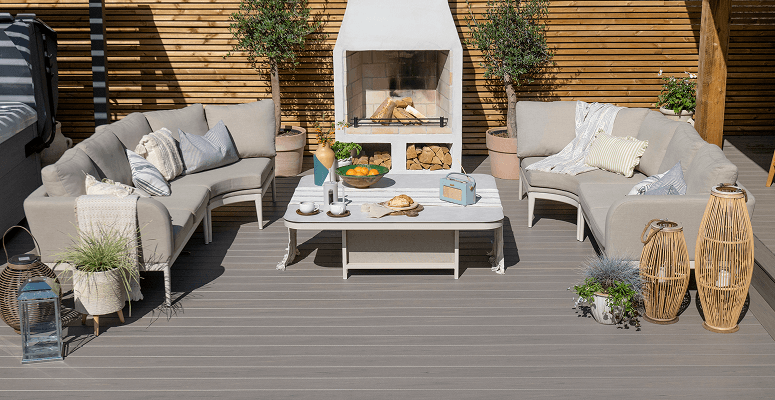
More than ever, customers are looking for gardens that feel like an extension of their homes. A well-designed deck is ideal for creating this aesthetic, giving the impression of adding an outdoor room to the house, resulting in a versatile space that can be used throughout the year.
Outdoor living expert Simon Parry, who is a landscape gardener and TrexPro® composite decking installer, says: “I’m working more and more with clients who want their garden to flow seamlessly from their house, so they can enjoy the space to its full potential.”
Leading composite decking manufacturer Trex® has worked with its qualified TrexPro installers to create five tips for building a deck that becomes an extension of the home.
1. Start with high-performance deck boards
The heart of a deck is the material it is made from, with low-quality boards leading to long-term deck failures. Choosing the right product ensures the deck itself looks great and creates a stable base that lasts for years to come.
Timber decking can be problematic over time, being prone to warping, rotting, cracking and splintering. As well as creating cosmetic issues, these can lead to dangerous, uneven surfaces that may need replacing in just a few years.
Composite decking is specifically engineered to overcome these challenges. Market leader Trex, which invented composite decking 30 years ago, designs its products to be high-performance. Made with 95% recycled plastic film and reclaimed materials, Trex boards resist mould, mildew, warping, splintering, rot, decay and are fade-and stain-resistant*.
2. Create cohesion with the home
To create a seamless flow from inside the home to outside, a deck should harmonise with the style and décor of the indoor room it connects to. This can be achieved by using similar colour palettes, patterns and materials.
Does the room have floors in a herringbone pattern? Emulate the design with composite boards in the same layout. Has the homeowner chosen a light oak finish in their home? Recommend a similar tone for their deck. Trex has 15 colours and finishes to choose from across its five ranges, so whatever your style there is a colour for you. For example, if you are looking for a light oak, then Transcend® Lineage in Carmel would be perfect, or for a contemporary grey Enhance® Tide Pool would work well.
Samples are available from the Trex website for you to match the colour of the deck to the flooring of the adjoining room. Trex boards don’t require painting or staining and their fade-resistance properties ensure the colour will stay true without constant upkeep.
3. Define zones
Defining different areas of a deck can create the illusion of additional living space, while enabling a functional layout. Whether the homeowner wants an area for entertaining, a barbecue space or a quiet spot for reading, there are techniques to achieve this.
For example, built-in seating that forms a border between a zone for relaxation and a dining area. Incorporating different levels across the deck is another way to separate zones for specific uses.
While these are relatively subtle ways to make the deck an extension of the home, a growing number of homeowners are going further by installing fully-equipped outdoor kitchens that incorporate not just a barbecue or pizza oven, but also a food preparation area, fridge and sink for hassle-free dining and entertaining.
4. Incorporate lighting
Incorporating lighting into a client’s deck will increase the sense that it is an extension of the home, by making it more functional and appealing for evening use.
Lighting approaches regularly used by TrexPro installers on client projects include a mix of structural and ambient lighting.
Structural lighting, such as recessed floor lights along boundaries and stair riser lights, will make the deck safe for use during the hours of darkness, while string lights or wall-mounted lights will create an inviting atmosphere and provide enough brightness for dining.
5. Add cover
Finally, creating a sheltered area on a deck is a further way to create the feeling of an extra room of the house. Opt for a pergola or awning to cover a wider space, increasing the deck’s usability on the hottest days, or a moveable parasol for smaller areas. Any of these will add practicality to the space, as well as helping to define different zones.
Inventing composite decking 30 years ago, Trex is now the world’s number one decking brand and is sold in more than 47 countries.
Designed to be different, all Trex’s boards are engineered to be high-performance and low-maintenance and are created from 95% recycled and reclaimed materials. In fact, Trex has never felled a single tree to create its decking.
2026 has seen Trex introduce two new colours to its UK range – Carmel, a light oak that features in its Transcend® Lineage range, and Tide Pool, a soft warm grey that joins the Enhance® range. Read more on the new launches here.
For more information on Trex visit uk.trex.com. To order your Trex sample, click here.
When you specify decking for a client, you stake your professional credibility on it. If something goes wrong, it won’t matter where the responsibility lies – and no one wants a failed product on their track record.
Getting the specification right at the very start protects the project, the client relationship and your reputation. And yet, there’s a handful of errors that keep cropping up and risking the integrity of both the deck and the installer. Leading composite decking manufacturer Trex® has worked with its qualified TrexPro® composite deck installers – who are often called in to put right other people’s blunders – to identify the top five deck planning mistakes.
1. Using a sub-standard subframe
The subframe is often to blame for most long-term deck failures, but it’s the detail least likely to be inspected by clients. Not only is it hidden out of sight, but it takes specialist know-how to spot weaknesses.
Our TrexPro installers often begin projects by tearing up decks that have failed just a few years after being built. Common discoveries are rotting subframes, botched joists supported with packers and scraps of unsuitable decking board and timbers that are not protected by moisture-resistant butyl tape.
If the subframe doesn’t support the chosen decking boards properly – whether that’s joist spacing, materials or types of fasteners – you could end up with a bouncy deck, shifting floor, not enough airflow… and an urgent call for remedial work within just a few years.
The first thing to consider is the materials used for the subframe. Traditional treated timber remains a popular choice because it’s affordable, familiar to work with, and ideal for straightforward builds on level ground.
However, it’s worth weighing up other options to suit the site conditions and budget. Plastic subframe systems are a good choice for damp or shaded areas as they are more resistant to damp and moisture. Aluminium frames provide excellent strength and stability and are often used in high-end or complex installations, including balconies. Pedestal systems, typically paired with paving or composite decking, are especially useful on uneven surfaces or rooftops, allowing precise height adjustment and integrated drainage.
Whichever route you choose, factor in adequate airflow beneath the deck to reduce moisture buildup, reducing the risk of decay and extending the life of the subframe.
Always cross-reference the manufacturer’s installation guide for the specific product you’re fitting, as the materials will vary in quality and therefore demands on what’s beneath. Trex provides detailed technical guidance for every one of its composite decking products, taking the guesswork out of specification. Beyond the structural build, moisture protection is non-negotiable in the UK’s damp climate. Trex® Protect, a butyl-backed joist tape, applied to the top edge of every joist, beam and bearer, creates a physical barrier against wateringress and significantly extends the subframe’s life. It’s a simple addition with a meaningful impact on long-term client satisfaction.
2. Dismissing drainage
Elevated decks are increasingly common on split-level gardens and sloping plots. But many deck-planners forget about water management underneath. Without it, moisture accumulates under the deck, speeding up deterioration of any timber in the subframe. Drainage needs to be specified at the design stage rather than treating it as a fix later. Trex RainEscape® is an under-deck drainage system designed to channel water away from the subframe, protecting the structure while making the space below usable. For elevated decks, that could be a dry storage area, bin housing or a sheltered seating area – bringing tangible additional value to the project.
Trex RainEscape
3. Recommending the wrong material
Many clients think of traditional timber when they imagine a deck. What they’re less likely to envisage is the constant maintenance and fixing that goes with it.
There are also many types of cheaper alternatives to timber, including some of the lower-cost plastic decking boards. These can be a false economy, as they’re prone to peeling, cracking and fading – leading to a disappointed customer who’ll need to have their deck replaced before long, and end up paying twice!
That’s where the pro expertise comes in, weighing lifecycle costs, not just the price at the start. Trex composite decking is performance engineered to hold its appearance through all weather conditions without the upkeep that timber demands – no splintering, no cracking, and no annual sanding and oiling. It’s resistant to fading and staining*, both of which are covered by the warranty. Made from 95% recycled and reclaimed materials, it’s also a sustainable choice.
Trex invented composite decking 30 years ago and offers options spanning a wide range of budgets and aesthetics, giving you the confidence to recommend a product that will last – whether homeowners opt for tried and tested favourites like Trex’s Colour of the Year Biscayne – part of its Transcend Lineage range – or one of its new additions for 2026 Transcend Lineage in Carmel or Tide Pool, part of the Enhance collection.
Not only is it better for your customers in the long run, but it’s also good for your reputation and will reduce callbacks to sort out problems.
4. Skimming over warranty terms
Warranty conversations can be cut short in the rush to agree specification. That’s a mistake, because if anything goes wrong further down the line, you’ll be the one they call to put it right.
Be fully aware of the warranty terms for everything you install. Trex backs its composite decking with up to 50-year limited residential warranties, giving both you and your client confidence in the long-term performance of the product.
Briefing clients on warranty terms at handover is good practice: it sets expectations, demonstrates professionalism, and gives everyone a clear reference point if questions arise later.
5. Wasting opportunities – and materials
It takes skill and experience to design a deck efficiently to make best use of time and resources. Sadly, one of the most common mistakes when building a deck is to do it wastefully. A proficient installer will know how to design the deck to make maximum use of the boards – putting offcuts to use and being creative with the boards layout and patterns. It saves the customer throwing away money and reduces the amount of material left over at the end of the build.
And the other type of waste? The opportunity to have the perfect deck! Imagine a deck that’s technically flawless, yet doesn’t suit the way its owners use it. It might become cramped as soon as there’s a BBQ, table and chairs added. Or it could simply be awkwardly shaped or wrongly positioned.
Even if the build is perfect, it won’t reflect well on you.
A good deck designer asks the all-important questions at the design stage:
· How do people move between inside and outside?
· Where does the sun fall throughout the day?
· In which season will this deck be used most?
· What will go on the deck – toys, furniture, a hot tub, an outdoor kitchen – and how will people move between those zones?
A spec that protects
A premium deck becomes part of its owner’s lifestyle, and the spec should reflect that.
Every decision, from subframe and drainage to warranty and flow, comes back to the same principle: the time you spend on the planning stage is a long-term investment. Clients may not notice the details in the subframe or the importance of a drainage channel, but they will appreciate a deck that feels right, looks great and performs year after year. And that’s the kind of standard that protects your reputation.
Trex is available online and at merchants throughout the UK. To find your nearest supplier, contact trex@arborforestproducts.co.uk or call 01469 535415. To explore the Trex range or order a free sample, visit uk.trex.com.
Clients making a significant investment in their outdoor space usually want three things from the end result: a space that looks fantastic, performs well day-to-day and stands the test of time.
For projects involving a composite deck, choosing the right building materials is fundamental to meeting these expectations.
By focusing on a handful of key factors, you can ensure you’re not just installing a stunning deck – you’re delivering a valuable asset your client can enjoy for years to come.
Here are the five things to prioritise when choosing composite decking:
1. Warranties
Warranties are a signal of a manufacturer’s confidence in the quality and durability of their product.
Composite decking that comes with an extended warranty period can reassure your clients that their investment is protected over the long term, making it easier for them to choose a premium product.
The most reputable brands typically offer 25-year limited residential warranties and 10-year commercial warranties. Unsurprisingly, the world’s number one decking brand, Trex®, leads the pack with a 50-year limited residential warranty for decking boards in its premium Signature®, Transcend® and Transcend® Lineage® ranges.
Warranties differ across brands, so it’s important to understand what’s included and what’s not. A worthwhile warranty should provide coverage against material defects, splitting, splintering, rot and decay under normal usage conditions. Damage caused through incorrect installation, inadequate structural support or abnormal use would not typically be covered.
2. High performance
The materials and methods used to create composite decking boards vary widely and directly affect how the boards perform under everyday use.
For maximum performance and durability, choose solid decking boards that are ‘capped’ with a protective shell that shields them against scratches, fading and stains, as well as mould, mildew and moisture.
The weather-resistant shell featured on brands including Trex – the first manufacturer to introduce it – means your client’s deck will look better for longer and be robust enough to stand up to kids, pets and entertaining, but also to the UK’s less-than-perfect climate.
Credit: Trex
3. Low maintenance
The need for minimal maintenance is one of the biggest reasons homeowners choose composite decking over traditional timber decking – as well as lower upkeep costs, it means more time enjoying their outdoor space and less time maintaining it.
In practical terms, ‘low maintenance’ should mean no sanding, sealing or staining and only occasional cleaning to keep the deck looking its best. However, not all composite boards perform equally, with lower-quality or uncapped products being more prone to staining, fading or mould growth, especially in shaded UK gardens.
This is where product specification really matters. Decking with a protective outer shell or cap will resist moisture ingress and staining and withstand everyday wear without the need for ongoing maintenance. It’s also worth checking manufacturer guidance on cleaning and care to make sure the finished deck will deliver the effort-free experience your client is expecting.
4. Sustainability
For many clients, sustainability has moved on from being a ‘nice to have’ to an important part of purchasing decisions – and it’s another factor that makes composite decking a more attractive option than traditional timber.
When assessing the environmental credentials of composite decking brands, look for a brand that uses a high proportion of recycled materials, such as reclaimed wood fibres and recycled plastics. As well as reducing the demand for virgin timber, this also gives new life to materials that might otherwise end up in landfill.
An extra tip: don’t take claims about sustainability at face value – it’s worth looking beyond the marketing hype to understand what a manufacturer is actually doing to ensure their materials are responsibly sourced. Checking that the brand you’re specifying is credible on this front will help you meet the expectations of the most eco-conscious clients.
Credit: Trex
5. Product and price range
One of the biggest advantages of composite decking is the ability it gives you to match a client’s vision to their budget.
This is much easier to achieve with a brand that offers a clear, tiered product range. For example, Trex’s range progresses from the entry-level Enhance® Basics collection to the mid-range Enhance® Naturals range, the premium Transcend and Transcend Lineage lines and the luxury Signature collection. Each step up brings enhanced aesthetics, greater durability and longer warranties, while still offering core features including easy upkeep and resistance to fading and staining. For details, visit uk.trex.com/warranty and uk.trex.com/care.
For clients, this means a budget-conscious project can still offer the benefits of performance and durability, while higher-end schemes can achieve a more refined, design-led finish with photorealistic grain patterns and broader colour options. It also makes it easy for you to present options transparently and explain what the differences in costs and features mean over the lifespan of the deck.
Discover Trex
Inventing composite decking 30 years ago, Trex is now the world’s number one decking brand, sold in more than 47 countries.
Designed to be different, all Trex’s boards are engineered to be high-performance and low-maintenance and are created from 95% recycled and reclaimed materials. In fact, Trex has never felled a single tree to create its decking.
2026 has seen Trex introduce two new colours to its UK range – Carmel, a light oak in its Transcend Lineage range, and Tide Pool, a soft, warm grey in Trex’s Enhance collection, both of which incorporate Trex’s innovative SunComfortableTM technology. Read more about them here.
For more information on Trex visit uk.trex.com. To order free Trex samples, click here.
Customers ask the same question when planning for their garden transformation: which deck material should I choose, and why? With rising expectations around durability, aesthetics and long-term value, the answer matters now more than ever.
While timber has traditionally been the go-to option, its performance in the UK’s unpredictable climate means that installers are now opting for high-quality composite as an alternative.
No warping, rotting or splintering
One of the biggest drawbacks to installing timber decking is how it reacts to the elements. Prolonged exposure to the UK’s extreme weather conditions means timber boards are prone to:
Warping
Rotting
Cracking and splitting
Splintering
These aren’t just cosmetic issues. Warped boards create dangerous uneven surfaces while rotting, cracking and splintering can make decks unsafe underfoot. It also doesn’t give a true reflection of the work that’s gone into the installation and will need replacing in just a few years.
Composite decking is specifically engineered to overcome these challenges. Inventing composite decking 30 years ago, Trex® in particular is at the forefront of innovation in composite and is designed to give homeowners the look, feel and beauty of timber, without the associated problems.
Alongside being designed to resist water, Trex incorporates a durable outer shell to protect against splitting and cracking.
No sanding, staining or sealing
Maintaining timber decking year after year is time-consuming and back breaking work, with costs adding up over time resulting from reoccurring maintenance to preserve its appearance and longevity.
To keep timber looking its best, homeowners will typically need to sand back the surface to remove old peeling finishes and to prevent splintering, before applying stain or paint to refresh its appearance and sealing to protect against moisture.
This maintenance not only costs money, but also time that customers should be spending enjoying their outdoor space!
Composite decking removes this burden entirely. Trex prides itself on creating deck boards that don’t fade and don’t need sanding, staining or sealing. In fact, Trex can be cleaned using just soap and water to keep it looking new for years to come. The colour and finish are built into the boards, meaning decks keep their aesthetics without the upkeep.
Designed for longevity
When installing decking, both contractors and clients need the confidence that it will stand the test of time. That’s why all Trex composite decking comes with industry-leading limited residential warranties of 25 to 50 years.
This level of coverage speaks volumes about the durability of Trex composite decking over timber. While timber may need replacing sooner than expected, Trex is engineered to deliver decades of reliable use.
Not all composites are equal
While composite might come out ahead of traditional timber decking, it’s important to remember that not all composite decking is made equal! Look for solid, capped boards for strong structural performance and integrity. Hollow and uncapped boards, while cheaper, are subject to structural failure and significant damage in a short period of time – meaning more call backs from customers.
Discover Trex
Inventing composite decking 30 years ago, Trex is now the world’s number one decking brand and is sold in more than 47 countries.
Designed to be different, all Trex’s boards are engineered to be high-performance and low-maintenance and are created from 95% recycled and reclaimed materials. In fact, Trex has never felled a single tree to create its decking.
2026 has seen Trex introduce two new colours to its UK range – Carmel, a light oak that features in its Transcend Lineage range, and Tide Pool, a soft warm grey that joins the Enhance range. Read more on the new launches here.
For more information on Trex visit uk.trex.com. To order your free Trex sample, click here.