Irrigation winterisation gets treated as a job rather than a plan, and that is where most freeze damage starts. A system blown down in a rush on the first cold morning of October is a system where something gets missed, and what gets missed usually does not announce itself until April.
The work itself is not complicated. Getting it right is mostly a matter of deciding early what happens, in what order, and who is responsible for each part. Here is how to plan a commercial irrigation shutdown so the system comes back on in spring without a repair bill attached.
Irrigation controller set for winter
Decide the date before the weather decides it for you
The single most common mistake is letting the first cold snap dictate the timing.
Shutting down too early wastes an autumn’s worth of establishment watering, which matters on sites with new planting or recently laid turf. September and early October can be dry, and young planting still needs water. Shutting down too late risks water sitting in pipework, valves and backflow devices when temperatures drop below freezing, and that is where the expensive damage happens.
The practical answer is to book the shutdown for a fixed window, usually late October into early November in most of the UK, and hold the system in a reduced-run configuration until then rather than switching off entirely. That gives planting what it needs through autumn without leaving the system exposed.
Sites in exposed or northern locations, or with shallow pipework, should plan earlier. Sites with significant new planting may justify holding on later, provided someone is watching the forecast and the system can be drained at short notice.
Work out what you actually have before you drain it
A surprising number of commercial sites do not have a current record of their own irrigation system, particularly where it has been extended over the years.
Before the shutdown, confirm the location of every isolation valve, drain point, backflow device and manifold, and note which zones feed which areas. Where the system has been added to since installation, the newer sections are the ones most likely to be missed, because they are not on any drawing and nobody remembers they exist.
This matters more than it sounds. A zone that never gets drained because nobody knew it was there will keep failing every spring, and the cause looks like bad luck rather than an omission.
The sequence that prevents most of the damage
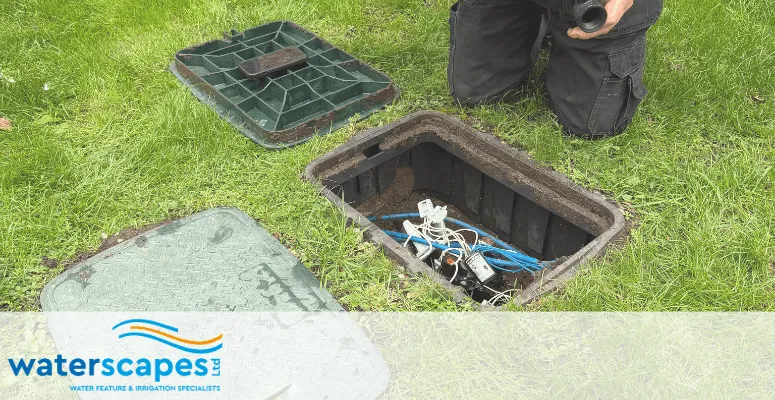
Engineer working in irrigation valve chamber
A proper shutdown follows an order. Skip a step, or run them out of sequence, and water gets left behind.
Isolate the supply first. Shut the water off at the main isolation valve or stopcock serving the system, and confirm it is fully closed rather than nearly closed.
Then drain what gravity will take. Open the manual drain points and let the system empty where the fall allows it. On systems designed with drainage in mind, this does a good deal of the work.
Blow the remainder down with compressed air. Give this part to someone experienced. Air pressure has to match the system, and too much pressure damages sprinklers, dripline and valve seals just as effectively as frost does. Work zone by zone, running each until only mist comes through rather than water, and keep individual blow cycles short to avoid heat damage at the sprinklers.
Drain and protect the backflow device. Backflow preventers are among the most expensive components on a commercial system and among the most commonly damaged over winter. Drain them fully, leave the test cocks part open, and insulate where the device stays outdoors.
Leave the valves where residual water can escape. Solenoid valves sit partially open where the design allows it, so anything left in the line has somewhere to go rather than sitting against a diaphragm.
Set the controller to its rain or off mode rather than cutting the power. That holds programmes in memory without running any zones, and it takes a moment to check the backup battery while you are there. A controller that loses its programme over winter turns spring restart into a reprogramming job.
Protect any pumps last. Where a booster or borehole pump serves the system, drain it, isolate it electrically, and follow the manufacturer’s winter guidance. Pumps left with water in them over a cold winter are a predictable spring failure.
Dripline needs its own attention
Subsurface and surface dripline behaves differently from sprinkler zones and is often the part of a system that survives winter least well.
Emitters hold small volumes of water that gravity drainage will not clear, and blowdown pressure that is safe for sprinklers can be too high for dripline. Lower the pressure for those zones, flush the lines properly before draining, and check that flush end caps and any air relief valves have been dealt with rather than left closed.
Where dripline runs under planting that will be lifted or replaced over winter, note the location before the beds are worked on. Dripline damaged by autumn planting works is one of the more frequent spring faults, and it is entirely preventable.
Water features do not shut down, which is the point
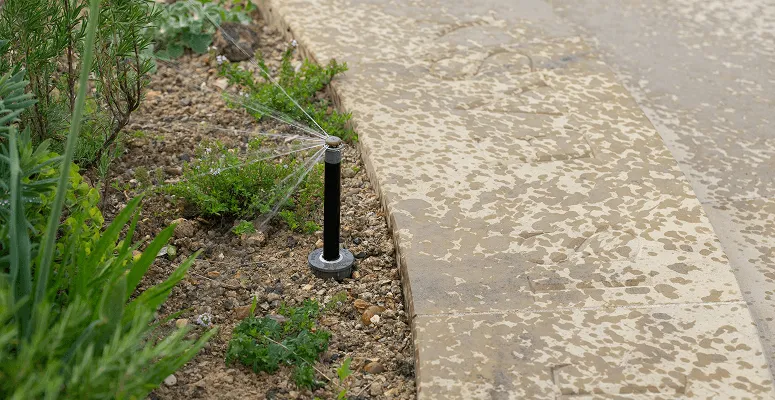
Dripline and emitter in planting
Commercial water features generally run through winter, which makes it tempting to leave them for another day. Deal with them while the irrigation contractor is on site instead.
Features that stay running need their winter position confirmed: circulation adequate to prevent standing water freezing, top-up and trigger sensors working, and any frost protection or low-temperature shutdown correctly configured. Features being taken out of service for the season need draining properly, with pumps removed or protected and standing water cleared from any element that can crack.
Check structural condition at the same time. Cracks and failing joints get worse over winter, and repairs are considerably cheaper before frost has had a season to work on them.
Write down what you did
Shutdown documentation is the cheapest insurance available on a commercial irrigation system, and most sites still do not produce it.
A short record of what was drained, when, by whom, and anything found or deferred in the process turns spring recommissioning from an investigation into a checklist. It also settles the question that comes up every April when something fails: whether the fault was there in October or arrived over winter.
Include the controller settings as they were left, the position of any valve left part open, anything that could not be drained and why, and photographs of anything found in poor condition. Where a specialist carried out the work, ask for this as standard.
The mistakes that cause most of the damage
Four issues account for most of the freeze damage seen at spring restart.
Partial drainage, with water left in low points, dripline, backflow devices or extended sections that were never on the drawings.
Blowdown pressure set too high, which is quicker and damages sprinklers, seals and dripline while it works. Those failures surface the following season and get blamed on age.
Controllers powered down completely, so programmes are lost, batteries flat, and spring restart begins with reprogramming rather than testing.
No record of what was done, which makes every spring fault a fresh investigation and makes it impossible to tell whether a problem is new.
Scope it and book it
For contractors managing grounds on behalf of clients, scope and quote the shutdown properly rather than folding it into general autumn works. It takes longer than most sites assume, and it needs equipment and judgement. It is also the job with the clearest link between doing it well and avoiding cost in spring.
For estates and facilities teams, book it now, with a named date and a named responsible party, and ask for documentation as part of the deliverable. A shutdown that happens on a plan rather than on the first frost is one that gets done properly.
“Nearly everything we repair in April traces back to something that was not done properly in October,” says Ed Harwood, maintenance contracts manager at Waterscapes. “Usually it is water somewhere it should not have been. It is a cheap job to do well and an expensive one to do quickly.”
Waterscapes provides specialist irrigation and water feature maintenance, repair, refurbishment and technical support, including a full design facility, for commercial and public-facing environments across the UK. Contact maintenance@waterscapes.co.uk or visit www.waterscapes.co.uk.
Waterscapes has announced the launch of a new troubleshooting guide to help facilities and estates teams diagnose the irrigation faults that surface in high summer.
Last month marked Smart Irrigation Month, which highlights the importance of water-efficient irrigation. Ed Harwood, maintenance contracts manager, has formulated the guide to cover the faults behind most summer callouts.
Harwood says:
“The most useful thing a site team can do is narrow a fault down before they call. If we arrive knowing it’s one zone, it’s recurring, and it started after the groundworks went in, a half-day investigation becomes an hour. The checks a team does in ten minutes are worth more than any part they might have replaced.”
The guide draws a firm line on electrical faults, which Waterscapes identifies as the category where in-house troubleshooting wastes the most money. Intermittent wiring faults impersonate failed components, and sites can spend a full season replacing parts without touching the underlying fault.
The guide also notes that flow monitoring, remote alerts and weather-based controllers change when faults are found rather than how they are fixed, and it follows the company’s June guidance on when smart irrigation upgrades pay for themselves.
Commercial water features don’t get a seasonal switch-on. They run year-round, which is why they miss the seasonal attention irrigation gets. There’s no spring commissioning moment to prompt a proper look, and summer demand builds gradually until something becomes visible: green water, a dropped level, a pump that has gone quiet.
By then it’s a presentation problem on the most visible asset many sites have. Water features tend to sit where people gather: entrances, courtyards, public realm, hotel frontage. When one is struggling, everyone can see it, and the photographs people take of a site in summer tend to have the feature in them.
This piece covers what fails on commercial water features in peak summer, why it happens, and the short checks that keep features presenting well between maintenance visits.
Why summer is the hardest season
Heat, sunlight, long run hours and peak footfall arrive together. Warmer water feeds biological growth, stronger sunlight accelerates algae, evaporation rates climb, and pumps run longer hours under more load. Because summer is also when sites host events and visitors, the cost of a feature looking poor is higher than at any other point in the year.
It’s also the season of events. Open days, weddings, launches and client hospitality all cluster between June and September, so the window between a feature starting to struggle and somebody important noticing is at its shortest.
None of these pressures is dramatic on its own. The problem is that they compound, and they do it fast.
Algae and water clarity
Algae moves fastest. What was clear in June can be green by mid-July without consistent treatment and circulation. Once growth takes hold it clogs filters and intake screens, which restricts flow, puts pumps under strain, and reduces the circulation that was helping keep the water clear in the first place. One missed fortnight of treatment can set up a month of recovery.
Features in full sun move faster than shaded ones, and any dead spot in circulation, a corner the flow doesn’t reach or a return that has lost pressure, will green up first. Those corners are the early-warning gauge for the rest of the feature.
The fix is cadence rather than heroics. Regular treatment, working circulation, and clean filtration through the warm months hold clarity at a fraction of the cost of recovering a feature that has been let go.
Moving water is your ally
Circulation does more work in summer than any other input. Moving water carries oxygen, disrupts the still conditions algae prefers, and keeps treatment distributed rather than pooled. Features with fountains or aerators tend to hold their clarity longer through hot spells than still bodies of water on the same site.
The practical point: if a feature has an aerator or a fountain element, summer is the season to keep it running, not the season to rest it. And if a large or still feature struggles every summer, adding aeration is often a cheaper fix than chasing the symptoms with chemistry alone.
Evaporation, levels and automatic top-up
Evaporation is the quieter problem. On a stretch of hot days, a feature can lose enough volume to drop the water below its level sensor. If the automatic top-up isn’t keeping up, or a trigger sensor has stuck or scaled over, a pump can run dry and sustain damage before anyone notices the waterline has moved.
Automatic top-ups help, but only if they’re working. Through summer, levels, top-up mechanisms, and trigger sensors need checking weekly rather than monthly. A failed sensor only shows if it’s checked. Where a feature has no automatic top-up at all, summer is when a manual top-up rota needs to be more than a good intention.
Maintenance in action
Pumps and electrics under load
Pumps take more punishment in hot weather, not less. Long run hours and warm water put motors under continuous load, and bearings that were marginal in spring tend to fail in July. Electrical faults that would have been picked up in a quick winter check become callouts at the worst possible time.
“A healthy pump is a quiet one,” says Ed Harwood, Maintenance Contracts Manager at Waterscapes. “A change in sound is usually the first warning we get, and it often arrives days before anything shows on the water. Site teams who know what their feature normally sounds like catch problems earlier than any instrument.”
Debris around intakes does similar damage more slowly. It starves the pump, shortens its life, and is one of the simplest things to check and clear.
Balance tanks matter here too. Sediment builds through the year, and summer’s biological load accelerates it. A tank that’s quietly silting up restricts flow to the pump and skews level readings, and it does both without anything visibly failing.
Debris, litter and the events season
Summer footfall brings its own maintenance load. Wind-blown debris, grass clippings from more frequent mowing, litter, and the things people throw in: coins, food, the occasional drinks can. Organic material is the worst of it, because it feeds the same biological growth the treatment regime is trying to hold back, and it finds its way to intake screens within days.
On sites with regular events, schedule a skimmer and intake check straight after each one rather than waiting for the next routine visit. The hour spent clearing up after a busy weekend is cheaper than the callout three weeks later.
What the water and stonework tell you
Water chemistry drifts faster in heat. Even features that don’t need full chemical management benefit from regular summer checks, because cloudy water, scale on edging, and scum lines at the waterline usually point to chemistry, circulation, or filtration drifting out of spec before instruments confirm it.
Read the stonework on every visit. Staining, scale, and tide marks each tell you something specific, and they tend to appear before the water itself looks wrong.
Algae and debris
The ten-minute weekly check
Between scheduled maintenance visits, a short weekly look by whoever is on site catches most of what would otherwise turn into a callout. That means checking water clarity, water level, sound, debris around intakes, and any change in how the feature is presenting. None of it needs equipment, and none of it takes more than ten minutes.
If the feature has a plant room, a glance at the pressure gauge and a listen at the door can be added without making it a longer job.
The point is noticing what has changed since last week and flagging it while it’s still a small job. Whoever does the looking doesn’t need water feature experience, just a sense of what the feature looked and sounded like the week before.
What a summer maintenance visit covers
On a maintenance visit through summer, our team works through intake screens for debris, automatic top-up mechanisms and trigger sensors for free movement, balance tanks for sediment build-up, and pumps for vibration, noise, and seal condition. Water chemistry gets tested rather than judged by eye, and treatment is adjusted for the season rather than left on a winter setting.
Most of these are five-minute checks. Missed across a season, each becomes a much bigger job, which is why summer cadence matters more than summer heroics.
Records, water bills and the quiet cost of losses
There’s a quieter commercial angle here: water cost. A feature losing volume to evaporation is expected. A feature losing volume to a slow leak, a sticking automatic top-up, or splash-out from a misadjusted nozzle is paying for the same water twice, and on a metered commercial supply that shows up on the bill long before it shows up at the waterline.
Keeping a basic record helps: top-up frequency, treatment dates, anything adjusted. If the automatic top-up is metered, the usage trend will flag a hidden loss weeks before it’s visible. The same record supports the water-use reporting that more estates and facilities teams are being asked for each year.
When to bring in a specialist
The escalation line is simple. If a skim, top-up, or filter clean resolves it, site teams can usually handle it. Recurring clarity problems, pumps tripping or running loud, level sensors misbehaving, or anything electrical should go to a specialist, because each tends to be cheaper the earlier it’s seen.
The cost logic is the same as the rest of summer maintenance. A fault seen in July is almost always cheaper to put right than the same fault left until the end of August.
“Most of the summer water feature callouts we attend started as something small a fortnight earlier,” Ed adds. “The sites that hold their presentation through August are the ones where someone looked every week. Little and often beats rescue jobs every time.”
Floating fountain, Jubilee campus
Waterscapes provides specialist water feature maintenance, repair, refurbishment, and technical support for commercial and public-facing environments across the UK. Email maintenance@waterscapes.co.uk or visit waterscapes.co.uk.
Read Waterscapes’ article in Pro Landscaper’s July issue which explores maintenance of water features through the hotter months.
Commercial water and irrigation company Waterscapes has released a practical decision framework targeted at facilities managers to determine when to repair an irrigation system and when recurring faults indicate a wider upgrade is needed.
The framework, published and available to read on the Waterscapes website this month, addresses one of the most common budget decisions facing estates and facilities teams managing ageing irrigation infrastructure.
Paul Jeffery, managing director of Waterscapes, says: “A single component failure in an otherwise sound system is normal maintenance. But when the same zone fails repeatedly, you’re not fixing the component anymore. You’re managing a symptom. Something else is driving the failure.”
The guide sets out indicators that repair is no longer the right call, including increasing callout frequency, multiple faults appearing in quick succession and systems over ten years old running on components near the end of their design life.
It also makes the case for phased upgrades as an alternative to full system replacement, starting with controls and remote monitoring before progressing to zone-by-zone pipework and valve upgrades. Jeffery says this approach spreads capital spend across budget years while delivering measurable reductions in callout frequency and water consumption.
The framework recommends a condition survey as the starting point for any upgrade decision, giving budget holders costed options for repair, partial upgrade, or phased replacement rather than relying on contractor opinions alone.