
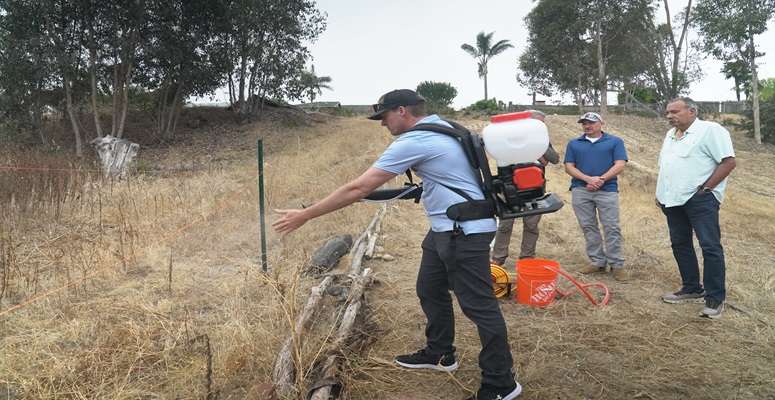
As wildfire reshapes landscape design across the West, CitroTech‘s Andrew Hotsko explains why prevention is becoming part of the landscaper’s job.
For most of the last century, wildfire demanded a response—engines, air tankers and red slurry dropped once smoke filled the sky. What has shifted is the recognition that the most decisive work happens long before any flame appears, and much of it happens in the landscape itself.
That reframing explains why CitroTech, an Oceanside, California manufacturer of EPA Safer Choice recognized fire inhibitors, now talks less to firefighters and more to the people who design, build and maintain fire-exposed properties. “The first hundred feet around a home is the most important real estate in a wildfire,” says Andrew Hotsko, the company’s chief operating officer. “And the people who already own that space—professionally—are landscapers. They’re better positioned to add resilience than almost anyone.”
CitroTech makes a clear, ground-applied fire inhibitor that works ahead of fire season, not during an active blaze. “Most people picture the red retardant from the news. That’s an aerial product, it’s phosphate-based, and it’s designed to be dropped in front of an active fire,” Hotsko explains. “What we make is the opposite end of the timeline. It’s applied from the ground, ahead of the season, and it dries clear—so it disappears into the landscape instead of coating it.” The food-grade chemistry carries no phosphates, halogens or PFAS, with UL GREENGUARD Gold certification and aquatic toxicity of LC50 greater than 750 mg/L. “We’re changing how willing the fuel on a site is to ignite,” Hotsko says, “without changing how the site looks.”
Hotsko frames his company’s product as a complement to defensible space and structure hardening, not a replacement. “The foundation—a real step forward, and the place every serious wildfire plan begins. We’re built to work right alongside them.” Beyond the ember zone, much of the landscape stays planted—slopes, perimeters and established vegetation. “That’s exactly where a proactive treatment earns its place,” he says. “You harden the structure, you keep the ember zone clear, and then you treat the living landscape that remains. Each layer does a different job—together they’re far stronger than any one of them alone.”
Read the full article in the July issue of Pro Landscaper USA.













0 Comments