
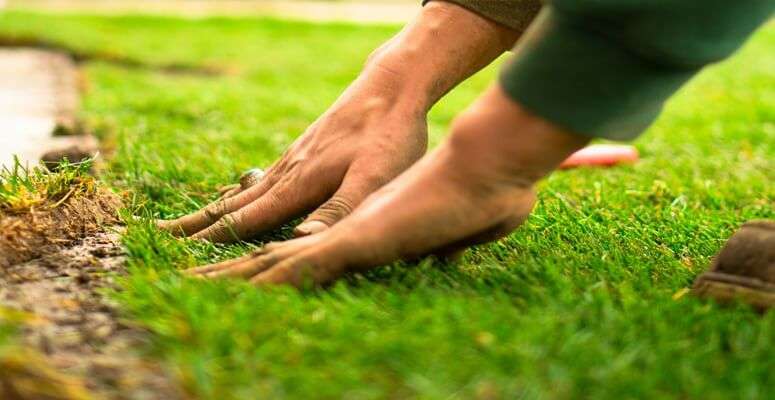
Carlos Bataller, founder and CEO of Realturf USA, shares practical advice on four critical areas: creating clean edges, managing curves and undulations, planning drainage and controlling heat.
Creating clean, durable edges without nail strips or timber
Bataller advises against installing turf directly next to natural grass. “Over time, natural grass will typically begin to grow into the turf edge, which can create added maintenance.” Instead, he recommends fixed borders: “Hardscape transitions such as pavers, concrete and natural stone are often the better solution.” To strengthen the perimeter, edging systems like VertEdge help improve edge definition. When terminating against a stone wall or foundation, he says: “It is better to have a concrete edging around the perimeter and glue the turf down after stretching it and applying the sand infill.” For curved applications where seams must stay invisible, a concrete perimeter edge is again the best solution.
Cutting curves and handling rolling terrain
“Using a new blade is critical when cutting curves,” Bataller notes. “A sharp blade helps the installer achieve a smoother cut.” For rolling terrain, he advises: “On a warm, sunny day, roll the turf out and allow it to rest for a few hours. This gives the material time to relax, soften and better conform to the terrain.” When deep undulations create wrinkles, he recommends relief cuts: “The cut should be seamed back together carefully using seam tape and adhesive, so the transition is secure and the seam is as clean and discreet as possible.”
Assessing drainage before laying
Bataller stresses checking three things first: overall slope, gutter discharge points and existing drainage infrastructure. He also advises identifying areas where soil stays wetter, as those show where water settles. Native soil type then dictates the approach: “Sandy soils typically allow water to move through more quickly, while clay soils hold water longer. Loam is usually the most balanced.”
Managing heat with fiber choice and infill
“Darker tones can contribute to higher surface temperatures, but heat performance is influenced by a combination of color, yarn density, fiber technology and infill,” Bataller says. “Certain yarn shapes and reflective pigments are designed to help deflect or manage heat.” For cooling infills, he recommends water-activated systems like HydroChill and T°Cool for landscape turf, and organic options for sports fields.
Successful artificial turf installation depends on attention to detail long before the first piece is unrolled. Following these four principles can mean the difference between a feature that fails and one that performs for years.
Read the full article in the May issue of Pro Landscaper USA.















0 Comments